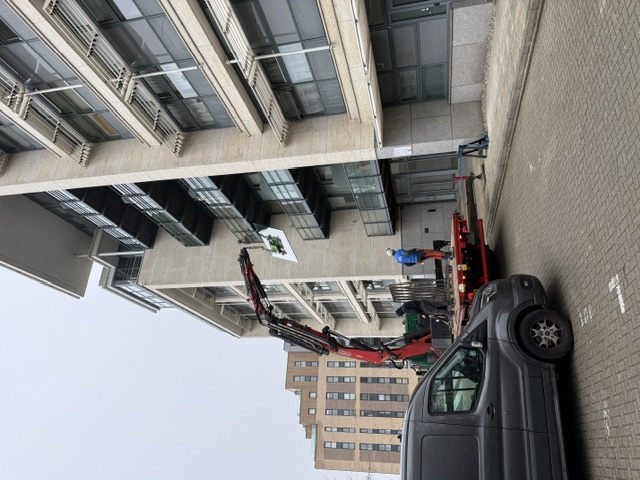
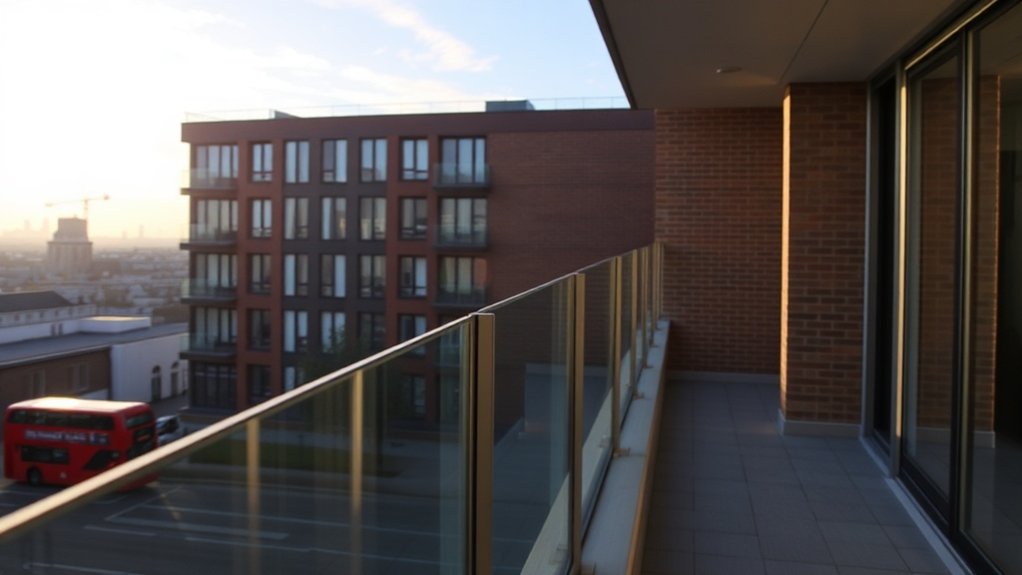
You choose semi frameless glass balustrades in London when you need compliant edge protection that keeps sightlines open, minimises visible steelwork, and still meets BS 6180 and local borough safety requirements. Toughened or laminated glass panels sit in slim aluminium or stainless base channels or posts, with options for privacy, acoustic control, and heritage-sensitive fixings. They suit balconies, terraces, stairs, and roof decks, and below you’ll see how to select, specify, and install them correctly.
Key insights
- Semi-frameless glass balustrades use minimal aluminium or stainless-steel framing, giving clear views while still providing a defined, safe edge.
- They comply with BS 6180 and London Building Regulations when designed with appropriate glass thickness, line-load capacity, and structurally calculated fixings.
- Ideal London applications include residential balconies, terraces, rooftop gardens, hotel decks, stair cores, and mezzanine edges.
- Toughened or laminated safety glass can be clear, tinted, fritted, or acid-etched to control privacy, glare, and solar gain in London’s dense urban context.
- Systems are compatible with heritage and conservation settings by using discreet base channels, slim posts, and non-invasive fixings to protect existing fabric.
What Are Semi Frameless Glass Balustrades?
When you specify a semi frameless glass balustrade , you’re choosing a system where the glass panels are structurally supported along the base or sides by minimal aluminium or stainless-steel framing, while the top edge remains largely unobstructed. You still achieve a continuous handrail line or capping if required, but the visual bulk of traditional posts is reduced.
You typically use toughened or laminated safety glass, engineered to meet line-load requirements on balconies, stair cores, and roof terraces. In London, you’ll often integrate these systems with historical architecture, using discreet base channels to protect heritage fabric while delivering contemporary transparency. You can also specify laminated glass interlayers that enhance acoustic insulation, improving façade performance along busy streets without compromising sightlines or safety.
Semi Frameless vs Frameless and Framed Balustrades
When you compare semi frameless balustrades with fully frameless and fully framed systems, you’re really weighing visual impact against practical performance on site. You need to balance sightlines and architectural style with cost, fixing complexity, and access requirements for installation in a London setting. At the same time, you must assess differences in tested load performance, edge protection, and long-term maintenance demands to guarantee the system remains safe and serviceable.
Visual Impact And Style
Although each balustrade type can meet regulatory and structural requirements, semi frameless glass delivers a distinct visual balance between openness and defined structure that suits many London projects. You get cleaner sightlines than with fully framed systems, yet a stronger perimeter definition than pure frameless, which can visually “disappear” too much on complex façades.
You can specify slim posts and handrails in custom color options to coordinate with window systems, cappings, or balcony steelwork, reinforcing a coherent envelope design. Semi frameless configurations also accommodate integrated decorative elements—etched bands, fritted patterns, or privacy zones—without compromising edge cover or fixing performance. This approach lets you achieve a contemporary, lightweight aesthetic while still expressing hierarchy, rhythm, and edge legibility across terraces, roof decks, and internal atria.
Cost And Installation Factors
For most London projects, semi frameless glass balustrades sit in a clear mid-range position on both cost and installation complexity between fully framed and pure frameless systems. You avoid the intensive structural preparation of floor-mounted frameless channels while using less metalwork than traditional framed railings, so labour and fixings stay predictable.
You’ll typically assess:
- existing substrate, edge details, and waterproofing interfaces
- preferred Color options for posts, cappings, and brackets
- glass specification aligned with your load and span strategy
Semi frameless systems install cleanly on concrete slabs, steel frames, and engineered timber with minimal rework. You gain strong material durability from powder-coated aluminium or stainless components, but without the premium of bespoke frameless engineering, making semi frameless a cost-efficient upgrade path on refurbishments and new builds.
Safety, Strength, And Maintenance
Cost only tells part of the story; semi frameless balustrades also sit in a very specific performance band between fully framed and frameless systems. You gain higher glass exposure than framed lines, but with more predictable load paths than fully frameless, which simplifies structural sign‑off and onsite testing.
From a safety standpoint , you’re still working with laminated or toughened glass, continuous or near‑continuous handrails, and compliant edge cover, so you can meet BS 6180 and typical London borough requirements. Semi frameless systems also suit historical preservation briefs: you reduce visual bulk while avoiding invasive base channels that can compromise fabric.
Maintenance is straightforward: periodic glass cleaning, checking fixings for torque, inspecting seals, and monitoring movement at interfaces with existing interior decor.
Is Semi Frameless Glass Right for Your London Property?
When you assess whether a semi frameless glass balustrade suits your London property, you need to balance structural performance, compliance, and visual impact . You’ll want a system that respects historical architecture yet updates your interior decor with a clean, contemporary line.
You should first clarify how you intend to use the space and what loads it must safely resist. Then, review your site conditions and planning constraints with a competent installer.
- Evaluate fixing substrates, edge conditions, and drainage routes.
- Confirm required barrier height, live-load ratings, and glass specification.
- Align handrail profiles, hardware finishes, and sightlines with your architectural concept.
If these parameters align, semi frameless glass can be a technically robust, regulation-compliant option for terraces, stair cores, and mezzanines in demanding London settings.
Benefits for London Homes and Apartments
When you specify semi frameless glass balustrades for a London home or apartment, you maximise natural light transmission while maintaining compliant edge protection. The minimal post and handrail structure reduces visual bulk, which is critical in compact urban spaces where every millimetre of usable area and sightline matters. By selecting the right glass thickness, fixings, and layout, you gain a brighter, more open feel without compromising structural integrity or safety.
Maximising Natural London Light
Although London’s skyline keeps growing taller , you can still draw maximum daylight into your home by specifying semi frameless glass balustrades that minimise visual obstruction. By reducing the vertical profile of posts and handrails, you optimise the light path from window or terrace edge to the rear of each room, even where surrounding structures overshadow your façade.
You can also respect Historical architecture while introducing contemporary transparency. Low-iron toughened glass delivers superior light transmission and neutral colour, supporting:
- Clear visual links to city views and sky
- Artistic integrations such as etched motifs or fritted bands
- Compliant safety performance with BS 6180 and Part K
Correctly engineered fixings, tested load capacities, and professionally detailed junctions ensure you gain more natural light without compromising edge protection or structural reliability.
Enhancing Compact Urban Spaces
Maximising natural light is only part of the brief in London; semi frameless glass balustrades also help you extract more usable area from compact floor plans. By replacing bulky guarding with slimline, structurally tested glass, you visually push back boundaries on balconies, mezzanines, and stair voids, making every square metre work harder.
You maintain compliant fall protection while reducing visual interruption to historical architecture and modern interiors alike. Carefully specified laminated safety glass , securely fixed in low-profile channels or minimal posts, delivers high load performance without adding visual bulk. You also support environmental sustainability by choosing durable, recyclable glass and aluminium components that minimise replacement cycles. The result is a future‑ready, code-compliant solution that frees space and sharpens your urban layout.
Semi Frameless Glass Balustrades in Commercial Spaces
In commercial environments across London , semi frameless glass balustrades deliver compliant edge protection while preserving clear sightlines and a contemporary aesthetic. You integrate them where you need robust performance without visual bulk, especially when aligning new works with historical architecture and strong cultural influences. The minimal post layout and engineered glass specification let you optimise usable floor area while meeting duty-of-care obligations.
You’ll typically coordinate with structural engineers and façade specialists to verify:
- Load paths, fixing centres, and substrate capacity for concentrated line loads
- Glass thickness, interlayers, and edge treatments to satisfy impact and crowd-loading criteria
- Handrail continuity, return details, and progression to adjacent barriers or partitions
London Uses for Semi Frameless Glass Balustrades
When you specify semi frameless glass balustrades in London, you’re typically looking at three high-demand applications: residential balcony safety, modern staircase design, and commercial terrace barriers. Each use case has distinct loading requirements, fixing details, and compliance checks under UK Building Regulations and BS standards. You need to understand how these systems perform differently on a high-rise balcony, an internal stair flight, and a busy hospitality terrace before you select hardware, glass thickness , and handrail configuration.
Residential Balcony Safety
Although a balcony often serves as your main outdoor escape in a London home, it’s also a critical fall risk zone that demands a robust safety solution. Semi frameless glass balustrades let you maintain sightlines to historical architecture while bringing your balcony up to modern load, impact, and height standards.
You’re specifying a system that must manage wind loading, occupant crowding, and long‑term exposure. Focus on:
- Laminated safety glass with certified edge finishing and tested point-fixings
- Corrosion-resistant stainless or aluminium profiles compatible with eco friendly materials and drainage detailing
- Precise alignment, anchor pull-out testing, and documented compliance with BS 6180
Modern Staircase Design
Where a London staircase becomes a key architectural feature rather than just a means of access, semi frameless glass balustrades let you deliver openness, light transfer, and rigorous safety performance in one system. You can specify toughened, laminated glass with continuous or point-fixed channels, achieving Category 1 or higher load requirements while keeping lines clean and minimal.
In historical architecture refurbishments, semi frameless systems sit discreetly against stone, brick, or steel, preserving heritage fabric while meeting modern regulations. You’ll maintain clear sightlines to original details and integrate concealed LED handrails or slim steel cappings for a contemporary edge. For schemes prioritising urban greenery, the transparency supports biophilic design, visually extending planting across stair voids without creating bulky visual breaks.
Commercial Terrace Barriers
How do you keep London’s rooftop bars , hotel terraces, and podium decks feeling open while still hitting stringent edge‑protection and wind‑load requirements? You specify semi frameless glass balustrades engineered to BS 6180 and aligned with current Building Regulations. They give you clean sightlines over historical architecture while delivering reliable containment performance.
You can integrate:
- Toughened/laminated glass with structural interlayers, modelled for crowd‑load, impact and overturning resistance.
- Discreet base channels or point-fixings that coordinate with drainage, threshold details, and rooftop waterproofing systems.
- Height, glass thickness, and deflection criteria tuned to exposure, reducing maintenance and environmental impact over the asset life.
This system lets you maximise terrace capacity, manage wind, and protect guests, without resorting to heavy steelwork that compromises the design-led character of premium London venues.
Semi Frameless Glass Balustrades for Staircases and Landings
When you specify semi frameless glass balustrades for staircases and landings, you combine a clean, contemporary aesthetic with robust edge protection and code-compliant guarding. You achieve high-end glass aesthetics while maintaining clear sightlines to feature lighting, internal vistas, or external urban views. On circulation routes, that transparency enhances spatial legibility and passive supervision without introducing visual clutter.
You’ll coordinate balustrade layout to maintain consistent rise, going, and guarding heights, ensuring continuous protection along winders, half-landings, and intermediate landings. Impact-resistant toughened or toughened-laminated glass panels control deflection under crowd loading and accidental impact. Precise setting-out of glass edges to nosings and landings prevents pinch points and trip hazards, while allowing for movement tolerances. You deliver a future-ready, low-maintenance solution aligned with progressive London interiors.
Design Options: Posts, Channels, Handrails, Fixings
Although the glass defines the visual language of a semi frameless balustrade, your choice of posts, channels, handrails, and fixings ultimately governs performance, compliance, and longevity. You’re balancing cutting‑edge glass aesthetics with material durability, structural integrity, and London-specific loading standards.
You’ll typically coordinate four key elements:
- Posts: Square or circular posts in stainless, powder‑coated steel, or aluminium; you’ll size them to span, exposure, and occupancy, using engineered baseplates and through‑bolting where possible.
- Channels: Surface‑mount or recessed shoe channels deliver a cleaner look; specify drainage, isolators, and tested wedge or grout systems to control deflection.
- Handrails: Capped or offset rails in stainless or timber enhance grip, stiffness, and fall protection; integrate corner transitions, LED profiles, and movement joints for longevity.
All fixings must be corrosion‑resistant, structurally calculated, and compatible with adjacent materials.
Choosing Glass Type, Thickness, and Finish
Because the glass does the real structural work in a semi frameless balustrade , you need to select type, thickness, and finish based on load paths, breakage behaviour, and site conditions—not just appearance. Start by choosing toughened laminated glass for enhanced Glass durability and post-failure integrity, especially on elevated edges and wind‑loaded façades.
Specify thickness from actual span, fixing method, and deflection limits . Longer spans, point‑fixed panels, and exposed corners typically demand thicker laminates to control flex and edge stress.
For aesthetic appeal, consider low‑iron glass to avoid green edges, and select a finish—clear, tinted, fritted, or acid‑etched—to manage privacy, glare, and solar gain. Pre-plan edge treatments: polished, arrissed, or recessed within channels to protect vulnerable edges.
Safety Regulations and Building Control in London
When you install semi frameless glass balustrades in London, you must work to specific safety standards set by the Building Regulations and relevant British Standards. You’ll need to coordinate with Building Control to secure approval for the design, fixing methods, and load performance before and during installation. To protect yourself and your client, you should prepare full compliance documentation, including structural calculations, glass specifications, test data, and installation records.
Key London Safety Standards
How do you make sure your semi frameless glass balustrade in London isn’t just attractive, but fully compliant? You start by aligning your specification with BS 6180 and the London Building Regulations, then refine it for the project’s load paths, edge conditions, and occupant profile.
Key expectations you must meet include:
- Load resistance: Design to withstand crowd and line loads on domestic, communal, and roof-terrace applications, verified through structural calculation.
- Glass performance : Use toughened or laminated safety glass with appropriate impact classification and post-breakage integrity.
- Interface with context: Detail fixings so they respect historical architecture, manage thermal movement, and allow for responsible glass recycling at end-of-life.
Building Control Approval Process
Although your design work happens on site and on paper, Building Control is the gatekeeper that decides if your semi frameless glass balustrade in London can be signed off as safe and compliant. You’ll need Building Control engaged from concept stage, not after fabrication.
First, secure the correct building permits, confirming use class, edge conditions, and load criteria. Submit structural calculations that demonstrate line-load, crowd-load, and point-load resistance for the proposed fixing method and substrate.
Building Control will scrutinise glass specification, interlayer type, and material sourcing to ensure traceability and conformity to harmonised standards. They’ll also review interface details with slabs, steel, or timber to verify tolerance for deflection and movement. Expect site inspections to confirm that installed components match the approved design and safety assumptions.
Compliance Documentation Requirements
Before a semi frameless glass balustrade in London ever gets near sign-off, you’ll need a complete compliance pack that Building Control can interrogate and cross-reference against current regulations. You’re proving that innovation doesn’t compromise life safety, especially in contexts shaped by historical architecture and local cultural influences.
Your documentation set should typically include:
- Structural calculations, load-path diagrams, and fixing schedules signed off by a chartered engineer
- Glass specifications (type, thickness, interlayers, edge treatments), impact classifications, and test evidence to BS 6180 and related standards
- Installation methodology , QA checklists, and maintenance guidance aligned with the as-built configuration
Tie these to drawings showing barrier zones, fall heights, and interface details with substrates. Digital submission, clear traceability, and product certification will considerably streamline Building Control scrutiny.
Wind, Privacy, and Noise for London Glass Balustrades
When you specify semi frameless glass balustrades for a London project, you need to treat wind loading, privacy, and noise control as core performance requirements rather than afterthoughts. You’ll face elevated wind pressure on high‑rise terraces, riverfront sites, and exposed rooftops, so you must detail glass thickness, interlayer type, fixing centres, and post stiffness to achieve robust wind resistance and limit deflection.
To address privacy concerns, you can deploy frosted, tinted, or gradient‑opaque glass, setting privacy zones relative to adjacent sightlines and neighbouring glazing. For acoustic comfort, specify laminated glass with sound‑damping interlayers and guarantee continuity in handrails and base channels to avoid flanking paths. Always coordinate these strategies with structural calculations and façade engineering models.
Semi Frameless Glass Balustrade Costs in London
Robust performance on wind, privacy, and noise only has value if the balustrade package remains commercially viable, so you need clear cost benchmarks for semi frameless glass balustrades in London. Typically, you’ll plan on a per‑linear‑metre rate that folds in hardware, glass innovation options, and compliant installation.
Key cost drivers include:
- Glass specification: laminated vs. toughened‑laminated, thickness increments, edge finishing, and treatments that enhance aesthetic appeal while meeting BS 6180.
- Fixing method : base‑channel vs. discrete posts, tolerance for slab deflection, and detailing to control cold bridging and water ingress.
- Site complexity: London logistics, crane or hoist requirements, night works, and integration with roofing, decking, or steelwork interfaces.
You’re investing in engineered safety, not just transparent barriers.
Choosing a Semi Frameless Balustrade Supplier in London
Although semi frameless systems can look similar at a glance, choosing the right balustrade supplier in London is fundamentally a risk‑management decision as much as a design choice. You’re trusting them with structural glass, edge protection, and liability exposure, so scrutinise credentials first. Look for BS 6180 compliance, UKCA/CE‑marked components, and full calculation packs , not just generic brochures.
Assess their understanding of London’s architectural fabric and Historical context, especially on terraces, heritage façades, and riverfront schemes. Ask how they model line loads, glass breakage scenarios, and post‑fixing into mixed substrates.
If innovation matters, interrogate their Environmental impact: recycled aluminium content, low‑iron glass sourcing, and end‑of‑life recyclability. Finally, prioritise suppliers who offer rigorous site surveys, detailed drawings, and transparent warranties.
Installation Steps and How Long It Takes
Before anyone lifts a pane of glass, a semi frameless balustrade installation in London starts with setting out, verification of structure, and fixing positions against the approved drawings and calculations. You then drill and chemically anchor base channels or posts, ensuring edge distances, embedment depths, and tolerances meet BS standards and engineer’s specs.
Next, you position and level glass panels, insert setting blocks, and secure clamps or wedges to achieve uniform gaps and line. You’ll then seal junctions with compatible silicones or gaskets to protect material durability and maintain aesthetic appeal.
A typical domestic run (5–10m) installs in 1–2 days, depending on:
- Site access and substrate quality
- Complexity of connections and corners
- Curing times for resins and sealants
Maintenance, Cleaning, and Long-Term Care
Once the balustrade’s installed and signed off, its long-term performance in a London environment depends on disciplined cleaning and inspection routines . Prioritise non-abrasive Cleaning tips: use pH-neutral glass cleaner or diluted mild detergent, soft microfiber cloths, and non-scratch squeegees. Avoid acidic products that can attack stainless fixings or weaken edge seals.
Inspect quarterly for chips at glass edges, loose fixings, and any corrosion at base shoes or posts. Re-torque accessible fixings to the installer’s specification and record adjustments. Clear drainage channels so standing water doesn’t compromise long term durability.
On coastal or high-pollution sites, increase cleaning frequency and specify anti-corrosion treatments. Consider nano-coatings on glass surfaces to repel contaminants and reduce maintenance cycles without sacrificing safety or structural reliability.
When Semi Frameless Glass Balustrades Aren’t the Best Option
In some projects, forcing a semi frameless glass balustrade into the design creates more risk and cost than benefit. You should step back when structural , regulatory, or functional priorities don’t align with glass-dominant solutions. For example, if you need robust interior privacy, extensive clear glazing can undermine the brief and push you toward retrofitted films or blinds that look like afterthoughts.
Consider alternative systems when:
- You require high-impact resistance in heavy-traffic or abuse-prone zones.
- Fixing substrates can’t reliably take point loads or anchor stainless components.
- The concept prioritises solid balustrades with integrated services or decorative accents.
In these cases, a well-engineered steel, timber, or hybrid balustrade can deliver safer performance, cleaner detailing, and lower lifecycle cost—without compromising design innovation.
Frequently Asked Questions
Can Semi Frameless Glass Balustrades Be Retrofitted Onto Existing Balconies or Terraces?
Yes, you can retrofit them, but you must assess installation challenges and structural compatibility first. You’ll check existing slab strength, edge conditions, and any embedded services before fixing new posts or channels. You’ll likely need core drilling, chemical anchors, or surface-mounted plates, all designed to current load standards. Always commission structural calculations, use certified systems, and coordinate with building control to guarantee innovation doesn’t compromise safety or durability.
How Do Semi Frameless Balustrades Affect the Natural Light in Basement Flats?
They maximise natural light transmission to basement flats by eliminating bulky posts and using clear, toughened glass. You get brighter interiors and improved visual depth, ideal for compact, low-level spaces. Worried about privacy concerns? You can specify frosted or tinted panels while still preserving daylight. Maintenance requirements stay low: periodic glass cleaning, hardware inspection, and drainage checks ensure long‑term safety, compliance with loading standards, and an innovative, uncluttered aesthetic.
Are There Colour-Matched Post and Handrail Options to Suit Period London Properties?
Yes, you can specify colour-matched posts and handrails to respect period detailing while still integrating contemporary glass. You’ll select RAL or BS colours that achieve historical accuracy and aesthetic compatibility with existing ironwork, stone, or joinery. Powder-coated aluminium or steel systems provide durable finishes, compliant with UK loading and edge-protection standards. This lets you deliver a modern, low-maintenance solution that reads as original rather than intrusive.
Can I Integrate Planters, Lighting, or Power Outlets Into the Balustrade Design?
You absolutely can, and the design scope is almost absurdly flexible. You’ll achieve planter integration via structurally independent troughs or brackets fixed to posts or adjacent structure, never the glass itself. For lighting options, you’ll use low‑voltage LED strips in handrails, post caps, or base channels with IP‑rated fittings. Power outlets sit in nearby newels or masonry, with segregated cabling, certified connections, and full compliance with BS 7671 and guard‑loading standards.
Do Semi Frameless Balustrades Impact Wi‑Fi or Mobile Signal Strength Indoors?
They don’t normally affect Wi‑Fi or mobile performance in a noticeable way. Standard toughened glass causes minimal wireless interference and very low signal attenuation compared with metal or dense masonry. Issues only arise if you specify glass with metallic coatings, integrated metal mesh, or continuous stainless cappings that sit in the signal path. For signal‑critical interiors, you’d coordinate balustrade detailing with AP locations and RF modelling at design stage.
Summary
When you choose semi frameless glass balustrades for your London project, you’re not just ticking a compliance box; you’re locking in a clean, engineered finish that performs day after day. Like a well‑tuned machine , every component—from post spacing to glass specification—works together to protect users and maximise views. Partner with a proven local installer, follow a robust maintenance plan, and you’ll have a system that stays safe, sharp, and site-ready for years.