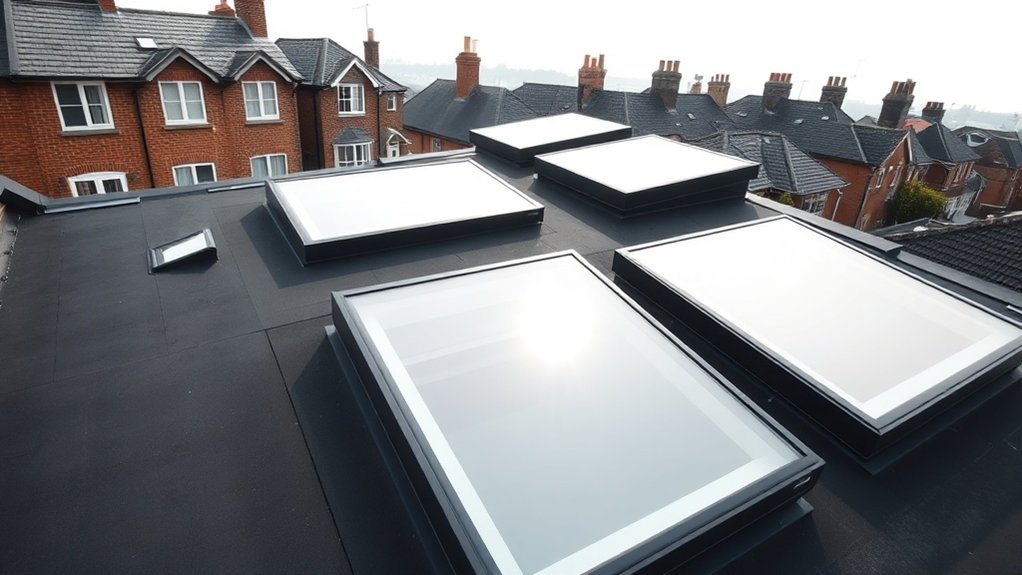
You use flat roof skylights in London to pull diffuse daylight deep into overshadowed plans while keeping a tight, Part L‑compliant thermal envelope. By choosing the right unit—fixed, vented or walk‑on—with low‑e double or triple glazing, warm‑roof build‑up, and thermally broken frames, you limit heat loss, condensation and leaks. Correct sizing, orientation, and upstand detailing are critical to avoid glare and water ingress, and you’re about to see how to get those decisions right.
Key insights
- Flat roof skylights bring high, diffuse daylight into London homes, bypassing overshadowed facades and improving light levels in deep-plan rooms.
- Choose between fixed, opening/venting, and walk-on rooflights, balancing daylight, ventilation, access, safety, and structural loading.
- Specify double or triple glazing with low‑e coatings, thermally broken frames, and suitable U/G-values to meet London’s energy and overheating requirements.
- Confirm planning permission and Building Regulations compliance (Part L, F, A, B, K, M), especially in conservation areas or heritage properties.
- Ensure correct installation with insulated upstands, compatible membranes, and planned maintenance to avoid leaks, condensation, and long-term performance issues.
Why Flat Roof Skylights Work So Well in London Homes
Because London’s housing stock is dense , often north‑facing, and prone to overshadowing, flat roof skylights offer a direct way to capture high, diffuse daylight from above, bypassing obstructed façades and narrow window openings. You’re exploiting the brightest part of the sky dome, so you stabilise lux levels without excessive solar gain. With the right build‑up, you integrate them cleanly into your roof insulation zone: warm‑roof construction, continuous vapour control, insulated upstands, and thermally broken frames prevent cold bridging and interstitial condensation.
You also gain design leverage. Slim sightlines, flush external kerbs, and neutral glass tints let you push skylight aesthetics without compromising U‑values or airtightness. Automated blinds and smart glazing specs fine‑tune g‑values to suit London’s variable climate.
Main Types of Flat Roof Skylights for London Properties
When you’re planning a flat roof skylight in London, you’ll typically choose between fixed flat rooflights, opening and venting skylights, or structural walk-on glass rooflights. Each option delivers different performance regarding U-values, solar gain control, natural ventilation, access, and load-bearing capacity, so you need to match the unit type to the room’s use and your Part L/F compliance strategy. By understanding how these systems differ in glazing build-up, frame profile, and hardware, you can specify a solution that maximises daylight while meeting thermal, acoustic, and safety requirements.
Fixed Flat Rooflights
Although they’re the simplest variant of flat roof glazing, fixed flat rooflights remain the go‑to choice for many London properties due to their robustness , airtightness, and clean detailing. You get a sealed unit that maximises daylight while minimising heat loss and air leakage, ideal for deep‑plan extensions and basement lightwells.
You’ll usually specify a thermally broken aluminium frame with high material durability, bonded to a structural double‑ or triple‑glazed unit, set on an insulated upstand to shed water at a precise fall.
- Slim sightlines and bespoke color options to align with contemporary façade palettes
- Laminated inner panes for impact resistance and enhanced security
- Solar-control and low‑E coatings to manage g‑values and U‑values
- Factory‑applied perimeter flashings to speed installation and reduce snagging
Opening And Venting Skylights
While fixed units simply deliver light, opening and venting skylights add controlled airflow and smoke clearance to your flat roof strategy, which is critical in London’s dense urban fabric and tightly insulated envelopes. You can specify manually operated, chain-driven, or fully motorised actuators, linked to rain, wind, temperature, and smoke sensors for automated purge ventilation and AOV compliance.
You’ll want high-performance roof insulation continuity at the upstand, with thermally broken frames and warm-edge spacers to prevent cold bridging and condensation risk. Go for multi-point locking and airtight gaskets to avoid uncontrolled infiltration when the unit’s shut.
Factor in skylight maintenance from the outset: accessible actuators, replaceable seals, and cleanable drainage channels ensure long-term performance and protect internal finishes.
Walk-On Glass Rooflights
Ever wondered how to reclaim light from a flat roof without losing usable terrace or balcony space? Walk-on glass rooflights let you run decking, tiles, or paving directly over structural glazing while daylight floods the interior below. You’ll specify toughened/laminated glass , anti-slip surface treatments, and insulated units to hit London energy targets.
They integrate cleanly with:
- Structural steel or timber joists using proprietary upstands and warm-roof build‑ups
- Solar panel integration on adjacent zones, maintaining access routes for maintenance
- Rainwater harvesting through perimeter drainage channels feeding attenuation or storage tanks
- Balustrade or frameless edge details that comply with Part K and Part M without visual clutter
You gain dual-use roof space, improved U-values, and future‑proofed infrastructure in one intervention.
Daylight, Orientation and Sizing Flat Roof Skylights
Because flat roof skylights act as primary daylighting apertures rather than decorative features, you need to treat orientation, glazing area, and shaft design as tightly coordinated variables rather than aesthetic choices. In London’s latitude, you’ll typically favour north or northeast orientation for diffuse, low-glare daylight , using south-facing units selectively with solar-control coatings to manage gains. Size to daylight factor targets, not guesswork: often 10–20% of floor area, adjusted for room depth and surface reflectance.
Specify deep, flared shafts with high-reflectance linings to push light deeper into the plan. Internal Color options for reveals should stay in the LRV 80+ range to maximise bounce. Build in maintenance tips early: accessible upstands, self-cleaning glass , and drainage detailing to keep performance stable.
Flat Roof Skylight Costs in London
When you cost a flat roof skylight in London, you’re balancing glazing spec (U-values, G-values, acoustic rating), structural requirements (upstands, trimming, steelwork), and installation method (cold roof vs warm roof, kerb details, access). You’ll need to account for both supply-only figures and full install costs, including scaffolding, crane lifts, weatherproofing, and internal making-good. By planning your budget around these line items and using smart savings—like standard module sizes, factory-finished upstands, and bundled works—you can control spend without compromising performance.
Key Price Factors
Although flat roof skylights look deceptively simple, their cost in London’s market is driven by a tight interplay of technical variables: roof construction, structural opening size, glazing specification (double, triple, or solar-control), frame material, access requirements, U‑values, and compliance with Part L and Part B . You’re fundamentally paying for a high‑performance envelope component, not just “a window in the roof”.
Key price drivers typically include:
- Interface with existing roof insulation, vapour control layers, and membrane tie‑ins
- Bespoke upstand fabrication, kerb details, and allowable deflection of the flat roof deck
- Hardware: concealed actuators, smoke vents, or access hatches that complicate skylight maintenance
- Detailing for cold‑bridge elimination, internal finishes, and drainage falls to avoid ponding around the unit
Budgeting And Savings
Those cost drivers aren’t just academic; they dictate how you should structure your budget and where you can safely trim spend on a flat roof skylight in London. Start by ring‑fencing funds for the “fabric first” elements: high-spec glazing, thermal breaks, and airtight upstands. That’s where Energy efficiency and long‑term savings come from.
Next, prioritise Material durability . Allocate budget to powder‑coated aluminium or GRP kerbs, UV‑stable seals, and corrosion‑resistant fixings; they cut lifecycle costs and call‑backs.
To keep upfront spend lean without compromising performance, rationalise sizes to standard modules, minimise bespoke geometry, and coordinate early with your roofer to avoid reworks. Finally, run a simple payback calculation on U‑value upgrades and solar-control coatings to quantify real cost-per-lux and ROI.
Planning Permission and Building Regulations for London Skylights
How do you make sure your flat roof skylight in London complies with planning rules and the Building Regulations before you cut into the deck? First, confirm if the project sits under Permitted Development or needs a full planning application , especially in conservation areas or where historical architecture is involved. Height above the existing roof plane and overlooking risk are key triggers.
You’ll also need Part A (structure), Part B (fire), Part K (fall protection), and Part L (thermal) compliance designed in from day one.
- Check local authority constraints, Article 4 Directions , and heritage officer guidance
- Coordinate structural openings, upstands, and weathering with an engineer and roofer
- Specify safe access routes and barriers for skylight maintenance and cleaning
- Document calculations, details, and manufacturer data for Building Control approval
Glazing Options and Energy Performance for Flat Roof Skylights
When you specify glazing for a flat roof skylight in London, you need to weigh double vs triple glazing regarding thermal performance, dead load, and cost per m². You’ll look closely at U-values to control heat loss, while balancing g-values and solar control coatings to manage solar gains and glare in both summer and winter. By matching the glazing build-up—pane thicknesses, gas fill, and low‑e coatings—to your orientation and roof build-up, you can optimise energy performance without compromising daylight.
Double vs Triple Glazing
Although both double and triple glazing deliver high-spec performance on flat roof skylights, the right choice hinges on your thermal targets, roof build-up , and budget. You’re balancing pane count against weight, frame capacity, and long-term material durability. Double glazing typically suits retrofits and lighter warm-roof buildups, while triple glazing comes into its own on new-build envelopes chasing aggressive energy specs.
- Double glazing: suitable where structural loading is tight but you still need robust acoustic and thermal performance.
- Triple glazing: best when you’re future-proofing against rising energy costs and want maximum comfort.
- Frame systems: specify thermally broken aluminium or hybrid composites to align with glazing weight and color options.
- Detailing: guarantee spacer bars, seals, and fixings are compatible with your chosen unit depth.
U-Values and Solar Control
Once you’ve settled on double or triple glazing, you need to pin down U‑values and solar control so the skylight actually performs in London’s mixed, often overcast climate. You’re targeting a whole-unit U‑value around 1.0–1.2 W/m²K or better, not just centre-pane figures. Specify argon or krypton fill, warm-edge spacers, and thermally broken upstands to minimise thermal bridging.
For solar control, balance g‑value with visible light transmittance. In south or west orientations, consider low‑g solar-control coatings or laminated interlayers to cut summer gains while keeping daylight levels high. Pair these with internal blinds or switchable tinting if you want dynamic performance. Factor in color options and self-clean or hydrophobic coatings so cleaning methods remain simple on difficult roof access.
Choosing Between Fixed, Ventilated and Walk-On Skylights
Before you commit to a rooflight specification, you need to decide whether a fixed, ventilated, or walk-on skylight best matches the way you use the space and the performance you expect from the roof build-up. Fixed units maximise light and airtightness, with minimal maintenance and strong material durability, ideal when you’re prioritising thermal integrity and clean aesthetic integration. Ventilated skylights add purge ventilation and smoke clearance, so you treat them as part of the building’s M&E strategy, not just glazing. Walk-on units turn the roof into usable amenity, demanding enhanced load paths and anti-slip finishes.
- Assess structural loading, deflection limits, and impact resistance.
- Coordinate opening lights with MVHR and purge rates.
- Detail thresholds for level-access terraces .
- Align frame sightlines with interior design intent.
Flat Roof Skylight Installation and Working With London Contractors
When you move from design intent to installing a flat roof skylight in London, execution hinges on sequencing, tolerances, and coordination between your roofer, skylight supplier, and main contractor. You’ll want a set-out drawing with exact structural opening, upstand height, and finished roof build-up, so everyone’s working to the same datum.
Specify a prefabricated insulated kerb, compatible with your membrane system, and insist on hot-air welded or fully bonded junctions for robust rain protection. Coordinate glazing spec early: low‑e, solar control coatings balance solar heat gain and daylight. On-site, check level, squareness, and fixing torque against manufacturer data. Agree a programme slot so the opening’s never left exposed and cranage, access, and lifting points are fully planned.
Common Flat Roof Skylight Problems and How to Avoid Them
Three recurring issues undermine flat roof skylights in London: water ingress , condensation, and premature seal failure, all usually traced back to detailing, interface workmanship, or specification gaps. You avoid leaks by specifying compatible membranes, warm Roof insulation build-ups, and properly sized upstands with continuous vapour control. Demand fully welded laps, pre-formed corners, and test hose the perimeter before sign‑off.
- Specify drained and ventilated skylight frames to mitigate interstitial condensation and mould.
- Insist on structural calculations for glass thickness, wind uplift, and maintenance loads.
- Enhance skylight security with laminated inner panes, anti-tamper fixings, and concealed curb anchors.
- Schedule annual maintenance: re-torque fixings, inspect sealant beads, clear drainage channels, and check membrane terminations for UV or mechanical damage.
Design Ideas for Flat Roof Skylights in Extensions and Refurbs
Although flat roof skylights are often treated as a simple hole-in-the-roof solution, you get far better results by treating them as a key element in the architectural concept for your extension or refurb. You should set them out on a strict grid, aligned with structural steels and key sightlines, so roof build-ups, services, and drainage all coordinate.
Consider pairing skylights with a roof garden, using walk-on units to create visual continuity between internal and external planes. Specify low-profile, thermally broken frames to keep U‑values tight and minimise cold bridging.
If you’re integrating solar panels, orient skylights to avoid PV shading, or use modular layouts that create clear PV zones. Add internal light wells with splayed reveals to maximise daylight penetration into deep plans.
Frequently Asked Questions
Can I Retrofit a Flat Roof Skylight Into a Listed London Building?
You can, but you’ll need listed building consent and tight compliance with Historical preservation and Building regulations. First, commission a heritage impact assessment and structural survey. Specify a low‑profile, conservation-grade unit with slim sightlines, neutral external framing, and laminated low‑iron glass. Coordinate fixing details to avoid cutting historic joists, use lead or compatible membrane flashings, and integrate Part L/U‑value targets while preserving original fabric and roofscape character.
How Do Flat Roof Skylights Affect Indoor Acoustics and Noise Levels?
They act like acoustic lenses: you’re punching a controlled hole in the envelope, so detailing dictates sound insulation and noise reduction . You’ll specify laminated acoustic glass, warm-edge spacers, and deep multi-chamber frames, then decouple the kerb with acoustic mastic and isolating tapes. Avoid drum‑skin effects with rigid upstands and dense internal liners. If you integrate these correctly, you’ll cut rain impact noise and airborne traffic sound while gaining daylight.
What Maintenance Schedule Is Recommended for London’s Polluted Urban Environment?
You should run a quarterly maintenance schedule in London’s polluted urban environment. Set cleaning frequency at every 3 months using non‑abrasive agents and deionized water to prevent particulate etching. Inspect seals, upstands, and drainage channels each visit. Reapply weatherproofing methods—UV‑stable sealants, compatible flashing tapes, and membrane tie‑ins—annually. Log gasket compression, glass coatings, and fixings torque to catch early failures and keep performance optimized for long‑term, low‑leak, high‑clarity operation.
How Do Skylights Impact Smart Home Systems and Automation Integration?
Skylights supercharge smart systems by acting as dynamic daylight devices that sync with your home’s automation backbone. You integrate sensors for Natural light levels, solar gain, and sash position into your BMS or Matter-enabled hub. Then you trigger adaptive blinds, HVAC load-shedding , and tunable lighting scenes, boosting energy efficiency. You’ll specify motorized actuators, rain sensors, and smart glass options, then commission custom logic for peak performance and predictive control.
Are There Insurance Implications of Installing Flat Roof Skylights in London Homes?
You will trigger insurance implications, mainly around weatherproofing, glazing spec, and security. Insurers often insist your Skylight design uses laminated, impact‑rated glass, certified upstands , and approved fixings to mitigate storm and ingress claims. You’ll need evidence of compliant installation, maintenance logs, and possibly a higher excess. If you can demonstrate enhanced energy efficiency, reduced condensation risk, and burglar‑resistant detailing, some underwriters may offset premiums or bundle it into a performance‑led policy.
Summary
When you cut a skylight into a flat roof, you’re not just punching a hole; you’re installing a calibrated light engine. Spec the right U‑values , upstand height and silicone perimeter, and that aperture becomes your north star—guiding thermal performance, daylight factors and future maintenance. Treat the glass as the “dial” of the room: size, orientation and spec it correctly, and you’ll tune London’s grey sky into a controllable asset, not a persistent defect risk.