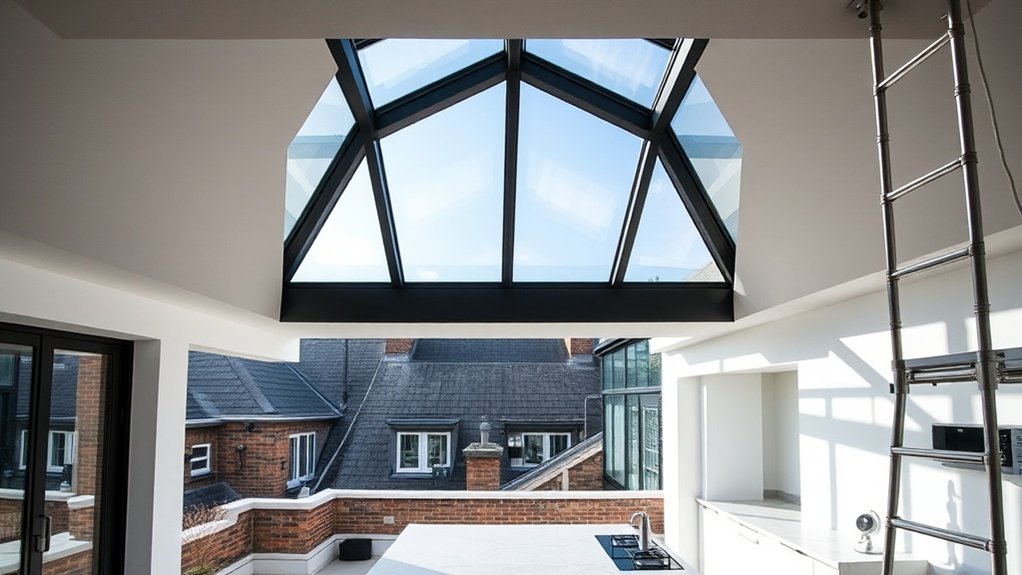
You install a roof lantern in London by first confirming it’s structurally safe , compliant with local planning and any conservation or listed‑building controls, and compatible with your existing roof build‑up. You’ll need structural calculations, high‑performance insulated glazing, proper waterproof upstands, and secure fixings that resist wind uplift. Allow for ventilation, shading, and access for maintenance to avoid condensation, leaks, and overheating. Next, you’ll see how permissions, design choices and installer selection affect the success of your project.
Key insights
- Check if your London property needs planning permission or falls under permitted development, especially in conservation areas or for listed buildings.
- Arrange a structural survey to confirm your existing roof can safely support the lantern’s weight, wind loads, and any required reinforcements.
- Ensure compliance with UK Building Regulations (Parts A, L, and C) for structure, thermal performance, and moisture resistance.
- Choose a lantern size, style, and frame material (e.g., thermally broken aluminium) that suits your roof, room proportions, and local streetscape.
- Specify high‑performance glazing, ventilation options, and proper insulation around the curb to control heat, condensation, and energy use.
Can You Add a Roof Lantern in London?
Although adding a roof lantern in London is usually feasible, you must first confirm that your existing roof structure, property type, and planning constraints will safely allow it. You begin with a structural survey to verify load paths, joist capacities, and any need for trimming steels or reinforcement.
You then review roof design: pitch, span, and existing coverings determine suitable lantern dimensions, weight, and fixing methods. Flat and low‑pitch roofs often require upgraded insulation and robust waterproofing details around the curb.
Next, you assess services and solar integration potential. You must map wiring, ventilation ducts, and potential PV placement to avoid conflicts. Finally, verify fire‑separation lines and safe access for installation and future maintenance before committing to the specification.
Planning Permission and Conservation Rules for Roof Lanterns
Before you specify a roof lantern in London, you need to confirm whether it falls under permitted development criteria or requires full planning permission. You must also check for listed building restrictions , where any alteration to the roof structure or external appearance typically needs formal consent. If your property lies in a conservation area, you’ll have to assess additional controls on height, glazing proportions, and external finishes to guarantee compliance and protect the building’s architectural character and safety.
Permitted Development Criteria
When you plan a roof lantern installation in London, you must first determine whether it falls under Permitted Development rights or requires formal planning permission, especially in conservation areas or on listed buildings. You’ll assess height, position, and projection beyond the existing roof plane. Typically, the lantern mustn’t exceed the highest part of the roof and should project no more than 150mm above the existing roof surface.
You must use obscure glazing and restrict opening mechanisms where overlooking may occur, maintaining privacy and safety. Any solar integration, such as PV cells within glazing, must sit flush and avoid reflective glare onto highways or neighboring properties. Aesthetic enhancements are acceptable, provided materials match or closely complement the existing roof and local character.
Listed Buildings Restrictions
Even where a roof lantern might qualify as Permitted Development on a typical property, any proposal on a listed building in London triggers a stricter regime and usually requires listed building consent in addition to (or instead of) planning permission. You must demonstrate that the lantern won’t harm the building’s architectural significance, structural integrity, or historic fabric.
Expect conservation officers to scrutinise profiles, sightlines, and fixing methods. They’ll typically resist visible upstands, bulky frames, or cutting original rafters. You’ll need detailed drawings, heritage impact assessments, and specifications showing reversibility of works, controlled water ingress risk, and compliant glass and loading calculations.
Innovative solutions are possible when you prioritise historic preservation and aesthetic integration, using slimline thermally broken frames, low-profile external lines, and heritage-appropriate colours and finishes.
Conservation Area Considerations
Listed building controls focus on the fabric of an individual property, whereas conservation area rules in London widen the lens to protect the character of whole streets and roofscapes. You must treat a roof lantern as an alteration to the external envelope , so you’ll usually need planning permission in a conservation area, even when Permitted Development might apply elsewhere.
Planners will assess scale, siting, glazing proportions, and frame colour to ensure historic preservation and aesthetic integration. You should evidence minimal visual intrusion from public viewpoints, use low‑profile designs, and align the lantern with existing roof geometry.
Always commission scale drawings, sections, and material specifications, and reference local Conservation Area Appraisals. Early pre‑application discussions reduce redesign risk and help you secure consent efficiently.
Structural Checks and Building Regs for Roof Lanterns
Although roof lanterns look lightweight, they act as structural openings in your roof and must be treated accordingly under UK Building Regulations . You’ll need a structural engineer to verify existing joists, trimmers, and load paths, ensuring the new opening doesn’t compromise rafter stability or lateral restraint. Roof anchor points must be specified to resist wind uplift, especially on exposed London sites and taller buildings.
Your installer should provide structural calculations to satisfy Part A (Structure) and detail thermal junctions to comply with Part L (Conservation of Fuel and Power). Robust flashing details are critical for Part C (Resistance to Moisture), preventing driven rain from tracking under the frame. For higher-level lanterns, factor in safe access and temporary edge protection to align with CDM safety obligations.
Choosing the Right Roof Lantern Style for Your Home
When you choose a roof lantern style, you’ll need to balance traditional vs contemporary designs with the structural and thermal performance your property demands. You must assess frame materials and finishes not just for aesthetics, but for load-bearing capacity, corrosion resistance, fire performance, and long-term maintenance. Size, shape, and proportion also require precise planning to avoid overloading the roof, causing glare or overheating, and compromising safe access for cleaning and inspections.
Traditional vs Contemporary Designs
How do you balance architectural character, thermal performance , and long-term durability when choosing between traditional and contemporary roof lantern designs for your London property? You’ll weigh proportional sightlines, glazing geometry, and how each option manages solar gain, condensation risk, and maintenance.
Traditional designs echo period detailing and symmetry, ideal in conservation-led streetscapes. Contemporary lanterns push larger spans, slimmer profiles, and sharper lighting effects, enabling bolder, open-plan spaces with controlled glare.
- Respect existing roof pitch and alignment to avoid structural complications
- Model daylight factors to compare traditional vs modern geometries
- Coordinate color options with façade materials and internal finishes
- Assess U-values, g-values, and ventilation strategy for occupant safety
- Factor cleaning access, snow/wind loading, and London pollution exposure
Frame Materials and Finishes
Selecting the frame material and finish determines how reliably your chosen lantern style performs over decades, not just how it looks on day one. You’ll usually choose between thermally broken aluminium, engineered timber, or composite systems . Assess material durability under London’s moisture, pollution, and wind loading; specify certified products with proven corrosion resistance and structural testing.
Prioritise non-bridging frame profiles, integrated drainage channels, and robust gasket systems to maintain airtightness and prevent condensation. Finish options matter just as much: choose powder-coated aluminium with marine‑grade specifications where exposure is high, or factory-finished timber with micro-porous coatings and documented maintenance intervals. Select UV-stable colours to prevent chalking, and insist on finishes compatible with sealants and adjacent roofing materials to avoid premature failure.
Size, Shape and Proportion
A correctly sized and proportioned roof lantern does more than admit light; it controls glare , limits heat gain and loss, and protects the roof structure from overstress. You’ll balance natural light, structural capacity, and thermal performance while aligning the lantern with your room’s geometry.
Key design considerations:
- Match lantern footprint to room dimensions (typically 20–35% of roof area) to avoid over‑lighting and overheating.
- Align the lantern’s long axis with the room’s primary circulation or focal view for maximum aesthetic enhancement.
- Verify joist spans and load paths before choosing large or asymmetric shapes.
- Use taller lantern pitches to improve self‑cleaning and light diffusion on deep plans.
- Coordinate internal ceiling bulkheads and lighting with the lantern outline to retain clean, innovative sightlines.
Glazing, Energy Efficiency and Noise Control
Why does your choice of glazing matter so much when fitting a roof lantern in London? Because the right glazing options directly affect thermal performance, safety, and acoustic comfort in a dense urban environment. You should evaluate low‑emissivity coatings , argon‑filled double or triple glazing, and warm‑edge spacers to minimise U‑values and reduce thermal bridging at the frame interface.
Specify toughened or laminated glass for overhead safety and enhanced security. Laminated panes also improve noise insulation, cutting traffic and aircraft disturbance. Select glass with certified g‑values that balance daylight with heat loss, and confirm edge seals meet BS and EN standards for durability. Finally, confirm the whole lantern system carries independently tested energy ratings , not just the glass units.
Ventilation, Shading and Heat Control
When you plan ventilation and shading for a roof lantern in London, you’re managing solar gain, condensation risk, and occupant comfort as much as daylight. You need controlled natural ventilation to purge heat and moisture, plus shading strategies that modulate light without killing daylight enhancement.
Specify integrated actuators for opening vents, linked to temperature and CO₂ sensors, so the system reacts before overheating or condensation form. Combine low-g solar-control glass with internal or external blinds to fine‑tune g‑values through the seasons.
- Motorised ridge vents for stack-driven natural ventilation
- Rain and wind sensors for automatic safe closure
- External louvres to intercept peak summer solar gain
- Recessed, reflective blinds to diffuse light and cut glare
- Smart controls integrating shading with HVAC and lighting systems
Roof Lantern Costs, Timelines and On-Site Disruption
Although the design and performance specs often take centre stage, you also need a clear handle on costs, programme, and disruption before committing to a roof lantern in London. Budget typically splits into structural alterations , the lantern unit, glazing upgrades, and finishing. Enhanced Roof lantern aesthetics, solar-control glass, and integrated blinds increase cost but can reduce long‑term cooling demand.
You’ll usually allow one day for structural opening works, one for framework and lantern installation, and another for internal making-good, though complex steelwork or listed buildings extend this. Expect localised noise, dust, and temporary weatherproofing while the old roof section is open. Plan protection for finishes below, safe access to the roof, and future maintenance requirements , including cleaning strategy and access routes.
Choosing a Roof Lantern Installer in London
Once you understand budgets, programme, and likely disruption, you need to focus on who’s actually going to install your roof lantern in London. You’re not just buying glass; you’re buying competency with structure, weathering, and Building Regulations. Shortlist specialists who demonstrate mastery of roof lantern materials and modern installation techniques, not generic glazing firms.
Look for installers who can evidence:
- Structural calculations for openings, upstands, and lantern loads
- Experience integrating lanterns with warm roofs and tapered insulation
- Documented waterproofing details for abutments, junctions, and kerb interfaces
- Formal training from system manufacturers and third‑party accreditations
- Robust QA process, including air‑tightness, safety glazing, and sign‑off photos
Insist on method statements and risk assessments; they reveal how rigorously they’ll protect your home and deliver long-term performance.
Frequently Asked Questions
How Do Roof Lanterns Affect My Home’s Resale Value in London?
They typically boost your home’s resale value by enhancing natural light, perceived space, and aesthetic appeal. Buyers in London’s competitive market often pay more for bright, energy-efficient interiors. When you specify high-performance glazing, robust ventilation, and compliant structural detailing, you reduce overheating and condensation risks, which surveyors notice. A well-designed lantern signals innovation and low maintenance, helping your property stand out in listings and professional valuations.
Are There Insurance Implications When Installing a Roof Lantern?
Yes, you’ll face insurance implications. You must notify your insurer so they can reassess Insurance coverage and update policy requirements. They’ll want details on structural alterations , glazing specifications, U‑values, load calculations, safety glazing standards (e.g., BS EN norms), and certified installation. If you don’t declare the change, a future claim for water ingress, storm damage, or glass failure could be reduced or rejected, especially if workmanship or materials don’t meet their technical criteria.
Can Smart Home Systems Be Integrated With Roof Lantern Blinds or Vents?
Yes, you can integrate smart home systems with roof lantern blinds and vents—and here’s where it gets interesting. You connect motors and sensors to enable full smart home integration and precise roof lantern automation. You’ll link them via Zigbee, Z-Wave, or Wi‑Fi to platforms like Home Assistant or Control4. Always specify failsafe stops, rain and wind sensors, manual override , and encrypted communication to maintain safety, reliability, and future‑proof control.
How Do I Clean and Maintain a Roof Lantern Safely in a Townhouse?
You clean and maintain a roof lantern safely by using a stable platform or scaffold, never just a ladder. Follow a strict maintenance checklist: isolate electrics, check seals, inspect fixings, and clear drainage channels. Apply non-abrasive glass cleaner and microfiber tools; avoid high-pressure washers. Use telescopic poles for internal panes. Schedule biannual Cleaning tips, plus post-storm inspections, and document issues to integrate with any smart-maintenance monitoring system .
Are There Specific Roof Lantern Considerations for London’s Air Pollution Levels?
You should specify glass and seals that withstand high Air pollution loads, so deposits don’t etch the surface or clog drainage channels. Prioritize self-cleaning or photocatalytic coatings and robust gasket systems. Address Ventilation concerns with controllable trickle vents and automated actuators linked to indoor air-quality sensors, so you can purge particulates without excessive heat loss. Plan safe access routes for more frequent inspections and precision cleaning.
Summary
So now you know: in London, you can’t just hack a hole in the roof and hope for daylight salvation. You’ll juggle planning rules, structural calculations, U‑values, g‑values, trickle vents and safety glass like a very cautious acrobat. Do it right and your compliant, load‑tested roof lantern will sit there serenely, thumbing its nose at leaks, heat loss, and building control—while your neighbour’s DIY skylight quietly evolves into an indoor paddling pool.