You need skylight repair in London that actually fixes leaks, stops condensation, and stabilises heat loss, not just a quick reseal. A specialist will inspect flashing, upstands, drainage channels, and glazing seals, then use compatible membranes, gaskets, and high‑performance sealants suited to London’s wet, wind‑driven rain. They’ll also assess whether repair or full unit replacement offers better long‑term value. Next, you’ll see how to spot urgent problems and what a proper repair process involves.
Key insights
- Hire FENSA-registered skylight specialists in London who follow UK Building Regulations and have proven experience with both modern and heritage roofs.
- Typical costs range from about £180–£350 for minor resealing to £350–£750 for glazing repairs, with heritage work often higher.
- Common issues include leaks from failed seals or flashing, misted double glazing, condensation between panes, and hairline cracks from thermal movement.
- A thorough repair should include leak diagnostics, inspection of flashing and upstands, seal renewal, drainage checks, and post-repair water-testing.
- London’s frequent rain and humidity accelerate skylight deterioration, so regular inspections and timely repairs prevent minor defects becoming major leaks.
Quick Safety Checks Before You Inspect a Skylight
Before you go anywhere near a skylight, verify that your access route and work area are structurally sound and properly protected against falls. Check roof decking, joists, and any walkways for deflection, soft spots, or corrosion. Confirm guardrails, harness anchor points, and temporary barriers meet current UK fall-protection standards .
Identify the skylight type (fixed, ventilated, domed, walk-on) and confirm its load rating so you never step on a non-walkable unit. For Skylight cleaning or close inspection, use crawl boards or a mobile access platform instead of loading frames or glazing.
Assess weather: avoid high winds, heavy rain, or icy surfaces. Implement basic Ventilation tips—shut down nearby mechanical vents temporarily to prevent unexpected pressure changes or drafts affecting stability.
Signs Your Skylight Really Needs Repair
Once a skylight starts to fail, it usually shows clear, diagnosable symptoms that you can’t ignore. You’ll notice localized drafts around the frame, indicating failing seals or insulation gaps. Condensation trapped between glazing panes signals compromised units that no longer perform thermally. Discoloration or staining on surrounding plasterboard reveals moisture tracking along fixings or upstands.
Pay attention to light quality too. If daylight appears uneven, with harsh glare instead of diffused illumination, the glazing or solar shading system may be deteriorating or incorrectly tensioned. Distortions in reflections on the glass often point to structural stress or frame movement.
When these signs appear, you should commission a technical survey immediately to stabilise performance, protect interior decor, and avoid more invasive future works.
Common Skylight Problems in London Homes
Because London’s climate and housing stock present specific stresses, skylights here tend to suffer a predictable set of technical failures: perimeter seal breakdown leading to air and water ingress, failed double- or triple-glazed units that lose gas fill and mist up, hairline cracks from thermal shock, and frame distortion caused by differential movement between old roof structures and newer rooflight systems.
You’ll often see condensation between panes where earlier skylight design used low-spec edge spacers or inadequate desiccants, undermining energy efficiency and visible light transmission. Poorly insulated upstands and metal frames create cold bridges, driving heat loss and localized damp. On older properties, incompatible flashing systems and undersized gutters overload joints around the kerb. Each issue’s solvable with upgraded gaskets, thermally broken frames, and high-performance glazing.
Why London Weather Makes Skylight Leaks Worse
Although any rooflight is vulnerable to moisture , London’s specific weather pattern—frequent light-to-moderate rain, prolonged overcast periods, sudden downpours, and wide humidity swings—drives water into every weakness in a skylight installation. You’re not just battling rain; you’re dealing with continuous wet/dry cycling that stresses every seal, flashing edge, and fixing point around your view of the London skyline.
London’s climate amplifies three technical failure modes :
- Micro‑movement in roof structures, especially on historic architecture, opening capillary paths around frames.
- Persistent surface dampness, saturating porous masonry and degrading sealants faster than in drier regions.
- Rapid pressure changes during storms, forcing wind‑driven rain under poorly detailed or aged flashings.
If your skylight detailing isn’t resilient to these dynamics, even minor imperfections quickly evolve into active leaks.
How to Find the Source of a Leaking Skylight
To track down a skylight leak in London’s conditions, you need to separate true product failure from issues in the surrounding roof build‑up, and that starts with a structured inspection. Begin indoors: map damp patches relative to the skylight, then test with controlled hose‑water from the bottom up, never blasting directly at joints.
On the roof, check the frame junctions, flashing laps, and upstand height against current standards. Look for capillary tracks, failed sealant beads, and damage from previous works. Assess if the leak originates at the glazing seals, frame corners, or roof covering transitions.
While inspecting, evaluate skylight ventilation paths and drainage channels; blocked weep holes often mimic frame leaks and undermine skylight aesthetics through staining and patch repairs.
Fogging, Condensation and Misted Skylight Glass
Ever noticed your skylight glass turning milky, streaked, or fogged even when it’s not raining? That visual haze usually signals failed seals, trapped moisture , or inadequate ventilation around the unit. Unlike ordinary foggy windows, misted skylight glass often indicates moisture infiltrating the double- or triple-glazed cavity, where you can’t simply wipe it away.
You’ll want to diagnose whether the issue is surface condensation buildup or internal unit failure. Technicians typically:
- Test perimeter seals and glazing gaskets for micro-gaps and thermal bridging
- Assess roof ventilation and humidity sources directly beneath the skylight
- Measure glass temperature differentials to pinpoint where vapor’s condensing
Once you identify the cause, solutions range from resealing and upgrading desiccant systems to installing high-performance, low‑emissivity replacements engineered for London’s variable climate.
Cracks, Chips and Broken Skylight Glazing
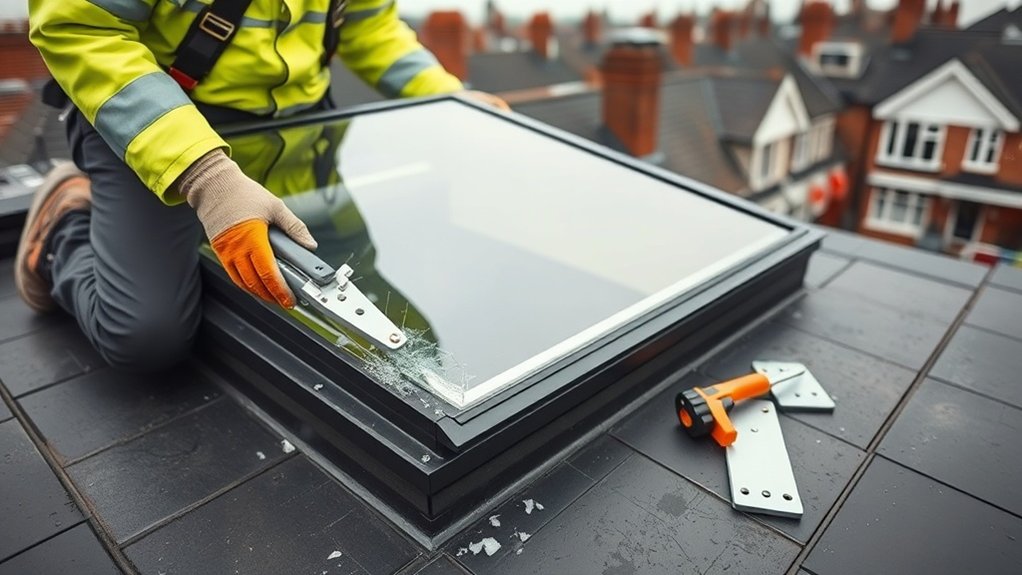
When you spot cracks, chips, or shattered skylight glazing, you need to identify the root cause—impact damage, thermal stress, installation defects, or material fatigue—before choosing a fix. By evaluating the depth, spread, and location of the damage, you can determine whether a localized repair (such as resin injection or edge sealing) will restore integrity and weatherproofing. Where the glass or polycarbonate has lost structural strength or safety performance, you’ll need to specify a full replacement unit that matches current loading, insulation, and glazing standards.
Common Causes Of Damage
Although modern skylight systems are engineered for durability, their glazing is still vulnerable to several predictable modes of damage: impact from hail or falling debris causing star cracks and chips; thermal stress from rapid temperature swings leading to hairline or radial fractures; frame movement or building settlement placing point loads on the glass or polycarbonate; and manufacturing or installation defects that leave edges unsupported or seals uneven. You’ll see these issues accelerated in London by pollution, wind-driven rain, and rooftop foot traffic.
Key triggers you should evaluate include:
- Incompatible or ageing skylight materials reducing impact resistance
- Poor detailing around flashings , allowing moisture to attack seals
- Maintenance practices that prioritise cleaning over structural inspection
Repair Versus Replacement
Before you decide how to deal with cracked or broken skylight glazing, you need to distinguish damage that’s safely repairable from damage that demands full replacement. Hairline cracks or minor edge chips in laminated or toughened glass can often be stabilized with specialist resins, preserving the existing skylight design and maintaining weather‑tightness.
You should replace glazing when cracks penetrate multiple layers, radiate from fixing points, or compromise structural integrity. Any impact damage that distorts the frame, breaks seals, or causes condensation between panes also signals replacement. Upgrading the glazing lets you rethink energy efficiency : low‑E coatings, warm‑edge spacers, and argon fills reduce heat loss while improving solar control. In many London properties, targeted replacement actually outperforms repeated temporary repairs over time.
Drafts, Heat Loss and Noise From London Skylights
Even minor defects in a London skylight’s frame, glazing, or seals can introduce cold drafts, measurable heat loss, and intrusive external noise that undermine the window’s performance. You’ll often trace these failures to degraded gaskets, warped frames, or poorly executed perimeter detailing that compromise both ventilation issues and airtightness.
You mitigate these problems by specifying high‑performance components and precision installation :
- Use warm-edge spacers, low‑E coated double or triple glazing, and inert gas fill to cut conductive and radiant heat loss.
- Integrate acoustic laminated glass and insulated upstands to reduce aircraft and traffic noise without sacrificing daylight.
- Upgrade seals with continuous, compressible weatherstripping that preserves clean sightlines, meeting strict aesthetic considerations while delivering measurable thermal and acoustic gains.
Temporary DIY Skylight Fixes You Can Do Safely
When your skylight starts leaking, you need to identify whether you’re seeing a minor joint failure, failed sealant, or evidence of a more serious structural issue. You can use specific short-term measures—such as temporary exterior-grade sealants and waterproof tapes—provided you apply them safely, from stable access points and in suitable weather. You’ll also need to know when these stop-gap fixes aren’t enough and it’s time to stop intervening yourself and call a qualified skylight professional in London.
Spotting Urgent Skylight Leaks
Although skylight problems often develop slowly, certain warning signs indicate an urgent leak that needs immediate attention and a safe temporary fix. Modern design trends and advanced skylight styles don’t eliminate risk; they just change where you need to look.
You should treat leaks as urgent when you see:
- Localised ceiling staining that rapidly expands after rain, especially in a ring around the skylight shaft.
- Dripping, misting, or water beads forming on internal plasterboard, frames, or electrical fittings near the opening.
- Damp, swollen, or delaminating timber reveals, and rusting fixings around the skylight perimeter.
Act quickly by containing water, protecting finishes, and documenting where moisture appears. Precise observation now helps your roofer identify failed junctions, compromised flashings, or glazing seals later, minimising invasive investigation and structural damage.
Safe Short-Term Sealants
Before a roofer can attend, you can often stabilise a leaking skylight with carefully chosen short‑term sealants that control water ingress without damaging the unit or voiding warranties. Focus on products labelled “removable” or “temporary roof repair,” as they prioritise reversibility over long-term sealant durability.
Use solvent‑free butyl tapes or low‑modulus neutral‑cure silicone around external frame joints, avoiding direct contact with glazing gaskets or weep holes. These options preserve skylight aesthetics while creating a flexible, watertight skin that tolerates minor frame movement.
Clean substrates thoroughly, dry the area, then apply in thin, continuous beads, tooling edges to shed water. Internally, deploy acrylic painter’s caulk only to guide drips into controlled channels, never as a structural or permanent barrier.
When To Call Professionals
Even with careful short‑term sealing , you should treat most skylight leaks as time‑critical defects that warrant a professional roofer or skylight specialist as soon as possible. Your DIY interventions should only stabilise conditions, protect interiors, and buy time for expert diagnostics.
You should call professionals immediately when you see:
- Persistent condensation between panes, distorted reflections, or clouding that degrades skylight aesthetics and signals failed seals.
- Recurrent damp patches, swollen plasterboard, or mould near the opening, indicating hidden membrane breaches and compromised energy efficiency.
- Structural movement: cracking sounds, sagging trims, or gaps between frame and roof covering after storms or snow load.
Specialists can perform pressure testing, infrared moisture mapping, and compatibility‑checked re‑flashing, ensuring durable weathertightness and optimised thermal performance.
When to Repair or Replace a Skylight in London
When a skylight in London starts to leak, mist over, or show signs of frame movement, you need to decide whether a targeted repair will restore performance or if full replacement is the more reliable solution. You should first assess glazing seals , flashings, and drainage channels; if degradation is localised, repair with advanced sealants, upgraded gaskets, or new flashings can stabilise performance while preserving skylight aesthetics and historical accuracy.
Consider replacement when you see widespread frame corrosion, delamination of double- or triple-glazed units, persistent condensation between panes, or structural deflection around the opening. At that point, a new unit with high-spec low‑E glass, warm-edge spacers, and thermally broken frames usually delivers better thermal efficiency, improved airtightness, and long-term lifecycle value.
Choosing the Right Skylight Repair Specialist in London
Although many tradespeople advertise general roofing services, choosing a skylight repair specialist in London demands more rigorous scrutiny of skills, methods, and compliance. You need someone who understands glazing physics, building envelopes, and complex roof interfaces, not just tiles and felt. Verify they’re FENSA-registered or equivalent, carry appropriate insurance, and follow UK Building Regulations for thermal performance and ventilation.
Look for a specialist who optimises both skylight aesthetics and energy efficiency, not merely fixes leaks. Ask how they handle condensation control, thermal bridging, and compatibility with smart-home shading or glazing technologies.
- Proven portfolio of skylight projects on London properties
- Clear methodology for diagnostics, temporary weatherproofing, and permanent repair
- Ability to source advanced glazing/flashings that enhance performance and aesthetics
How Much Does Skylight Repair Cost in London?
So what should you realistically budget for skylight repair in London, and what pushes the price up or down? For minor resealing and hardware adjustments, you’ll typically spend £180–£350 per unit. Localised glazing repairs or replacement of standard double-glazed units often range from £350–£750, depending on access complexity and roof pitch.
If you’re protecting skylight aesthetics or dealing with a structure of historical significance, expect £750–£1,800+, as conservation-grade glass , bespoke metalwork, and heritage-approved sealants raise costs. Complex access (scaffolding, rope access, or protected sightlines) can add several hundred pounds.
You’ll also pay more for high-performance upgrades—solar-control coatings, self-cleaning glass, or integrated blinds—but these can reduce lifetime energy and maintenance costs, improving long-term value rather than just short-term repair savings.
How Professional Skylight Repair Works Step by Step
Understanding the cost bands is only useful if you know exactly what work happens on site and why. A specialist starts with a forensic inspection : they map leak paths, test moisture levels, and photograph junctions with roof membranes, flashings, and structural elements. They also log historical preservation constraints and aesthetic considerations so any intervention remains visually coherent.
Next, they design a repair specification that sequences tasks for minimal disruption and maximum durability:
- Strip back finishes, expose fixings, test the integrity of kerbs, frames, and glazing seals.
- Install upgraded membranes, precision-formed flashings, and modern vapour control layers.
- Rebuild internal linings, reinstate trims, then perform water-testing and thermal imaging.
Finally, you receive a post-works report with photos, product data, and maintenance recommendations.
Skylight Repair for Period and Listed London Homes
Why do skylight repairs on period and listed London homes demand a different approach from standard roof work? You’re working within strict Historical preservation rules, fragile substrates, and non-standard geometries. You must first map original details: glazing bar profiles, putty types, lead flashings, and joinery species. Then you specify like-for-like materials or high-fidelity substitutes—such as slimline heritage double glazing or vacuum glass—to boost performance without altering sightlines.
You’ll often integrate concealed drainage channels , vapour control layers, and micro-ventilation to manage condensation while keeping external profiles authentic. Structural checks must address aged timbers, differential movement, and shallow roof pitches. Aesthetic considerations drive every intervention: ironmongery finishes, patina-compatible paints, and discreet fixings ensure the upgraded skylight meets conservation officers’ expectations yet delivers modern durability and efficiency.
Preventative Skylight Maintenance for London Properties
You can prevent most skylight failures in London by scheduling routine health checks that assess glazing seals, flashing integrity, drainage channels, and internal condensation points . During each inspection, you’ll identify minor defects—such as hairline sealant cracks or blocked gutters—before they escalate into leaks or structural damage. By combining these systematic checks with targeted weatherproofing against persistent London rain, you’ll extend the skylight’s service life and stabilise its thermal and moisture performance.
Routine Skylight Health Checks
How often do you treat your skylight like a building asset rather than just a feature in the roof? Routine health checks let you track performance , preserve skylight aesthetics, and respect historical significance in London’s conservation areas. You’re not just looking for damage; you’re measuring system behaviour.
Focus your inspections on:
- Glazing and frame interface – check for micro-cracks, UV degradation, frame distortion, failed seals.
- Mechanical and control components – test actuators, sensors, opening mechanisms, and any integrated BMS connectivity.
- Internal environment indicators – monitor condensation patterns, thermal bridging, and daylight distribution to validate design intent.
Weatherproofing Against London Rain
When persistent London rain hits your roof, a skylight becomes a high-risk junction between glazing, frame, and roof coverings, so weatherproofing must be treated as a system, not just a seal. You start by specifying high-performance flashing kits matched to your roof finish, then integrate breathable but waterproof membranes that lap correctly above and below the skylight curb.
You detail the fall of the surrounding roof so water accelerates away from junctions, not across them. To prevent condensation tracking into the reveal, you pair the skylight with balanced roof ventilation and insulated upstands. You choose sealants rated for UV, movement, and ponding, not generic mastics. Finally, you verify drainage channels remain clear so rain doesn’t compromise views or sky color.
Insurance, Warranties and Your Rights on Skylight Repair in London Homes
Although skylight problems often look like a straightforward maintenance issue, insurance cover, installation warranties , and UK consumer rights all interact in ways that can considerably affect what you actually pay for repairs in a London home. You should audit policy wording before initiating Insurance claims, confirming whether your insurer treats the leak as “storm damage” or “gradual deterioration.” Simultaneously, map your installer’s warranty coverage against the manufacturer’s guarantee to avoid gaps.
- Verify documentation: original invoice, installation certificate, product datasheets, maintenance records.
- Capture evidence: time‑stamped photos, moisture readings, and roofer reports specifying cause of failure.
- Assert rights: use the Consumer Rights Act 2015 to pursue the installer if workmanship’s substandard within a “reasonable” lifespan.
This structured approach minimizes out‑of‑pocket cost and negotiation friction.
Frequently Asked Questions
Can Skylight Repairs Improve My Home’s Energy Efficiency Rating in London?
Yes, targeted skylight repairs can improve your home’s energy efficiency rating. When you upgrade glazing, improve seals, and eliminate thermal bridges, you enhance thermal performance and reduce heat loss. You’ll gain measurable energy savings, especially when specifying low‑E glass , warm‑edge spacers, and insulated upstands. By integrating airtight installation details and considering solar gain control, you optimize year‑round performance and create a more future‑ready, low‑carbon building envelope.
Do I Need Planning Permission to Alter the Size or Position of a Skylight?
You’ll usually need planning permission if you alter a skylight’s size, projection, or position beyond permitted development limits. If the new opening changes roofline height, overlooks neighbours, or affects structural elements, consult planning officers first. Coordinate Skylight maintenance and Skylight aesthetics with Building Regulations : verify U-values, safety glazing, ventilation, and load paths. For innovative designs, get technical drawings, structural calculations, and written consent before commissioning fabrication or installation.
Are There Eco-Friendly Materials or Glazing Options for Skylight Repairs in London?
You’ve got several eco options. Specify Eco friendly glazing such as low‑E, argon‑filled double or triple units to cut heat loss and solar gain. Choose Sustainable skylight materials: FSC-certified timber frames, recycled aluminium, or uPVC with high recycled content. Add warm‑edge spacers, thermally broken frames, and external shading. You can also specify self‑cleaning or solar-control coatings to reduce maintenance and cooling loads while maximising useful daylight.
How Do Skylight Repairs Affect Natural Light Levels in Loft Conversions?
They directly influence brightness and light distribution in your loft. When you upgrade glazing, you’ll enhance daylight transmission , reduce glare, and refine skylight aesthetic by controlling color rendering and light diffusion. Precise Skylight maintenance—re-sealing, cleaning, realigning sashes—prevents condensation and dirt films that cut visible light. You can specify low-iron glass, larger clear openings, and optimized shaft angles to maximize uniform natural light levels while maintaining thermal efficiency and visual comfort.
Can I Coordinate Skylight Repair With Roof Insulation or Solar Panel Installation?
You absolutely can—and should—coordinate skylight work with roof insulation or solar panels ; why upgrade in three expensive, inconvenient acts when you can suffer once? Plan structural loading, glazing specs, and Skylight aesthetics alongside PV layout and insulation thickness. Evaluate repair cost considerations versus full replacement, integrate airtight vapour barriers, and pre-route cabling beneath flashings. This synchronized approach minimizes penetrations, reduces thermal bridging, and future‑proofs the roof for smart-energy systems.
Summary
You might think a bit of damp around your skylight isn’t urgent, but in London’s climate, minor leaks quickly turn into structural and mould problems. When you act early, you protect your roof timbers, insulation, and interior finishes—and keep your insurance and warranties valid. Use systematic checks, document issues, then bring in a specialist who understands period construction and modern systems. That way, you solve the problem once, not patch it repeatedly.