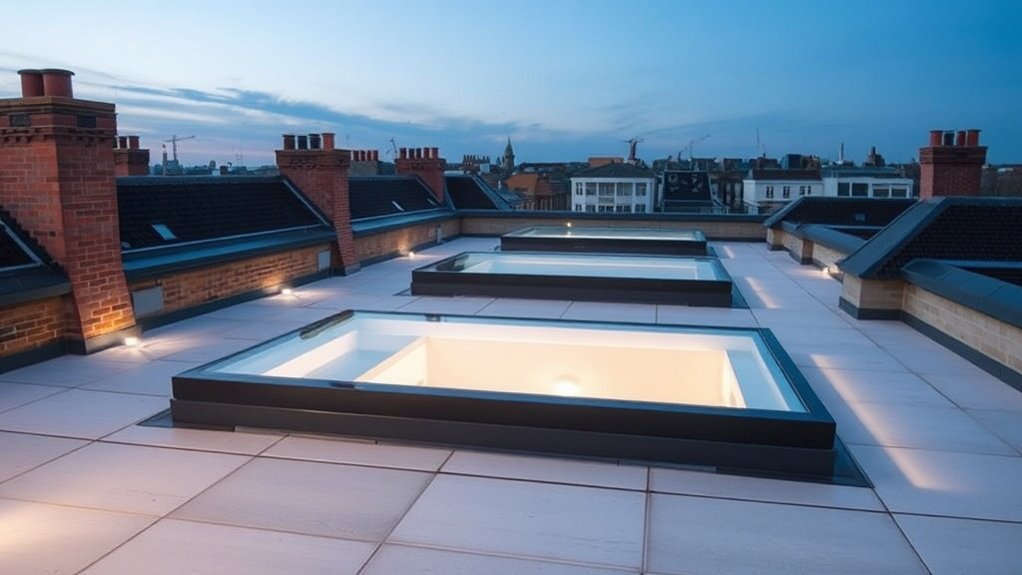
You use walk-on roof lights in London to safely channel daylight into basements and lower floors while maintaining usable roof, terrace or garden space. These structural glass units are engineered to BS EN 1991 for live loads, offer certified slip resistance, and integrate with flat-roof waterproofing and insulation. You must check structural capacity, fire and access compliance, plus potential planning constraints. Next, you’ll see how to specify them correctly for your property.
Key insights
- Walk-on roof lights in London provide secure, trafficable glass areas that maximise natural daylight while creating usable rooftop terraces for homes and commercial buildings.
- Systems are engineered to BS EN 1991 and relevant glass codes, with laminated, toughened, often anti-slip glass designed to carry specified live and impact loads safely.
- Proper installation demands structural checks, compatible waterproofing upstands, drainage falls, and thermal breaks to avoid ponding, cold bridging, and condensation.
- Designs must comply with Building Regulations (Parts A, B, K, M) and London planning policies, addressing overlooking, light spill, edge protection, and conservation constraints.
- High-quality products use thermally broken, marine-grade frames and require biannual inspections and gentle cleaning to maintain safety, weatherproofing, and long-term performance.
How Walk-On Roof Lights Work
Although they look like simple glass panels set into a terrace or flat roof, walk-on roof lights are engineered structural units that transfer live loads (people, furniture, maintenance equipment) through a laminated glass deck into a supporting frame and then into the building’s primary structure. You rely on multiple glass layers, bonded with structural interlayers , to achieve the required design load per BS EN 1991 and corresponding glass design codes.
You coordinate the frame with the roof build‑up, so point loads bypass insulation and waterproofing and bear onto steel, concrete, or engineered timber. Slip resistance comes from surface treatments or ceramic frit, which you can configure as decorative patterns. You control solar gain and privacy with selective glass tinting and coatings.
Key Benefits for London Basements and Lower Floors
When you integrate walk-on roof lights into London basements and lower floors , you transform what’s typically a constrained, artificially lit volume into usable, compliant space with controlled natural daylight and safe access above. You increase daylight factors, improve means-of-escape legibility, and reduce reliance on artificial lighting without compromising structural loading or slip-resistance on the external surface.
These units let you treat the external zone as a terrace or roof garden while maintaining robust impact resistance and guarding strategies to satisfy Approved Documents A, B, K, and L. Below, you gain superior skylight aesthetics with frameless internal edges , minimal thermal bridging, and laminated, heat-soaked glass specified to defined live-load categories, line loads, and concentrated loads, all documented for Building Control and warranty providers.
Are Walk-On Roof Lights Right for Your London Property?
When you’re considering walk-on roof lights for a London property, you need to confirm that the existing structure can safely carry the additional dead and live loads to current structural and fire codes . You’ll also have to balance daylight gains against overlooking risks, using glazing specifications, obscuration, and layout to maintain privacy. At the same time, you must guarantee full compliance with UK Building Regulations, including Part K (protection from falling), Part L (thermal performance), and any relevant planning or conservation constraints.
Assessing Structural Suitability
Before you specify walk-on roof lights for a London property, you need to verify that the existing structure can safely carry the additional dead and live loads these units introduce. You’re not just adding glass; you’re adding concentrated point loads, frame reactions, and potential dynamic loading from regular foot traffic, a roof garden, or solar integration.
Key structural checks include:
- Existing slab and beam capacity to EN 1991 and EN 1992 (or BS 5950 for older steel frames).
- Deflection limits to prevent glass stress concentrations and frame distortion.
- Edge bearing, fixing details, and thermal breaks to avoid cold bridges and local crushing.
- Compatibility with waterproofing build‑up , upstand heights, and fall geometry on flat or low‑pitch roofs.
Balancing Light And Privacy
Once you’ve confirmed the structure can safely carry a walk-on roof light, you need to decide whether it will actually work for how you use the space below. Map sightlines: from the roof garden down and from adjacent London properties in. If the room below is a bedroom, bathroom, or workspace, specify obscured or fritted glass to maintain privacy while preserving daylight.
Use multi-layer glazing with interlayers tuned for sunlight control: low‑g solar coatings, selective tints, or switchable glass where you need dynamic performance. Combine these with external shading (planters, pergolas, seating modules) to break up direct views. Model daylight factors and glare indices , not just lux levels, so the walk-on roof light enhances brightness without turning private interiors into display spaces.
Safety And Building Regulations
Although walk-on roof lights feel like pure architecture and lifestyle, in London they’re fundamentally a structural and regulatory problem you have to resolve first. You’re not just installing glass; you’re integrating a load‑bearing element that must satisfy Building Regulations Parts A, B, K, L, and possibly M. Each affects structural capacity, fire resistance, impact safety, thermal performance, and accessibility.
You’ll need engineer‑signed calculations confirming point loads, line loads, and deflection limits, plus evidence of material durability and slip resistance. Aesthetic design can’t override compliance.
- Verify CE/UKCA markings and documented test data
- Coordinate with Building Control early, not post‑installation
- Specify laminated, toughened glass with anti‑slip finishes
- Ensure upstands, drainage, and edge protection meet code and insurer requirements
Safety, Load-Bearing and Slip Resistance for Walk-On Roof Lights
You can’t specify walk-on roof lights in London without first confirming structural load requirements, slip resistance, and formal compliance with UK and EU safety standards . You’ll need to guarantee the glass build-up, support structure, and fixing details are engineered for the design live loads and concentrated loads applicable to your use case. At the same time, you should select slip-resistant glass finishes that meet relevant test classifications while still satisfying Part K and any additional local authority or warranty-provider criteria.
Structural Load Requirements
How do you guarantee a walk-on roof light is genuinely safe to use, not just visually robust? You start by treating structural load requirements as non‑negotiable constraints, then layer innovation—like decorative patterns and integrated lighting controls—on top.
You need to validate three core load domains:
- Imposed live load : Verify kN/m² capacity against BS EN/UK NA values for roof terraces, maintenance, or public access.
- Point load: Check localized kN point resistance for stiletto heels, furniture legs, and concentrated impacts.
- Impact and redundancy: Use laminated, toughened glass with fail‑safe behavior if a pane cracks.
- Support interface: Design frames, fixings, and upstands so load paths bypass seals and insulation, maintaining structural integrity under worst‑case combinations.
Slip-Resistant Glass Options
Once the glass build-up satisfies structural load requirements, the next gating factor is slip resistance under realistic contaminants—rainwater, fine dust, or even spilled drinks on a roof terrace. You’ll typically specify a laminated outer pane with a permanently fused anti-slip surface, rather than stick-on films that degrade.
You can choose acid-etched, screen-printed, or ceramic-fritted finishes , tuning roughness to achieve a reliable wet-pendulum or ramp-test classification without over-texturing the surface. Decorative patterns aren’t just aesthetic; you can use dot matrices, linear bands, or gradients to create directional grip zones along main circulation paths.
When daylight and mood matter, integrate colour options within the frit or interlayer, maintaining uniform slip resistance while expressing branding, zoning, or wayfinding across the glazed roofscape.
Compliance With Safety Standards
Three distinct compliance pillars govern walk-on roof lights in London: structural load-bearing, human impact safety, and verified slip resistance under wet conditions. You must evidence compliance, not just assume it, especially when lights form part of a roof garden or include solar integration.
Key checks you should require:
- Independent structural calculations to BS EN 1991 and relevant UK NA, including concentrated loads and dynamic crowd loading.
- Glass specification to BS EN 1993/BS EN 14449 with laminated build-ups that maintain residual load capacity after breakage.
- Slip-resistance testing to BS 7976 or BS 13036, achieving suitable PTV values for wet, external, shod use.
- Interface detailing that prevents ponding, accommodates waterproofing and thermal movement, and maintains fire and impact resistance at junctions.
London Planning and Building Regulations for Walk-On Roof Lights
Managing London’s planning rules and Building Regulations for walk-on roof lights demands close attention to structural safety, fire performance, and neighbour impact . You’ll need to evidence compliance with the London Plan, local conservation policies, and national requirements such as the Building Regulations 2010 (notably Parts A, B, K, M). In heritage settings, planners may prioritise historical preservation and roofscape character, limiting visible framing depth or reflective finishes.
You must demonstrate load paths, edge protection, and safe access in your submission, plus justify any overlooking or light-spill affecting neighbours or urban wildlife. For flat roofs, planners scrutinise amenity use, overlooking, and noise. Coordinate early with structural engineers, fire consultants, and your planning officer to align innovative glazing concepts with statutory and local authority constraints.
Thermal Performance of Walk-On Roof Lights and Condensation Risks
Although walk-on roof lights look like simple glass slabs, their thermal performance and condensation behaviour depend on tightly controlled detailing : glass specification, spacer design, edge insulation, frame conductivity, and junctions with the surrounding roof build-up. You’re effectively writing a mini building-physics script where any weak node becomes a cold bridge and a condensation trigger.
You should:
- Target whole-unit U-values that align with London’s stringent energy policies, not just centre-pane figures.
- Specify Thermal insulation continuity around the perimeter to avoid “cold ring” effects.
- Model internal surface temperatures to validate condensation control against expected indoor humidity.
- Coordinate airtightness strategy so warm, moist air can’t bypass your detail and condense on hidden structural interfaces.
Glass, Frames and Finishes for London Walk-On Roof Lights
While the structural glass does most of the visual work, London‑ready walk‑on roof lights only perform properly when you treat glass, frames, and finishes as an integrated system governed by loading, fire, slip resistance, and durability requirements. You’ll typically specify multi‑ply toughened and laminated make‑ups to secure Glass durability under concentrated pedestrian loads and differential thermal movement, verified against Eurocode and relevant British Standards.
You then coordinate drained, thermally broken framing profiles to balance Frame aesthetics with deflection limits, edge cover, and fire compartmentation lines. Finishes can’t be cosmetic afterthoughts: you’ll select slip‑resistant frits, acid‑etch, or ceramic patterns, plus marine‑grade anodised or powder‑coated frames, all tested for UV stability, urban pollutants, and maintenance cycles in London’s microclimates.
Walk-On Roof Light Installation for Retrofits, New Builds and Extensions
When you install walk-on roof lights in a retrofit, new build or extension, you must first verify the supporting structure and imposed loads against current UK standards (e.g. BS EN 1991, BS EN 1995/1996/1993 as applicable). You’ll need to coordinate opening sizes, edge support, and deflection limits so the glass unit performs safely under concentrated and distributed loads. Precise weatherproof detailing at upstands, membranes, and junctions with adjacent finishes is critical to avoid cold bridging, ponding and water ingress over the life of the installation.
Structural Considerations And Load
Before you specify a walk-on roof light for a retrofit, new build, or extension, you need to verify that the supporting structure can safely carry the permanent and variable actions introduced by the glazing unit. You’ll assess existing framing, slab thickness, and bearing details, particularly in historical architecture where unknown material strengths and hidden defects increase risk.
- Quantify imposed loads: foot traffic, maintenance, crowd loading, and concentrated point loads.
- Check compatibility of framing deflection limits with glass and sealant performance.
- Validate edge support , fixing patterns, and local punching shear resistance in concrete or steel.
- Integrate structural provision for future urban greenery loads, including planters and saturated substrate.
Document calculations, reference relevant Eurocodes/BS standards, and coordinate with your structural engineer before finalising the roof-light geometry.
Detailing For Weatherproof Integration
Although the structural design sets the capacity of a walk-on roof light, its long‑term performance depends on how precisely you detail the junctions to keep water, air, and vapour under control. You’ve got to coordinate fall, upstand height, and drainage to comply with Part C and BS 6229, especially on flat or inverted roofs.
Specify compatible membranes, primers, and edge trims so the kerb, glazing frame, and surrounding build-up form a continuous, testable waterproof layer. For retrofits, phase sequencing to protect existing finishes and manage temporary water paths.
Detail perimeter insulation, vapour control layers, and thermal breaks to eliminate condensation risk that could damage both garden aesthetics and interior design. Finally, pressure-test and flood-test where feasible before commissioning.
Walk-On Roof Light Costs, Timelines and How to Maximise Value
Because walk-on roof lights combine structural performance with bespoke glazing , you need to treat cost, programming, and value engineering as tightly coupled variables rather than afterthoughts. You’re not just paying for glass; you’re funding structural calculations, impact testing, and compliance with London-specific loading and Part L energy targets that influence energy efficiency and long-term operating costs.
To maximise value, lock down scope early: load classes, slip resistance, fire performance, thermal break strategy, and how the unit supports garden aesthetics below.
- Benchmark unit rates vs. live load class and glass build-up
- Run lifecycle cost models for U‑values, g‑values, and frame options
- Phase procurement to align with structural steel and waterproofing trades
- Use BIM coordination to eliminate rework and programme risk
Maintenance, Cleaning and Long-Term Care for Walk-On Roof Lights
Proper maintenance for walk-on roof lights isn’t cosmetic; it’s a risk-control measure that protects slip resistance, structural performance, and warranty validity. You should schedule inspections at least twice a year, plus after extreme weather, to check seals, edge details , and any movement in surrounding paving or decking that could compromise garden aesthetics or drainage falls.
Clean glazing with pH‑neutral, non-abrasive agents and soft pads only; avoid solvent-based products that might attack perimeter seals or fritted surfaces. Keep joints clear of moss and debris to prevent ponding and freeze–thaw damage. Verify that weatherproofing techniques (membranes, upstands, flashing interfaces) remain intact and continuous with adjacent roof systems. Document every inspection and intervention; manufacturers may require evidence to uphold performance and slip-resistance warranties.
Frequently Asked Questions
How Do Walk-On Roof Lights Affect Privacy for Overlooked London Properties?
They affect privacy only if you expose lines of sight to overlooking windows. You mitigate privacy concerns by specifying obscured or fritted glass, defining no‑view zones in plan, and modeling sightlines in CAD or BIM before build. You can also recess frames, add internal blinds, or integrate smart glass with switchable opacity. Always validate details against Part K and structural loading to avoid unsafe or non‑compliant configurations.
Can Walk-On Roof Lights Be Integrated With Smart Home or Automated Shading Systems?
You absolutely can integrate them with Smart integration and Automated shading , and you should treat it like orchestrating a tiny space-station hatch. You’ll specify motorised blinds or electrochromic glass, then expose them via APIs (e.g., MQTT, Home Assistant, KNX). You’ll implement fail-safes for rain, wind, and manual overrides, plus watchdog timers. Always sandbox automation logic, log every state change, and test worst‑case latency before you trust autonomous operation.
Are There Heritage-Friendly Walk-On Roof Light Options for Listed London Buildings?
Yes, you’ve got heritage-friendly options . You specify low-profile frames, conservation-grade glazing, and sightlines that match existing roof geometry to satisfy Historical preservation rules while delivering Modern aesthetics. Use a “like-for-like” visual spec but upgrade internals: laminated walk-on glass, non-reflective coatings, and thermally broken frames. Coordinate early with conservation officers, submit detailed section drawings, and run structural + condensation risk calculations before you lock the design.
How Do Walk-On Roof Lights Perform Acoustically Against Traffic and Aircraft Noise?
You’ll find they perform like a well-tuned 8‑bit noise gate : good, but configuration‑dependent. Multi‑laminated glass with interlayers provides solid Acoustic insulation and measurable Noise reduction against traffic and aircraft. Specify asymmetric laminates, deep insulated upstands, and airtight perimeter seals; otherwise flanking paths dominate. Model performance (Rw, Ctr) in software, then validate on-site. Don’t oversell—impact and low-frequency aircraft noise still require layered envelope strategies beyond the walk-on unit.
What Insurance Considerations Apply When Adding Walk-On Roof Lights to My Home?
You must notify your home insurer before specifying walk-on roof lights. Clarify structural load paths , installation safety controls, and contractor liability cover (public and professional indemnity). Confirm your policy treats the glass as part of the building, not “contents.” Ask how changes in risk (foot traffic, roof access) affect premiums and exclusions. Document maintenance requirements, inspection intervals, and slip‑resistance ratings; keep certificates and warranties to support any future claim.
Summary
When you choose walk-on roof lights for your London property, you’re not just cutting apertures in concrete—you’re compiling a controlled light-delivery system. Picture daylight streaming through structural glass, tracing clean lines across polished floors, while certified load paths and anti-slip finishes quietly mitigate risk. With compliant detailing, robust drainage, and a clear maintenance routine, you’re effectively hardening your roof’s surface layer—while turning every step above into a safe, luminous extension of your living space.