When you replace a skylight in London , you must treat it as a full building envelope upgrade. You’ll need modern, low U‑value, safety‑laminated glazing, correctly detailed flashings, and robust vapour control to cope with high rainfall, freeze–thaw and pollution. Check whether you need planning consent or Listed Building/Conservation Area approval, guarantee compliance with Parts L, B and F, and address any Party Wall issues early. Next, you’ll see how to choose, specify and install safely and cost‑effectively.
Key insights
- Assess if your skylight needs replacement by checking for leaks, condensation between panes, warped frames, and stained or distorted internal plasterboard.
- In London’s climate, choose modern double or triple-glazed units with argon fill, solar-control coatings, and laminated inner panes for comfort and efficiency.
- Expect costs to vary with access, scaffolding needs, roof type, skylight size, glazing spec, and heritage or conservation requirements.
- Ensure installers handle planning permission, Building Regulations compliance (Parts L, B, F), and provide documentation for warranties and future maintenance.
- Schedule regular external and internal inspections after replacement to maintain seals, flashings, and drainage, preventing leaks in London’s wet, polluted environment.
Spotting the Signs Your Skylight Needs Replacing
Even if your skylight still lets in daylight, specific warning signs indicate it’s due for replacement rather than another repair. You should look for persistent condensation between panes , spider-cracked glazing, or discoloured seals; these all indicate system failure, not surface wear. Any soft, stained, or distorted plasterboard around the opening suggests chronic moisture ingress.
From inside the loft, inspect surrounding roof insulation; damp or compressed insulation shows the skylight’s thermal envelope has broken down. Externally, check for warped frames, perished gaskets, or corroded fixings that compromise structural integrity and modern weatherproofing techniques. In London’s wind-driven rain, you can’t rely on aging units that predate current Part L and Part F standards; replacement becomes essential to restore compliance and safety.
Repair vs Replacement: Making the Right Call
Although minor leaks and draughts can sometimes be resolved with targeted repairs , you should assess your skylight against clear criteria before deciding not to replace it. Start by checking frame movement, glazing integrity, and evidence of long‑term water ingress into the roof build‑up. If the original skylight design lacks compliant upstands, safety glazing, or adequate ventilation, a like‑for‑like repair can lock in outdated performance.
You should also evaluate material durability. Cracked acrylic, UV‑brittled seals, or corroded metal fixings typically indicate end‑of‑life, where replacement delivers better value and safety. When repeated call‑outs, internal damage, or condensation issues persist despite correct installation and detailing, it’s usually more cost‑effective to specify a modern, tested unit than to keep investing in short‑lived repairs.
How London’s Weather Affects Skylight Lifespans
Because London combines high rainfall , frequent freeze–thaw cycles, and significant urban pollution, its climate accelerates wear on skylight components far more than many homeowners expect. Persistent moisture stresses seals, flashings, and upstands, increasing the risk of interstitial condensation, rot in timber kerbs, and corrosion of metal fixings. You’ll often see gaskets lose elasticity prematurely, undermining weather‑tightness.
Freeze–thaw cycling expands micro‑cracks in glazing and mortar interfaces, shortening service life, especially on older roofs and Historical architecture. Pollution and particulates etch glass, degrade sealants, and tarnish framings, diminishing skylight aesthetics and solar performance. To stay code compliant and safe, you must anticipate these loads: specify robust drainage paths, UV‑stable sealants, and corrosion‑resistant fixings, and schedule inspections after severe weather events.
Skylight Types and Styles That Work in London Homes
When you select skylight types for a London home, you need to balance daylight performance with strict weather‑tightness, ventilation, and fire‑safety requirements . You’re choosing a structural opening in a critical part of the building envelope, so every style must align with Part L, B, and F of UK Building Regulations while still delivering bold skylight aesthetics.
-
Fixed flush skylights – Slim-framed units in advanced Skycraft materials give high thermal performance, minimal sightlines, and excellent resistance to wind‑driven rain.
-
Top‑hung or centre‑pivot roof windows – Ideal where you need purge ventilation and compliant escape routes, especially in loft conversions.
-
Walk‑on and terrace skylights – Laminated, anti‑slip glass systems create usable outdoor space overhead while maintaining impact resistance, non‑fragility, and tested fire‑performance.
Skipping Common Pitfalls in Period and Flat Roofs
Start skylight replacement on London’s period and flat roofs by recognising the specific risks they carry: fragile substrates, hidden decay, complex roof build‑ups, and strict fire and thermal requirements under Parts B and L. You first commission a measured survey and core samples, confirming joist direction, insulation type, vapour control layers, and existing fire compartmentation.
You then coordinate structural design to avoid over‑cutting historic rafters or slender steel decks. For Historical preservation, you protect original slates, leadwork, and parapet details, sequencing works to minimise disturbance. On flat roofs, you avoid bridging warm roofs, maintain falls, and design upstands and kerbs to BS 6229 and NFRC guidance. Finally, you reconcile aesthetic considerations with planning constraints, keeping sightlines low while maintaining safe maintenance access.
Glazing Choices for Light and Energy Efficiency
When you replace a skylight in London, you need to assess whether double or triple glazing will give you the best balance between U‑value performance , structural load limits, and cost. You should also consider low‑E coatings and compatible solar control films to meet Approved Document L requirements while limiting glare and UV exposure. By managing solar gain and insulation correctly, you’ll reduce overheating risk, improve winter heat retention, and keep the installation safe and code compliant.
Double Vs Triple Glazing
Although both double and triple glazing can dramatically improve a skylight’s performance , they differ considerably in how they balance daylight, thermal efficiency, and cost. You’ll weigh these options against Skylight aesthetics, structural loading, and historical conservation constraints, especially under London’s planning and Building Regulations Part L and K.
-
Double glazing You get lower weight, simpler detailing, and good U-values. It’s often preferable where roof structure or conservation officers limit visible depth and frame profiles.
-
Triple glazing You gain superior thermal performance and reduced noise, but increase glass weight, frame bulk, and installation complexity, requiring careful structural verification.
-
Choosing appropriately You should model solar gain, daylight factors, and condensation risk, then coordinate with engineers and conservation officers to maintain safety, comfort, and architectural intent.
Low-E Coatings And Films
Low‑emissivity (Low‑E) coatings and retrofit films let you fine‑tune a skylight’s balance of daylight, solar control, and heat loss without sacrificing compliance with London’s Part L energy standards or Part K safety requirements. You specify the coating’s emissivity, visible light transmittance (VLT), and solar reflectance to align Energy efficiency with daylighting optimization and glare control.
You’ll typically choose soft‑coat Low‑E on inner panes for higher performance and harder pyrolytic coats on outer panes where durability and cleanability matter. Retrofit films apply to existing glass, but you must verify edge‑seal compatibility and structural glazing warranties. Always confirm that coated glass retains its impact resistance, walk‑on ratings (if applicable), and non‑fragility classification, and that installation methods follow manufacturer and British Standard installation guidance.
Solar Gain And Insulation
Because a skylight functions as both a window and part of your roof envelope, glazing selection must control solar gain while limiting heat loss to comply with London’s Part L and Part K requirements. You need glass that maximises daylight, manages overheating risk, and protects occupants near roof edges and slopes.
When you replace skylights in Historical architecture, you can still specify eco friendly materials and advanced glazing that meet safety and performance criteria.
- Triple or high-performance double glazing with argon or krypton fill reduces U‑values while maintaining visible light transmission.
- Solar-control interlayers or coatings lower g‑values, limiting summer gains without darkening interiors.
- Laminated inner panes provide fall protection, impact resistance, and improved acoustic and thermal performance.
Ventilation, Noise Control and Smart Comfort Features
When you evaluate skylight replacement options in London, you need to treat ventilation, acoustic performance, and smart controls as integrated systems rather than add‑ons. You’ll maximise ventilation benefits by specifying controllable openings with secure night‑vent positions, insect screens, and rain sensors that automatically close units to protect interiors. Motorised actuators should be fail‑safe and accessible for maintenance.
For noise mitigation, select laminated acoustic glazing, thermally broken frames, and compression seals that limit airborne and impact noise from traffic, rail, or aviation. Verify tested dB ratings , not just marketing claims.
Smart comfort features can include CO₂ and humidity sensors, app‑based control, and links to whole‑house MVHR or heat‑pump systems. Always guarantee actuators, wiring routes, and power supplies comply with electrical and fire‑safety standards.
Planning Rules, Building Regs and Party Walls for Skylights
When you replace a skylight in London, you must check whether the work falls under Permitted Development or requires formal planning consent, especially in conservation areas or on listed buildings. You also need to confirm the installation complies with current Building Regulations, including structure, fire safety, thermal performance, and ventilation. If the skylight affects a shared or adjoining structure, you’ll likely need to address Party Wall matters to protect both your property and your neighbour’s.
Permitted Development And Planning
Although a skylight replacement can appear straightforward, you must treat it as building work that’s controlled by planning rules, Building Regulations, and (in many London properties) the Party Wall etc. Under permitted development, you can usually replace a skylight on a like‑for‑like basis, but once you alter size, projection, or position to optimise skylight aesthetics or integrate innovative materials, planning constraints tighten.
In London, you must check conservation area status , Article 4 Directions, and any flat or maisonette restrictions before proceeding.
- Confirm if your roof plane faces a highway or is within a controlled streetscape.
- Verify that any new unit doesn’t project more than 150mm above the roof surface.
- Guarantee side‑facing roof windows use obscure glazing and restricted opening where required.
Building Regulations And Party Walls
How do you make sure a skylight replacement in London doesn’t breach safety or your neighbours’ rights? You start with Building Regulations . Your new unit must achieve compliant U‑values, satisfy Part L for energy efficiency, and meet Part B fire‑performance rules, including non‑combustible upstands where required. Structural changes must follow Part A; always obtain calculations for trimming rafters or forming openings.
If the skylight sits on, cuts into, or bears on a party wall or party structure, the Party Wall etc. Act 1996 applies. You must serve notice, obtain written consent, or agree an award via surveyors. That’s critical in dense streetscapes and properties with historical architecture, where precise detailing protects both fabric and your interior design ambitions.
Skylight Replacement Costs in London and Key Price Drivers
Even for a straightforward like-for-like swap, skylight replacement costs in London vary widely because they’re driven by several technical and regulatory factors: roof type (flat vs pitched), access and scaffolding needs , skylight size and glazing specification (e.g. laminated, low‑E, solar control), frame material, ventilation or opening mechanisms, and whether any structural alterations to rafters or joists are required to maintain BS and Building Regulations compliance. You’ll also balance Skylight aesthetics, historical accuracy, and performance, especially in conservation zones.
Core price drivers typically cluster around:
- Access and safety – scaffold, edge protection, fall‑arrest, temporary weathering.
- Specification – triple glazing, integrated blinds, smart sensors, fire‑rated or walk‑on units.
- Integration complexity – heritage detailing, insulation upgrades, vapour control, and compliant weatherproofing to avoid condensation and structural risk.
What to Expect During Your Skylight Replacement
When you book a skylight replacement in London, you should expect a structured process that starts with a detailed site assessment to check access, roof condition, and compliance with UK Building Regulations. On installation day, the contractor will follow a defined timeline covering safe roof access, removal of the old unit, fitting and sealing of the new skylight, and weatherproofing. Before handover, you’ll walk through post-installation checks , including operation of vents or blinds, inspection of internal finishes, and confirmation of warranties and certification.
Initial Site Assessment
Before any skylight is removed or installed, a qualified installer carries out a structured site assessment to confirm the roof’s condition, verify measurements , and identify safety and access requirements. You’ll walk the space with them while they evaluate structure, ventilation potential, and how the new unit can enhance natural light and skylight symbolism within London’s historical architecture.
They’ll also confirm compliance with UK Building Regulations, including fire performance, thermal efficiency, and safety glazing.
- Roof and structure check – Inspect rafters, deck, membranes, falls, and drainage paths to verify load capacity and moisture control.
- Measured survey – Record exact openings, roof pitch, and internal reveals for a precision-fit system.
- Risk and access analysis – Plan scaffolding, edge protection, and safe material handling routes.
Installation Day Timeline
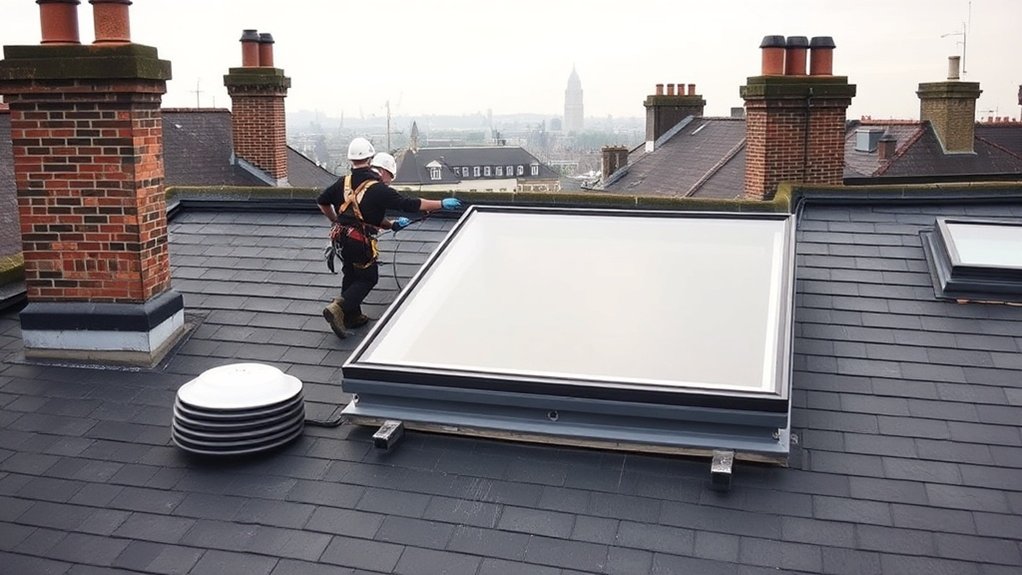
Once installation day arrives, your skylight specialist follows a defined, safety‑led sequence so work stays predictable, compliant, and controlled. They’ll begin with access setup, harness checks, and weather verification, then isolate electrics and protect interior finishes beneath the opening.
Next, they’ll remove the existing unit, inspect the opening, and adjust structural timbers to meet current British Standards and manufacturer tolerances. Roof insulation around the aperture is upgraded or reinstated to maintain U‑values and minimise thermal bridging.
The new frame and glazing go in, aligned to drainage paths and compatible roof coverings. Flashings are installed in layers, then sealed. If you’re integrating smart ventilation systems, control cables and sensors are routed now, ensuring airflow performance without compromising airtightness.
Post-Installation Checks
With the new skylight fixed, flashed, and wired, your installer moves straight into post‑installation checks to verify performance and compliance. They’ll confirm the unit’s anchored to structural members, flashings are sealed to BS EN standards, and any electrical components meet Part P and BS 7671.
-
Weather‑tightness and safety They perform a controlled water test, inspect internal vapour barriers, verify fall‑protection measures, and confirm glass specification (laminated/toughened) against your risk profile.
-
Thermal, acoustic, and control performance They check U‑values, air‑tightness tapes, smart controls, rain sensors, and ventilation modes, ensuring performance aligns with your brief.
-
Skylight aesthetics and historical preservation They validate sightlines, frame colour, and external profiles against conservation guidelines, documenting compliance for planners and your maintenance records.
Skylight Maintenance Tips to Keep It Leak-Free
Although a quality skylight and proper installation are essential, you’ll only keep it reliably leak‑free by carrying out regular, targeted maintenance. Inspect internal finishes quarterly for staining, blistering, or mould, which can indicate concealed moisture, especially where skylight aesthetics must complement historical preservation requirements.
Externally, access the roof only with compliant edge protection or harness systems. Clear debris from upstands, gutters, and drainage channels; blocked outlets are a primary cause of ponding and capillary leaks. Check flashings, counter‑flashings, and sealant joints for cracks, loss of adhesion, or UV degradation, and renew with compatible, manufacturer‑approved products.
Annually, verify fixings for corrosion or loosening, clean glazing with non‑abrasive agents, and document all inspections. If you detect movement or structural distortion, commission a chartered surveyor immediately.
Frequently Asked Questions
How Do I Choose a Reputable Skylight Installer Specifically in London?
You choose a reputable skylight installer by checking their qualifications first. Verify they’re FENSA- or CERTASS-registered, insured, and familiar with Part L and K requirements. Ask for detailed skylight design proposals , including structural calculations and condensation control. Demand a written installation timeline with milestones, access plans, and weather contingencies. Review previous innovative projects, request references, and confirm they provide manufacturer-backed warranties and post-installation safety inspections.
Can I Stay in My Home During a Skylight Replacement Project?
You usually can stay home, but plan carefully. Around 60% of occupants underestimate disruption from roof works. Expect noise, drafts, and short-term weather exposure. For safety, you’ll need exclusion zones under the opening and dust control. Avoid DIY challenges here —improper temporary sealing risks leaks and structural issues. Consider cost considerations like temporary protection, childcare, or remote work. Verify contractors follow BS standards, fall protection rules, and use certified flashing systems.
Are There Eco-Friendly or Recycled Materials Available for Skylight Frames?
Yes, you’ve got strong eco friendly options. You can specify skylight frames fabricated from recycled materials such as reclaimed aluminum, steel, or high‑recycled‑content PVC and fiberglass composites. Guarantee products carry verified environmental declarations and meet BS EN performance standards for structural integrity, fire safety, and thermal performance. You’ll also want low‑VOC sealants, thermally broken frames, and robust flashing systems to optimise energy efficiency while maintaining full compliance with UK Building Regulations.
How Does Skylight Replacement Affect My Home Insurance or Warranties?
Skylight replacement can alter insurance implications and warranty coverage because it changes your building envelope. Around 20% of domestic claims involve water ingress, so insurers scrutinize glazing work. You should notify your insurer before installation, use certified products, and obtain documented compliance with BS and building regulations. Manufacturers’ warranties often require professional fitting and maintenance; if you DIY or modify framing, you’ll likely void both product warranties and related policy protections.
Can Skylights Be Integrated With Existing Home Security and Alarm Systems?
Yes, you can integrate skylights with existing home security and alarm systems through security integration and alarm compatibility features. You’ll specify contact sensors , glass‑break detectors, or position switches wired to your alarm panel, following manufacturer specs and local electrical codes. Confirm low‑voltage cabling, power supplies, and wireless modules are certified and properly isolated from mains. You’ll also validate signaling protocols so your monitoring service receives accurate skylight status events.
Summary
So, after all this, you now know the “fun” truth: a skylight isn’t a hole in the roof, it’s a controlled penetration that either meets standards…or leaks on your laptop. When you choose certified products , follow Part L and K, respect party wall rules, and insist on proper flashing and fall protection, you’re not being fussy—you’re avoiding rot, mould, and claims. Ignore it all, and the next London storm will do your commissioning test for you.