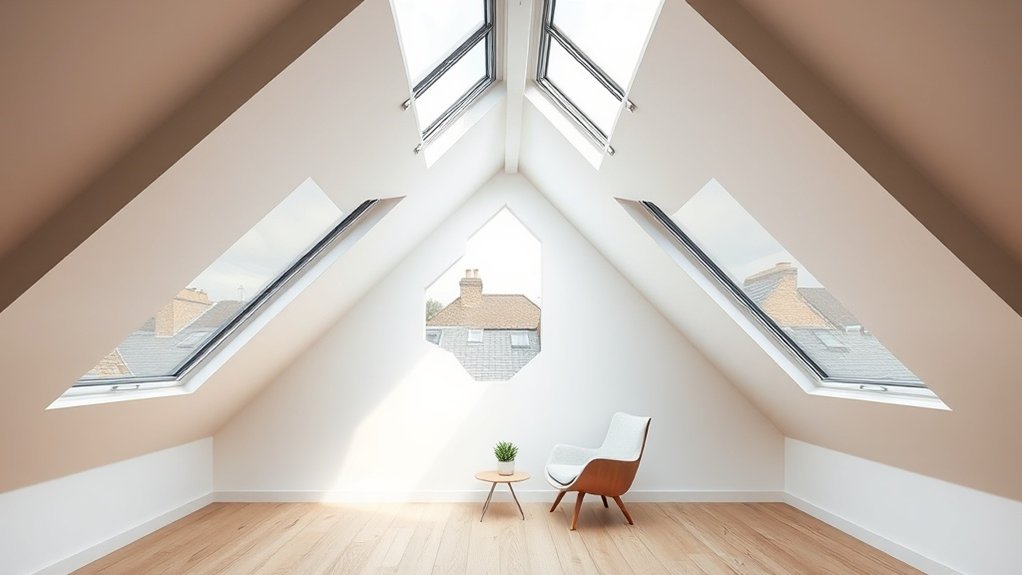
You use pitched roof skylights in London to open dead loft voids, hit daylight targets, and improve ventilation without compromising heritage facades or U-values. Done right, you’ll align units with rafters, reinforce trimmers, maintain continuous insulation, and use proprietary flashing kits to avoid leaks and cold bridges. High-performance, solar-control glazing helps manage glare and overheating in tight urban sites. If you want to avoid planning pushback and long-term defects, the next sections show you how.
Key insights
- Check if you need planning permission, especially in London conservation areas where skylight size, profile, and reflectivity are strictly controlled.
- Align skylight openings with existing rafters and use engineered reinforcement to maintain structural integrity and meet wind and snow load requirements.
- Choose suitable glazing and frames (low‑E, solar control, thermally broken) to balance daylight, overheating risk, and energy efficiency in London’s climate.
- Use proprietary flashing kits compatible with your roof covering and pitch, ensuring airtightness and long‑term protection against water ingress.
- Compare installers on full package costs, including structural work, insulation upgrades, warranties, and ongoing maintenance provisions.
How Pitched Roof Skylights Transform London Homes
When you install a pitched roof skylight in a London property, you fundamentally change how the building handles light, heat, and usable space. You re-engineer the roof build-up, introduce controlled solar gain, and convert dead voids into high-value volume. By aligning the skylight with the rafter layout and existing load paths, you maintain structural integrity while optimising daylight factors.
In London’s historical architecture, you can integrate frameless or low-profile units that respect sightlines and support cultural preservation. You’ll coordinate with conservation officers, specifying heritage-compatible external finishes and discreet flashings. Thermally broken frames, solar-control glazing, and airtight kerb detailing ensure the skylight works with high-performance insulation, vapour control layers, and MVHR systems, transforming the roofscape into a precision-engineered daylight interface.
Benefits and Drawbacks of Pitched Roof Skylights
Although pitched roof skylights can transform a London property’s performance and feel, you need a clear view of both their advantages and limitations before cutting into the roof. They boost daylight factors, reduce reliance on artificial lighting, and can enhance thermal performance when you specify high-performance glazing and airtight upstands .
However, you’re also introducing a penetration into the roof envelope, so detailing, workmanship, and product quality become non‑negotiable.
- Improve internal comfort, daylight autonomy, and ventilation rates in compact roofspaces.
- Elevate Urban aesthetics while remaining sympathetic to Historical architecture with low‑profile frames.
- Risk thermal bridging, interstitial condensation, and glare if orientation and U‑values are misjudged.
- Increase maintenance loads, with periodic inspection of flashing, sealant interfaces, and drainage paths essential.
London Planning Rules for Pitched Roof Skylights
Pitched roof skylights only deliver their performance benefits if you also keep the planners onside, and in London that means reading both local policies and the London Plan in detail. You’ll navigate three main constraints: heritage impact , neighbour amenity, and energy performance.
In conservation areas or where historical architecture dominates, case officers scrutinise external profiles, frame colour, and glazing reflectivity to avoid visual clutter in the roofscape. Flush-fit units, conservation-style detailing, and slimline flashings usually track better in design review.
You must evidence upgraded roof insulation and overall U‑value performance, not just the skylight’s glass spec, to satisfy energy policies. Protecting privacy and avoiding perceived overlooking also matters, so you’ll often need section drawings, sightline studies, and overshadowing diagrams.
Choosing Fixed vs Opening Pitched Roof Skylights
When you’re weighing up fixed versus opening pitched roof skylights, you need to balance ventilation and climate control against energy efficiency and install cost. An opening unit lets you purge heat build-up, manage condensation, and work your passive ventilation strategy, but it adds hardware, detailing, and maintenance to the specification. A fixed unit simplifies the roof build-up and can tighten the thermal envelope, but you’ll rely more on mechanical ventilation and smart glazing to stabilise internal temperatures.
Ventilation And Climate Control
Even in London’s mild but variable climate , the decision between fixed and opening pitched roof skylights directly affects ventilation performance, thermal comfort, and energy loads. You’re not just optimising Natural light and aesthetic appeal; you’re also configuring how your roofscape manages air movement and internal temperature.
Opening units act as high-level exhausts, driving stack-effect ventilation and purging latent heat, moisture, and pollutants from loft conversions and top-floor spaces. Fixed units rely on complementary vents or MVHR to avoid stagnant air.
- Manage cross-ventilation by pairing opening skylights with low-level inlets
- Specify actuators with rain sensors and programmable purge cycles
- Use trickle vents where you need controlled background airflow
- Integrate shading and glazing specs with your ventilation strategy
Energy Efficiency And Cost
Two core factors should drive your choice between fixed and opening pitched roof skylights in London: whole‑life energy performance and total installed cost. You’re balancing thermal envelope integrity against controllable ventilation and daylight strategy.
Fixed units typically deliver better U‑values, minimise thermal bridging, and integrate cleanly with high‑performance roof insulation . They reduce air infiltration risk and simplify detailing, so you’ll usually see lower capital outlay and tighter energy models.
Opening skylights introduce trickle and purge ventilation, potentially cutting mechanical cooling loads, but hardware, flashing complexity, and airtightness sealing push costs up. You’ll need higher‑spec gaskets and careful commissioning.
In London’s climate, prioritise low g‑value glazing to manage solar gain while maintaining visible light transmission, then model payback via reduced heating, cooling, and maintenance.
Daylight, Glazing and Energy in London Homes
Although London’s overcast climate limits direct sun, high‑performance skylight glazing can still deliver robust daylight factors while tightly controlling heat loss and solar gains. You use advanced glazing technology to optimise sunlight penetration, targeting uniform illuminance without glare or cold‑surface downdraughts.
You balance visible light transmittance (Tvis) against solar heat gain coefficient (g‑value), then pair this with low‑emissivity coatings and argon‑filled cavities to achieve low U‑values. That lets you downsize artificial lighting and maintain tight thermal performance.
- Specify Tvis and g‑value based on orientation and roof pitch.
- Use warm‑edge spacers to cut thermal bridging around the unit.
- Integrate spectrally selective coatings to filter unwanted infrared.
- Model daylight autonomy alongside SAP calculations to validate comfort and savings.
Ventilation, Overheating and Privacy With Skylights
While roof glazing opens up powerful daylighting, it also becomes a critical control point for ventilation, overheating risk and sightlines in tight London plots. You need skylights that don’t just admit light, but actively manage air change, heat gain and visual privacy.
Specify units with controllable openings, trickle vents and, where feasible, automated actuators linked to temperature and CO₂ sensors. Combine low-g solar control glass with external solar shading to cut peak summer gains without sacrificing sky view. Robust roof insulation must interface cleanly with the skylight upstand to avoid thermal bridges and condensation risk.
For privacy, consider higher cill heights, frosted or patterned inner panes, and angle-conscious positioning to block overlooking while still harvesting top-light and purge ventilation.
Designing Pitched Roof Skylights for Lofts and Extensions
When you design pitched roof skylights for lofts and extensions, you first need to assess rafter spans, load paths and existing purlins to confirm structural capacity and fixing points. From there, you can set out skylight positions and sizes to maximise daylight factors while controlling sightlines to protect privacy from neighbouring properties. Finally, you’ll coordinate the skylights with the extension’s roof build-up, drainage, and flashing details so the new openings read as a seamless part of the overall envelope.
Assessing Loft Roof Structure
Before you cut a hole in any pitched roof for a loft skylight, you’ve got to understand exactly how the existing structure works. You’re dealing with a load‑bearing system, not just tiles and felt. Start by identifying rafter size, spacing, and span, then check how roof insulation is installed so you don’t compromise thermal performance or create condensation traps.
Verify load paths before you reframe:
- Map existing rafters , purlins, binders, and ceiling joists to see what’s carrying what.
- Flag any historic deflection, rot, or over‑notching that already weakens the frame.
- Design structural reinforcement (trimmers, doubles, steel if required) around the opening.
- Coordinate with an engineer to validate calcs against wind and snow loads specific to London.
Maximising Daylight And Privacy
Get the daylight strategy right on a pitched‑roof skylight and you’ll transform a loft or extension without sacrificing privacy or overheating. Start by modelling daylight factors and solar gain for your roof pitch, orientation, and glazing area, then size the openings to achieve balanced lux levels across the floor plate, not hot spots.
Use high‑performance glazing with low g‑values on sun‑exposed pitches, and specify integrated solar shading —external blinds or louvres—to control glare and overlooking without killing daylight. Position skylights to capture sky‑vault light, avoiding direct sightlines from neighbouring properties.
Internally, coordinate reveal depths, lining colours, and interior decor to bounce light deeper into the plan while visually screening critical areas like beds and workstations. Pair manual or automated blinds with privacy glass where needed.
Integrating Skylights With Extensions
Although a skylight can feel like a simple cut‑out in a new roof, integrating it properly with a loft or rear extension is a full coordination exercise across structure, thermal envelope, drainage, and interiors. You’ve got to set out the opening with your engineer so the rafters, trimmers, and steels don’t clash with the glazing frame or upstand.
You then stitch the unit into the build‑up, keeping Roof insulation continuous and avoiding cold bridges at the reveals. Specify proprietary flashings that tie into your chosen roof covering and gutter strategy, so you don’t create a weak point.
- Align sightlines with key living zones
- Detail airtightness tapes and vapour control
- Integrate access for Skylight maintenance
- Coordinate blinds and services in the ceiling zone
Installing Pitched Roof Skylights and Keeping Them Watertight
When you’re installing a skylight on a pitched roof in London, the priority is integrating the unit into the roof build-up so it sheds water exactly like the surrounding tiles or slates. You set out the opening to suit rafter centres, trim with doubled trimmers, then run a continuous vapour control layer to avoid interstitial condensation in the roof insulation zone.
You fix the skylight to structural members, then rely on proprietary flashing kits matched to roof pitch and covering. Always counter-batten above the skylight so courses kick water away and into side channels. Bring underlay tight to the frame and tape junctions for airtightness. During skylight maintenance, regularly clear moss, check apron flashings, and reseal any disturbed fixings.
Costs, Warranties and Pitched Roof Skylight Installers in London
Because a pitched roof skylight is a structural opening in a weatherproof envelope, you need to treat costs, warranties, and installer choice in London as part of the same risk-managed package rather than separate decisions. Don’t just chase a low install price; interrogate whole‑life cost, skylight maintenance, and roof insulation performance.
Look for installers who’ll model thermal bridges , specify proprietary flashing kits, and give written guarantees that integrate with your main roof warranty. Aim for itemised quotes covering:
- Structural alterations, vapour control, and air‑tightness detailing
- Branded glazing units, upstand/kerb systems, and insulated flashings
- Defined labour and product warranties with water‑ingress wording
- Scheduled skylight maintenance regimes and emergency call‑out terms
This approach aligns upfront capex with long‑term energy, performance, and risk outcomes.
Frequently Asked Questions
Are There Heritage-Friendly Skylight Options for Listed London Buildings?
Yes, you’ve got several heritage-friendly skylight options for a listed building. You can specify conservation rooflights with slim sightlines, blackened steel frames, and flush-fitting profiles that respect heritage preservation requirements. Use conservation-grade glazing, putty-line aesthetics, and slate- or tile-matched flashings. Engage a specialist to coordinate with your conservation officer, supply detailed method statements, and justify thermal performance, solar control, and minimal visual impact in your listed building consent application .
How Do Skylights Affect My Home’s Resale Value in London?
They typically boost resale value, because you’re upgrading usable space and daylight performance. Buyers pay a premium for Natural lighting, enhanced Energy efficiency, and a contemporary spec. If you choose high-performance glazing, integrated blinds, and secure ventilation hardware, you’ll improve EPC perception and long-term running costs . Just guarantee detailing is robust: warm-edge spacers, proper upstands, and airtightness tapes, so surveyors see quality fabric upgrades, not potential water ingress.
Can I Integrate Skylights With Smart Home and Automation Systems?
You can fully integrate skylights with smart home and automation systems. With smart integration and automation compatibility, you’ll link actuators, rain sensors, and RF/Zigbee/Z-Wave modules to your existing hub. You can trigger opening via CO₂ thresholds, close on rain, or modulate blinds using solar gain data. Specify addressable controllers, native API support, and failsafe manual overrides to keep the system resilient, future‑proof, and genuinely intelligent.
What Maintenance Schedule Do London Insurers Expect for Skylight Coverage?
Insurers typically expect an annual documented inspection plus bi‑annual skylight cleaning to keep cover valid. You’ll schedule spring and autumn checks, focusing on seals, flashings, and glazing for proactive leak prevention. Log photos, contractor reports , and any remedial works. Clear gutters and drainage channels quarterly to mitigate ponding risk. If you’ve got sensors or smart vents, test them during each visit and archive performance data to evidence robust risk management.
Are There Eco-Certifications or Green Standards for Skylight Products in the UK?
Yes, you’ve got multiple eco benchmarks to work to. Prioritise skylights with BFRC energy ratings, CE/UKCA marking, and documented Energy Efficiency metrics (U‑value, g‑value, LT%). Specify units carrying BREEAM‑compliant documentation, Environmental Product Declarations, and PEFC/FSC‑certified Sustainable Materials in timber components. For best practice, align your schedule with Part L, consult BRE Green Guide data, and demand lifecycle carbon data from manufacturers as part of your design spec.
Summary
You’ve now decoded the dark art of pitched roof skylights in London—U‑values, g‑factors, Part L, and all the glamorous condensation risks. Instead of gambling on a bargain-bin skylight and heroic silicone, you can specify proper kerb upstands, BBA‑certified systems, and installers who actually own a hygrometer. Do that, and you’ll get daylight, ventilation and thermal performance—without the classic London feature: an “unplanned water feature” directly above your sofa.