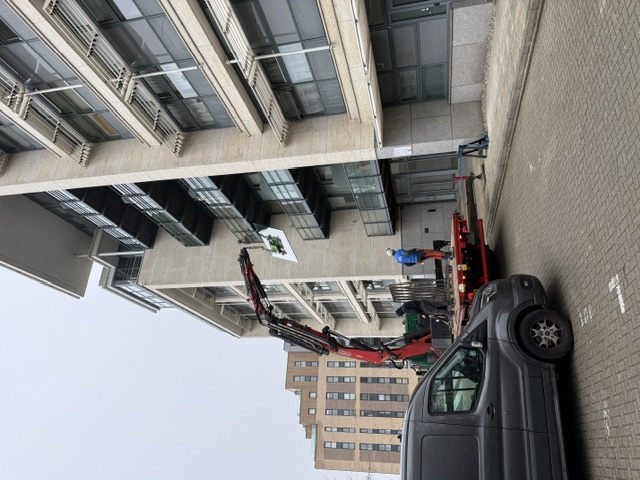
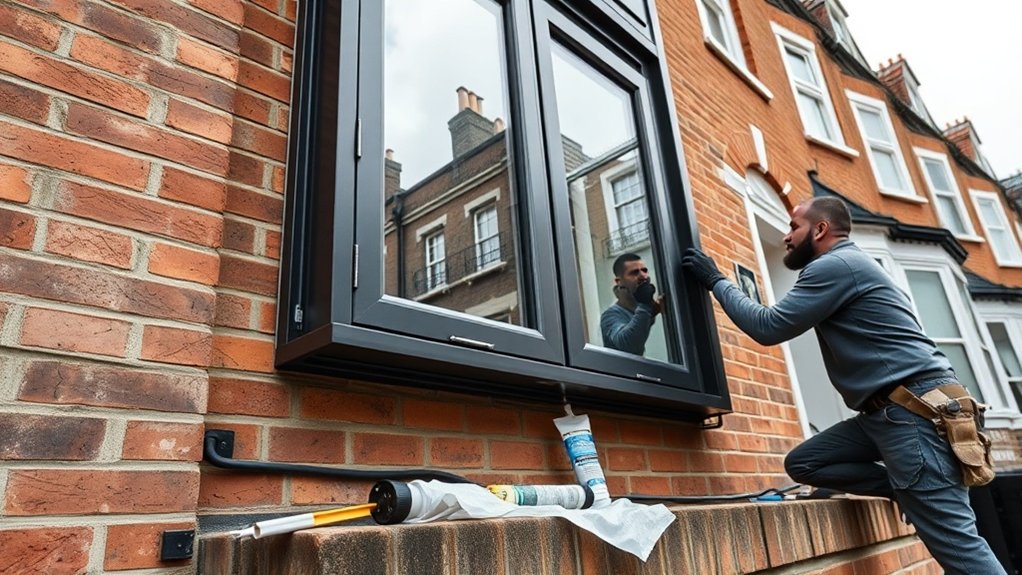
Aluminium window installation in London gives you slim, durable frames that cope with pollution, noise, and tight urban spaces while boosting security and thermal performance. You’ll need compliant systems with thermal breaks, low‑E double or triple glazing, and acoustic upgrades to suit your street’s microclimate. In conservation areas you must match sightlines and finishes to satisfy planning rules. Choosing accredited installers guarantees correct detailing, drainage, and airtightness, and there’s more to know to optimise your project.
Key insights
- Choose an installer with proven London experience, relevant accreditations, and strong references, especially for conservation areas, high‑rises, or complex access conditions.
- Specify thermally broken aluminium frames with low‑E double or triple glazing, argon fill, and proper seals to meet Part L energy and acoustic requirements.
- Confirm compliance with London planning rules, including heritage or conservation constraints, sightline expectations, and colour requirements before fabrication.
- Ensure the quote itemises survey, design, fabrication, access (scaffolding or towers), installation, waste removal, and certification, with clear lead times.
- Require documented installation methods, airtightness and drainage detailing, security hardware (multi‑point locks, laminated glass), and an aftercare/maintenance schedule.
Is Aluminium Window Installation Right For London Homes?
Although aluminium windows suit many London properties, you should assess their performance, aesthetics, and cost against your home’s specific requirements before committing. You’ll need to align frame profiles, glazing specifications, and opening mechanisms with London’s microclimates, street noise , and security expectations.
Start by mapping thermal performance and air‑tightness to your existing envelope, especially in historical architecture where you may integrate slimline aluminium within preserved façades. Evaluate how frame sightlines influence daylight penetration, views, and interior design schemes driven by minimalism or industrial aesthetics.
You should also consider planning constraints, access logistics on tight streets, and compatibility with smart‑home systems. When these variables align, aluminium becomes a future‑ready envelope component , delivering precision, durability, and design flexibility tailored to London’s dense urban context.
Pros And Cons Of Aluminium Windows In London
As you weigh aluminium windows for your London property, you need to balance their high durability in polluted, high-traffic environments against their specific performance limits. You’ll also want to assess how frame profiles, thermal breaks, and glazing options affect insulation, ongoing maintenance requirements, upfront cost, and lifecycle value . By examining these factors systematically, you can specify a window solution that meets your budget while optimising comfort, efficiency, and long-term lifespan.
Durability In Urban Environments
While London’s architectural landscape demands visual appeal, its pollution, traffic vibration, and variable weather make durability a critical performance factor for windows, and aluminium frames perform strongly under these pressures with a few caveats to take into account. You gain robust weather resistance, structural stability, and long service life, provided you specify the right system and finish for your micro‑location.
- Corrosion control – Marine-grade or powder-coated aluminium resists urban pollutants and acid rain, minimising surface degradation.
- Structural rigidity – Slim yet strong profiles tolerate wind loads and rail or road vibration without frame distortion.
- Surface longevity – High-quality coatings lock in aesthetic appeal, limiting chalking, fading, and pitting.
- Maintenance strategy – Scheduled cleaning, drain-hole checks, and prompt gasket replacement prevent accelerated wear in dense, high-traffic districts.
Thermal Efficiency And Insulation
Because London’s energy costs and Part L requirements keep tightening, you need to look at aluminium windows through a thermal‑performance lens as much as a design one. Raw aluminium conducts heat, but modern systems counter this with polyamide thermal breaks, multi‑chambered profiles, and advanced gaskets to deliver high thermal insulation and airtightness.
You’ll typically pair these frames with low‑E double or triple glazing, warm‑edge spacers, and argon or krypton gas fill to reduce U‑values and improve energy conservation. Specify systems with tested whole-window U‑values, not just glass figures, and guarantee installation detailing eliminates cold bridges at heads, jambs, and cills.
A limitation is that poorly specified or legacy aluminium frames can underperform, undermining your overall building fabric strategy.
Maintenance, Cost, And Lifespan
Three practical questions usually drive aluminium window choices in London: how much they cost up front, what they’ll need in upkeep, and how long they’ll last under urban conditions. You’ll typically pay more than for uPVC, but less than for high-end timber or composite, while gaining longer service life and slimmer, high-glazing-area frames.
- Maintenance – Minimal: periodic Cleaning techniques with neutral detergent, hinge lubrication, gasket inspection, and basic paint maintenance for powder-coated surfaces.
- Cost – Higher initial outlay, but reduced repainting, repair, and replacement cycles.
- Lifespan – 30–45+ years if you manage drainage slots, seals, and surface protection.
- Urban resilience – Aluminium resists moisture, UV, and pollutants better than timber, but poor installation or neglected seals can increase condensation and reduce longevity.
London Building Rules For Aluminium Window Installation
When you install aluminium windows in London, you must align the design and placement with local planning rules, especially in conservation areas and listed buildings. You also need to guarantee full Building Regulations compliance, covering thermal performance, ventilation, fire safety, and structural stability. In addition, you must select and specify glazing that meets safety standards for impact resistance , critical locations, and secure installation.
Relevant London Planning Rules
Although aluminium window systems are governed primarily by national Building Regulations, in London you must also navigate local planning controls, conservation policies, and sometimes estate-specific design codes before you install or replace units. You’ll coordinate performance-led aluminium design with constraints around historical architecture, street character, and aesthetic integration.
- Conservation areas: Local planners may require slim profiles, traditional sightlines, and specific RAL colours to respect established facades.
- Listed buildings: You’ll often need full planning and listed building consent, supported by detailed heritage and glazing-impact statements.
- Article 4 Directions: These can remove permitted development rights, so even like-for-like aluminium replacements may need consent.
- Estate and borough design codes: Housing estates, masterplans, or SPDs can dictate frame proportions, opening types, and visible hardware.
Building Regulations Compliance
Precisely how do you guarantee new aluminium windows in London satisfy Building Regulations as well as local planning demands? You start by aligning your specification with Parts L and F of the Building Regulations, validating whole‑window U‑values, thermal breaks, and airtightness against official SAP or PHPP calculations. You then integrate trickle‑vent strategies and controllable openings sized from room volume and usage.
Next, you reconcile compliance with aluminium aesthetics and historical preservation. In conservation areas or listed buildings, you mirror original sightlines, glazing bar patterns, and frame depths, while documenting equivalence in performance and appearance for planners. You also verify installation detailing: insulated cavity closers, damp‑proof integration, and tolerances that prevent cold bridging. Finally, you retain evidence: compliance certificates , calculations, and as‑built drawings.
Glazing Safety Standards
Even before you choose a frame colour or opening style, you have to design aluminium glazing around London’s safety‑critical rules in Building Regulations Part K and related standards such as BS 6262 and BS EN 12150. You’re not just picking glass; you’re engineering an impact‑resistant , shatter‑controlled surface that protects occupants and passers‑by.
- Critical locations: Specify safety glass in doors, side‑lights, low‑level panes, and guarding zones to meet Part K impact criteria.
- Glass type selection : Use toughened or laminated glazing, sized and supported to satisfy BS 6262 and wind‑load calculations.
- Edge protection: Detail setting blocks, gaskets, and bead profiles to prevent edge damage that could trigger failure.
- Performance layering: Combine safety glazing with Glass privacy films or spectrally selective window tinting without compromising compliance.
Choosing Aluminium Window Styles And Glazing
When you choose aluminium window styles and glazing, you’re defining both the performance and appearance of the entire installation, so each decision needs a clear technical rationale. You start by aligning opening types—casement, tilt-and-turn, or sliding —with ventilation strategy, access requirements, and structural constraints.
Next, you assess Glass options by light transmission, solar control, and safety classification, then match pane thickness to wind loads and pane size. You’ll also decide sightline priorities: ultra-slim profiles maximise glass area, while chunkier sections accommodate larger spans and integrated hardware.
Finally, specify Frame finishes: powder-coated RAL colours, dual-colour configurations, or anodised treatments. Each impacts durability, maintenance cycles, and visual integration with London brickwork, curtain walling, or internal design schemes.
Energy Efficiency And Noise Reduction In London Homes
Although aluminium windows are often praised for their strength and aesthetics, their real value in London homes comes from how precisely you engineer them for thermal performance and acoustic control. You’re balancing dense traffic noise , strict regulations, historical architecture, and evolving aesthetic preferences, so every specification matters.
- Thermal breaks and frame design – Specify polyamide thermal breaks, multi‑chamber profiles , and low-conductivity spacers to cut heat loss and condensation risk.
- High-performance glazing – Use low‑E coatings , argon-filled double or triple glazing, and optimized solar-gain factors for London’s variable climate.
- Airtightness and installation – Detail perimeter sealing , compressible tapes, and precision shimming to eliminate thermal bypass and sound leaks.
- Acoustic optimization – Combine asymmetric laminate panes, varied cavity depths, and decoupled frames to target specific urban noise frequencies.
Essential Security Features For Aluminium Windows
Why does aluminium lend itself so well to secure window design in London’s risk‑aware housing stock? Its high strength‑to‑weight ratio supports advanced security enhancements without bulky frames. You can specify multi‑chambered profiles that resist prying forces and integrate continuous reinforcement around the sash perimeter.
Focus on certified locking mechanisms. Multi‑point espagnolette or shoot‑bolt systems engage on all sides of the sash, distributing load and preventing flex‑based attacks. Pair these with internal glazing beads, so glass can’t be removed from outside, and laminated security glass that remains bonded even when cracked.
Consider hinge‑side protection: security hinges and anti‑jemmy pins stop the sash being levered off. Finally, include key‑lockable handles and restricted‑opening devices to balance security with safe ventilation.
Choosing A Reliable Aluminium Window Installer
Selecting a reliable aluminium window installer in London directly determines how well your chosen system performs, how long it lasts, and whether it actually meets security and thermal specifications on site. You’re not just buying products; you’re choosing a technical partner who understands advanced systems, window frame materials, and high-performance installation techniques.
- Assess technical accreditation and project-specific experience with aluminium systems, not just generic glazing.
- Request detailed surveys that capture structural openings , tolerances, drainage strategy, and interface with surrounding trades.
- Examine how they propose to handle thermal breaks, airtightness layers, and fixing patterns relative to the substrate.
- Demand fully documented processes: method statements, quality checks, photographic installation records, and compliance certificates.
This approach guarantees your innovative design translates into robust, verifiable performance.
Installation Costs, Timelines, And Aftercare In London
When you budget and programme aluminium window installation in London, you need clear cost structures , realistic lead times, and defined aftercare so the system performs as specified over its full service life.
You’ll usually see costs itemised by aperture : survey, design, window frame material, fabrication, access, installation, and commissioning. Custom colour options, acoustic glazing, and smart locking add premiums but can reduce lifecycle costs through durability and performance.
Lead times typically range from 4–10 weeks, driven by profile availability, powder-coating queues, and site constraints. Lock your programme only after you’ve approved shop drawings.
Robust aftercare should include written maintenance schedules, hardware adjustment visits, drainage checks, and sealant inspections, plus documented warranties for coatings, glass units, and operating gear.
Frequently Asked Questions
How Do Aluminium Windows Compare to uPVC and Timber for Long-Term Maintenance?
You’ll find aluminium windows demand less long-term maintenance than timber and often outperform uPVC in durability. They won’t warp, rot, or need repainting, and powder-coated finishes stay stable for decades. With thermal breaks, they now rival uPVC for energy efficiency. In a cost comparison, upfront prices are higher than uPVC but lower lifecycle costs beat both uPVC and timber, especially when you prioritise design precision and innovative performance.
Can Aluminium Window Frames Be Colour-Matched to Existing Interior Décor?
Yes, you can precisely color‑match aluminium window frames to your existing interior décor. You’ll use powder-coated finishes with RAL or bespoke shades, enabling accurate color matching and advanced interior coordination. Specify gloss level , texture, and dual-colour profiles to align frames with wall finishes, trims, or furniture. For innovative schemes, you can integrate metallics, anodised tones, or ultra-matte surfaces, ensuring technical performance without compromising your design vision.
What Warranty Should I Expect on Aluminium Frames, Glass, and Hardware?
You should expect 10–25 years Warranty coverage on aluminium frames, 5–10 years on glass units, and 5–10 years on hardware—because, ironically, innovation’s only exciting if it actually lasts. Look for written Material guarantees against frame corrosion, powder-coat failure, and glass seal breakdown, plus defined tolerances for hardware wear, locking performance, and weather-tightness. Insist on transferable warranties, clear exclusions, and documented maintenance requirements to keep every clause fully enforceable.
How Should I Clean and Care for Aluminium Windows to Prevent Corrosion?
You clean and care for aluminium windows using non-abrasive Cleaning techniques: rinse with lukewarm water, apply pH‑neutral detergent, then microfiber-wipe frames and glass. For corrosion prevention, avoid alkaline cleaners, wire wool, and strong solvents that strip protective coatings. Rinse salt, dust, and pollutants quarterly; increase frequency in coastal or urban sites. Inspect drainage slots , seals, and joints, clearing debris to prevent water retention and galvanic corrosion at fixings.
Are Aluminium Windows Suitable for Period or Listed Buildings in London?
Yes, you can use aluminium windows in period or listed buildings, but only with precision. Around 38% of UK listed consents now involve contemporary materials, provided Historical accuracy and architectural compatibility are proven. You’d specify ultra-slim thermally broken profiles, putty-line sightlines, and bespoke glazing bars, then colour‑match heritage palettes. Always pair 1:1 section drawings with heritage statements to convince conservation officers the visual impact remains authentically period.
Summary
When you weigh regulations, performance, and design, aluminium window installation in London becomes a highly engineered upgrade, not just a cosmetic change. By choosing the right profile, glazing, security hardware, and certified installer, you’ll solve thermal, acoustic, and safety challenges in one coordinated system. Specify carefully, compare like‑for‑like quotes, and insist on standards compliance, and your new aluminium windows will feel so efficient they could practically power the Tube.