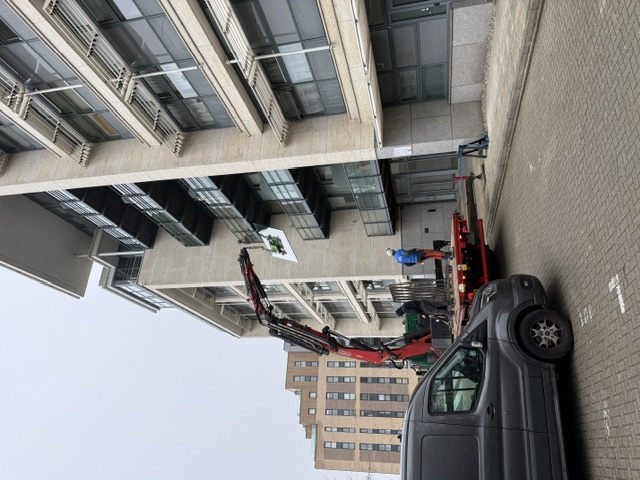
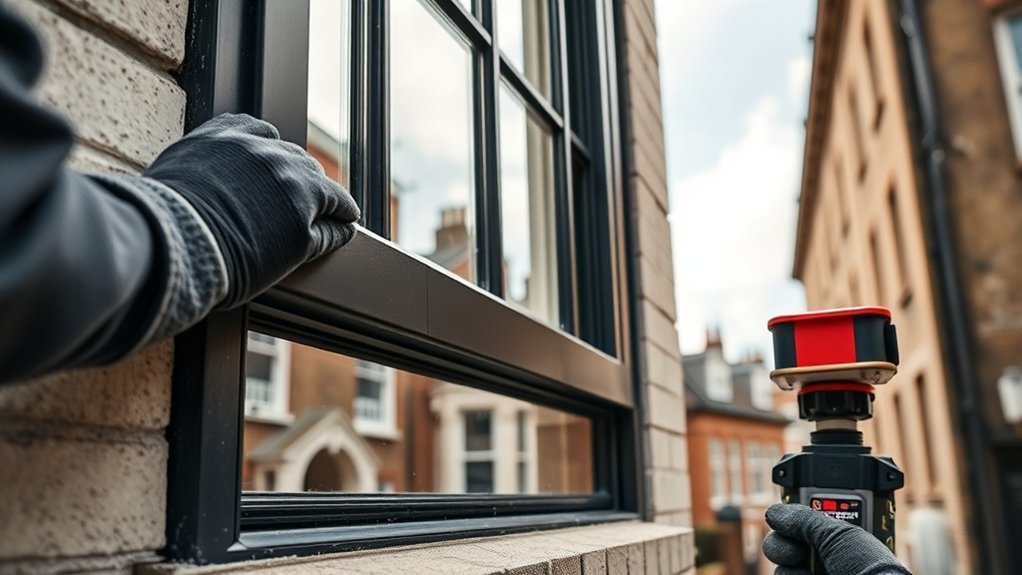
You’re not just fitting new steel windows in London; you’re coordinating surveys, conservation approvals, thermally broken profiles and high‑performance glazing to hit strict U‑values, Part L and Part Q. A good specialist reverse‑engineers existing sightlines for heritage areas, manages drainage and thermal breaks at head/jamb/cill, and sequences removal, fixing and sealing to protect old brickwork. You’ll also need itemised quotes, clear lead‑times and crane/logistics planning, which we’ll unpack in more detail next.
Key insights
- Choose thermally broken, galvanised and powder-coated steel windows for London’s damp, polluted climate and to meet current energy-efficiency standards.
- Confirm installers are London-based specialists experienced with conservation areas, listed buildings and local planning requirements for steel window replacements.
- Check that proposed systems support high‑performance double glazing, acoustic laminated glass and secure multi‑point locking to suit urban noise and security needs.
- Ensure the installer provides detailed drawings, section profiles, and like‑for‑like sightlines where heritage approval or sensitive façades are involved.
- Compare quotes on full scope: surveys, fabrication, finishes, installation, fire and building regulation compliance, and lead times for custom steel windows.
Steel Windows in London: When They’re the Right Choice
Whether you’re refurbishing a period townhouse or fitting out a contemporary commercial unit, steel windows are often the right choice when you need maximum structural strength in a minimal frame profile. You’re dealing with slender sightlines , high load capacity, and excellent resistance to torsion, which lets you integrate larger glazed areas without compromising stability.
In London, you’ll often specify steel when Historical preservation constraints demand authentic profiles , putty-line detailing, or true divided lights. You can match existing mullion and transom geometry while upgrading to modern thermal break systems and low‑E units. For aesthetic customization, you can exploit precision fabrication: non-standard radii, curved heads, or complex fenestration grids, combined with advanced powder-coat systems, metallic finishes, and integrated hardware for secure, high-performance assemblies.
Steel Windows vs Other Frame Materials for London Homes
When you compare steel windows with uPVC, timber, or aluminium frames for London homes, you need to assess how each material performs under constant moisture, airborne pollutants, and thermal cycling. You’ll look at corrosion resistance, frame stability, and maintenance intervals alongside U-values, thermal breaks, and glazing specifications . By weighing durability in an urban climate against energy efficiency and insulation performance, you can specify a frame system that meets both regulatory and long-term operational requirements.
Durability In Urban Climate
Although steel windows are often chosen for their aesthetics, their real advantage in London’s urban climate is structural durability under constant exposure to moisture, pollution, and temperature fluctuation. You’re dealing with acidic rain, particulate deposits from traffic, and persistent condensation driven by dense streetscapes and urban greenery.
High-grade steel sections, properly hot-dip galvanised and factory powder-coated, resist pitting and frame distortion far better than timber or standard uPVC. Joints stay tight, welds remain stable, and hardware anchorage points don’t loosen under cyclical loading from sash movement and wind pressure.
For historical preservation projects, you can specify ultra-slender steel profiles that replicate original sightlines without compromising structural performance, giving you long design life, reduced maintenance cycles, and dependable dimensional stability across decades.
Energy Efficiency And Insulation
Durability only pays off if the window also performs thermally in London’s mixed, often damp climate, so you need to look closely at how steel frames compare with timber, aluminium, and uPVC for energy efficiency. Modern thermally broken steel systems minimise conductive heat loss while keeping profiles ultra‑slim, so you retain window aesthetics without sacrificing U‑values.
You should assess:
- Thermal breaks – polyamide or resin barriers in steel outperform cold-bridge aluminium and rival advanced uPVC.
- Glazing capacity – steel accommodates high-spec double or triple glazing, low-e coatings, and warm-edge spacers.
- Airtightness – precision-engineered gaskets and multi-point locking cut infiltration in windy London exposures.
- Heritage compliance – steel lets you upgrade performance during historical restoration while matching original sightlines.
Planning Permission and Conservation Areas for Steel Windows
Properly handling planning permission is critical before you specify or install steel windows in London, especially in conservation areas or listed buildings. You must satisfy historical preservation requirements while still achieving contemporary performance and aesthetic appeal. Planning officers will scrutinise sightline thickness , glazing bar profiles, opening configurations, and external colour to guarantee the steel system respects the original façade rhythm.
You’ll need scaled elevation drawings, section details, and material specifications that reference relevant British Standards and local design guidance. For listed buildings, you often must evidence “like-for-like” replacement or clearly justify any deviation with technical benefits such as improved thermal performance or security. Engage the conservation officer early, present sample sections, and confirm whether Article 4 Directions restrict standard permitted development rights.
Steel Window Costs, Quotes and Timelines in London
Once you move from concept to specification, you need to treat steel window costs, quotations, and programme in London as tightly controlled variables, not rough estimates. You’re balancing structural performance, historical preservation requirements, and aesthetic appeal against budget and delivery.
Key cost drivers you should interrogate are:
- Section profile and glazing spec – thermal performance, acoustic rating, and coating systems.
- Opening types and ironmongery – impacts fabrication complexity and installation labour.
- Site access and sequencing – craneage, out-of-hours work, interface with other trades.
- Compliance documentation – conservation reports, CAD/BIM coordination, testing data.
For quotes, insist on itemised pricing, confirmed lead times, and written programme milestones from survey to commissioning. In London, allow realistic float for approvals, bespoke fabrication slots, and logistics constraints.
Steel Window Styles for Different London Property Types
With costs, lead times , and specifications under control, you next need to select steel window styles that suit the fabric, age, and planning status of the London property you’re working on. For Victorian and Edwardian terraces, you’ll typically align with slim, multi-pane configurations that reference original sash proportions, supporting historical preservation while upgrading performance.
For mansion blocks and warehouse conversions, you can push bolder industrial grids, maximising glass area and aesthetic appeal without compromising rigidity. Post‑war estates often suit simplified module-based layouts that streamline manufacture and installation.
Prime contemporary schemes usually demand ultra-slim thermally broken profiles, large formats, and minimal transoms, coordinating with cladding and façade lines. Throughout, you should map style decisions to elevation rhythm, brick coursing, and structural opening tolerances.
Choosing Styles, Sightlines and Opening Types
When you plan steel windows for a London property, you need to balance natural light and privacy while deciding where fixed panes are appropriate and where you require opening lights for ventilation and access. You’ll assess frame proportions and sightlines in millimetres, ensuring mullion and transom thicknesses don’t compromise performance, safety, or aesthetics. At this stage, you’re effectively setting out the operable versus non‑operable layout, hinge positions, and clear openings in relation to both building regulations and the architectural grid.
Balancing Light And Privacy
Although steel windows excel at maximising glazed area, you still need to control how much light and visibility you introduce into each room, and that starts with selecting the right frame profiles, sightlines and opening configurations. You’re not just choosing a look; you’re engineering Light control and Privacy solutions that respond to orientation, neighbouring buildings, and internal layout.
Consider:
- Specify slimmer mullions where you want deep daylight penetration; increase transom frequency to break down direct views.
- Use varied sightlines—taller lower rails or raised sill heights—to protect seating and work zones from overlooking.
- Combine clear and obscure glazing bands to admit zenithal light while blocking direct eye-level sightlines.
- Integrate vent sections with restricted apertures, so you maintain airflow without compromising privacy.
Fixed Versus Opening Panels
Before you lock in steel window dimensions , you need to decide where panels stay fixed and where they open, because that choice drives frame depth, hinge and locking hardware, maintenance access, and long‑term usability. Fixed panels let you minimise steel sections, maximise glass area, and simplify weather‑sealing, particularly useful on exposed London elevations or high-rise schemes.
Opening panels demand tighter tolerances: you’ll factor weight of double or triple glazing, hinge geometry, restrictors, and security-rated locking points. You’ll also coordinate trickle vents and smoke or purge ventilation requirements. For heritage refurbishments, you can combine fixed panes with slim top-hung or side‑hung vents to retain historical authenticity, while specifying contemporary decorative finishes that differentiate new steel from original fabric without compromising sightlines.
Frame Proportions And Sightlines
Because steel windows are fundamentally a matrix of frame depth , bar thickness, and opening type, getting frame proportions and sightlines right starts with setting clear visual and performance priorities for each elevation. You’re balancing light transmission, structural rigidity, thermal continuity, and interior acoustics, while maintaining precise aesthetic integration with surrounding finishes and facade modules.
Use this decision sequence:
- Define mullion and transom centres to align with structural grids, cabinetry, and partition lines.
- Select bar thickness to control perceived slenderness without compromising wind load or deflection criteria.
- Coordinate opening types so vent frames sit within dominant sightlines, not across them.
- Adjust frame depth to house glazing, blinds, and acoustic interlayers, ensuring flush junctions with internal linings and minimal shadow gaps.
Glazing, Thermal Efficiency and Noise Control Options
How do you specify steel window glazing in London so you meet Part L and Part O while still delivering slim sightlines and occupant comfort? You start by pairing thermally broken steel profiles with high‑performance double glazing, typically low‑E, argon-filled units targeting whole-window U-values of 1.4 W/m²K or better. Tune g-values to prevent summer overheating on exposed elevations.
You then layer in noise control. Assess existing dB levels and select soundproofing options accordingly: laminated acoustic panes, asymmetric buildups (e.g. 8.8/14/6), and warm-edge spacers to minimise resonance. For façades near rail or main roads, consider triple glazing only where frame depth and weight limits allow. Always coordinate cavity width, spacer type, and edge detailing to avoid thermal bridges and ensure condensation control.
Security, Fire Safety and Steel Window Regulations
Although aesthetics often drive the specification of steel windows in London, you still have to treat security, fire performance, and regulatory compliance as primary design constraints from RIBA Stage 2 onwards. You’re balancing Part Q, Part B, and local conservation guidance with Historical preservation and Aesthetic appeal, so you can’t treat these as bolt‑on issues.
You should rigorously coordinate:
- Enhanced security: PAS 24-rated steel frames, multi-point locking, laminated security glass, attack-resistant hinges.
- Fire strategy: EI-rated steel fire windows, intumescent seals, tested interfaces to surrounding construction.
- Egress and compartmentation: compliant opening sizes, smoke control considerations, aligned with the fire engineer’s report.
- Planning and heritage: profiles, sightlines, and glazing types pre-agreed with conservation officers to protect significance while delivering contemporary performance.
How Steel Window Installation Works on London Homes
Once you’ve locked down security , fire performance, and planning constraints, the actual installation sequence on a London home follows a tightly controlled process that protects both the building fabric and the new steel units. You start with a measured survey, checking structural reveals, damp-proof details, and any Historical preservation constraints. Next, you de-glaze or remove old frames, using controlled cutting to avoid disturbing adjacent brickwork or stucco.
You then install stainless or galvanized fixings into sound substrate, allowing for packers and thermal breaks. Frames are plumbed, squared, and temporarily braced before final anchoring. Perimeter gaps get sealed with compatible compressible tapes and low-modulus sealants, ensuring airtightness and drainage. Finally, you glaze, commission ironmongery, and verify aesthetic integration from street and interior views.
Installing Steel Windows on Tight Urban Sites
Why do London’s tight urban sites demand a different mindset for steel window installation? You’re working with minimal access, strict logistics, and sensitive façades, so every operation must be pre-engineered. You can’t rely on oversized machinery or generous laydown space; you’ve got to stage materials, labour, and traffic management with almost millimetric control.
To make tight sites work, you typically:
- Model access routes and lift paths in 3D, integrating cranes, hoists, and scaffold interfaces.
- Pre-glaze and pre-pack frames off-site to cut on-street assembly time and disruption.
- Use compact, low-vibration fixing systems to protect brickwork crucial for Historical preservation.
- Align sightlines, frame depths, and junction details with surrounding Urban aesthetics while meeting thermal and acoustic performance targets.
Choosing a Steel Window Specialist in London
When you choose a steel window specialist in London, you can’t treat it as a generic glazing contract; you need to verify professional credentials , manufacturer approvals, and compliance with BS and Part L requirements. You should also assess their design expertise, including section profiling, thermal break specification, and detailing around existing substrates and interfaces. Finally, you’ll compare quotes and timelines not just on headline cost, but on scope, lead times, access solutions, and aftercare provisions.
Assessing Specialist Credentials
How do you verify that a steel window specialist in London has the right technical competence, trade backing, and legal standing for your project? You start by checking whether their credentials align with your building’s regulatory context, Historical preservation constraints , and aesthetic considerations.
Look for:
- Formal qualifications & CPD – Evidence of manufacturer training on steel systems, CSCS cards, and ongoing technical upskilling in thermal, acoustic, and security performance.
- Trade memberships – FENSA, Certass, or GGF accreditation , plus association with heritage or conservation bodies where relevant.
- Compliance documentation – Public liability and professional indemnity insurance, RAMS, and a track record of Part L and Part K compliance.
- Verified project history – Case studies with site addresses, structural details, and references confirming tolerance control, corrosion protection, and installation quality.
Evaluating Design Expertise
Even with a fully qualified installer, you still need to interrogate their design capability, because steel windows are as much a precision-engineered façade element as a simple opening light. You’re not just buying sections and glass; you’re buying design intelligence.
Ask to see resolved details : head, jamb, and cill junctions, drainage strategy, and thermal break alignment. Check how they handle sightline continuity across multiple bays, corner conditions, and interface with structure and finishes.
Probe their experience with Historical preservation: can they reverse‑engineer existing profiles and replicate glazing bar geometry while upgrading performance? For contemporary schemes, test their approach to aesthetic integration with cladding, shading, and interior joinery. A capable specialist will produce coordinated drawings , ironmongery schedules, and compliant glazing specifications.
Comparing Quotes And Timelines
Once you’ve confirmed a contractor’s design competence, you need to subject their quote and programme to the same level of scrutiny. Don’t just compare bottom-line numbers; interrogate what’s specified, sequenced, and excluded. Steel aesthetics and material sourcing directly affect cost, lead-in, and installation risk.
Evaluate each proposal against:
- Specification detail – Section sizes, glazing build-ups, coatings, hardware; confirm they align with performance targets, not cheaper substitutes.
- Material sourcing – Origin of steel profiles, certification, and supply-chain resilience; ask for lead-time guarantees.
- Programme logic – Survey, shop drawings, fabrication, and site installation durations; check dependencies with other trades.
- Risk and contingency – Access, temporary works, tolerances to existing openings, and allowances for design coordination.
Choose the quote with the best-engineered methodology, not just the lowest price.
Frequently Asked Questions
How Do Steel Windows Perform in London’s Coastal or Riverside Environments?
You get robust performance if you specify the right system. In coastal or riverside environments, you combat marine corrosion with hot-dip galvanised steel , zinc-rich primers, and high-build powder coatings. You detail drained and ventilated glazing rebates, isolate dissimilar metals, and use austenitic stainless steel fixings. You enhance coastal durability with factory-sealed joints, EPDM gaskets, and scheduled maintenance inspections, ensuring long lifecycle performance even in aggressive chloride-laden atmospheres.
Can Steel Windows Be Integrated With Smart Home Automation Systems?
Yes, you can integrate steel windows with smart home automation systems. Want precise environmental control and security feedback from your glazing? You’ll specify motorised actuators , magnetic contacts, and compatible low-voltage wiring to enable full automation integration. Tie these into KNX, Zigbee, Z‑Wave, or IP-based controllers for centralised control, scheduling, and remote diagnostics. Guarantee hardware is rated for duty cycles, load, and weather exposure to maintain long-term performance.
Are There Eco-Friendly or Recycled Steel Options for Window Frames?
You can specify window frames fabricated from recycled steel sourced via certified scrap streams, often exceeding 60–90% recycled content. You’ll want suppliers using eco friendly manufacturing , such as EAF (electric arc furnace) steelmaking, closed-loop water systems, and low-VOC finishing. Verify Environmental Product Declarations and ISO 14001 compliance. You can also integrate thermal breaks, powder-coated finishes, and modular profiles to optimize embodied carbon while maintaining structural integrity and slim sightlines.
How Do Steel Windows Impact Indoor Air Quality or Condensation Levels?
Steel windows influence indoor air quality and condensation management through their thermal performance and airtightness. When you specify thermally broken profiles and high‑performance glazing, you stabilize interior surface temperatures, reducing cold bridges and moisture load on interior finishes. Proper gasket systems, trickle vents, and integrated drainage channels let you control vapor pressure and purge indoor pollutants. If you pair frames with balanced MVHR , you’ll maintain low RH, minimal condensation, and cleaner indoor air.
What Maintenance Is Required to Prevent Rust on London Steel Windows?
You prevent rust by treating steel like a precision component, not décor. For effective rust prevention, inspect frames quarterly, clean with pH-neutral detergent, then dry thoroughly. Touch up any coating breaks with zinc-rich primer and compatible topcoat. Lubricate hinges and drainage paths so water can’t sit. Consider micro-porous, powder-coated systems for advanced protection. These maintenance tips extend service life and preserve thermal performance in demanding urban environments.
Summary
You might worry steel windows will feel too “commercial” for a London home, but once installed, you’ll see slim, thermally-broken profiles framing the skyline like precision-drawn sections. Glazing beads, drainage paths, and gaskets disappear into the sightlines, while powder-coated finishes sit tight against brick reveals. Hardware closes with a solid, engineered click. From first survey to final mastic seal, you’re not just upgrading windows—you’re commissioning a finely detailed steel façade system.