
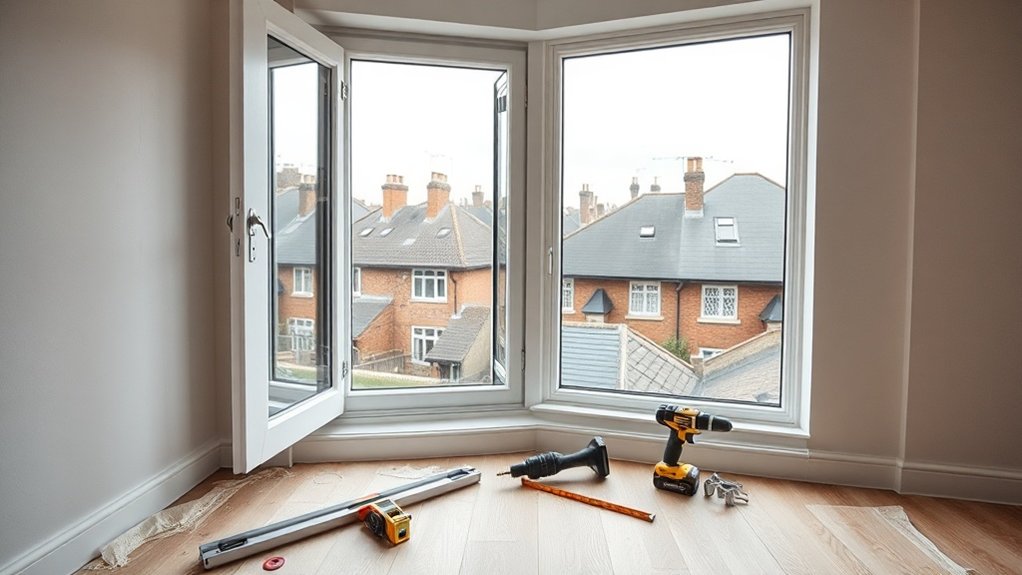
Tilt and turn window installation in London lets you maximise airtightness, security, and controlled ventilation in tight urban spaces. You get inward-opening sashes for safe cleaning, secure night ventilation, and excellent acoustic and thermal performance that meets London’s strict building, planning, and noise standards. Correct surveying, frame choice (uPVC, aluminium, or timber), and precision fixing and sealing are critical to avoid draughts, distortion, and leaks. Next, you’ll see how to design, measure, and install them properly.
Key insights
- Choose installers experienced with tilt & turn hardware and London regulations, including Part L (energy), Part F (ventilation), acoustic, and fire-escape requirements.
- Ensure a detailed survey records opening sizes, diagonals, reveal depths, and cill falls to guarantee airtightness, drainage, and correct operation.
- Select appropriate frames (uPVC, thermally broken aluminium, timber, or hybrid) and glazing (double/triple, low‑E, acoustic) for London’s climate and noise levels.
- Confirm secure ventilation options: tilt‑only night vents, lockable handles, and multi‑point locking to suit upper floors and urban security concerns.
- Verify installation includes proper sealing, packers, fixings, and commissioning of tilt and turn functions, plus documented warranties and FENSA/Certass certification.
What Are Tilt and Turn Windows and How Do They Work?
Although they look like conventional casement units, tilt and turn windows use a dual‑action hinge mechanism that lets the sash either tilt inwards from the top for secure ventilation or swing fully inwards from the side for maximum opening and easy cleaning. You control both positions with a single multi‑point handle : turn it 90° for tilt, 180° for full inward swing.
Internally, concealed steel gearing locks the sash around the perimeter, improving security and air‑tightness. You can specify window frame materials such as thermally broken aluminium, uPVC, or composite profiles to optimise structural rigidity, insulation, and sightlines. Pair these with selective glass tinting, low‑E coatings , and warm‑edge spacers so you actively manage solar gain, glare, and U‑values while maintaining slim, modern aesthetics.
Why Tilt and Turn Windows Suit London Homes and Flats
When you assess window options for a London home or flat, tilt and turn systems let you optimise limited internal space, control airflow precisely, and address urban safety constraints in one integrated unit. Their tilt function supports secure background ventilation even on higher floors or busy streets, while the turn position delivers full, controllable openings for rapid air exchange and easy cleaning. By combining compact operation with robust locking hardware and modern glazing, you solve practical issues around space, ventilation, and security common in dense London settings.
Space-Saving Window Design
How can you maximise light, ventilation, and usable floor area in a compact London flat without redesigning the entire room layout? Tilt and turn windows use a dual-action mechanism that opens inward in two calibrated modes, so you eliminate the swing clearance required by outward casements or traditional sashes. This frees wall space for storage, radiators, or furniture while preserving alignment with surrounding historical architecture and window aesthetics.
Because the sash seals against the frame on all sides, you can specify slimmer profiles, increasing glass-to-frame ratio and daylight penetration. In narrow streets, inward operation avoids clashing with balconies, railings, or neighbouring façades, making planning discussions easier and sightlines cleaner. You effectively expand functional floor area without altering the building envelope.
Improved Ventilation Control
Because air quality and thermal comfort in London homes can change rapidly across the day, tilt and turn windows give you unusually fine control over ventilation through their dual operating modes and continuous gasket seals. In tilt mode, the sash opens at the top, creating a controlled upper vent that drives buoyancy-led air exchange while minimising draughts at occupant level. You can maintain CO₂ and humidity targets ideal for indoor plants and sensitive finishes.
Turn mode lets you purge a room quickly, useful after cooking or during summer peaks. Multi-point locking hardware allows you to fix precise opening angles, balancing airflow with energy efficiency and noise constraints, while slim-line frames preserve window aesthetics and maximise free area for effective natural ventilation.
Enhanced Urban Safety
Amid London’s dense streetscapes and mixed-use neighbourhoods, tilt and turn windows address security and safety risks that traditional casements struggle to manage. You gain a multi-point locking system integrated into a robust sash and frame, resisting forced entry from busy streets or accessible roofs. The tilt mode allows secure night-time ventilation without creating a climbable opening, essential for ground-floor flats and child safety.
Internally, the turn function delivers a full, unobstructed escape route compliant with modern fire egress strategies. You can also clean exterior panes safely from inside, avoiding risky ladder access in mid- and high-rise buildings. Slim, engineered profiles preserve window aesthetics while supporting laminated or toughened glazing, acoustic seals, and secure restrictors—ideal for urban greenery installations on balconies and Juliet fronts.
Tilt and Turn vs Sash and Casement: Which Is Best for London?
When you compare tilt and turn windows with traditional sash and casement units in London, you need to assess hard performance metrics: space efficiency, ventilation control, safety , acoustic attenuation, thermal insulation, and airtightness. You’ll also want to factor in maintenance and cleaning access, especially for upper-storey or street-facing elevations, as well as how each system’s sightlines and profiles work with your property’s architectural style. By weighing these technical criteria against your flat or house’s specific constraints, you can identify which window type offers the most practical and long-term value.
Space, Ventilation And Safety
How do you balance floor space, airflow, and security in a dense city like London? Tilt & turn systems give you precise control. The inward-tilt setting creates secure micro-ventilation without projecting into the street or interfering with blinds, radiators, or furniture, protecting your usable floor area and indoor aesthetics. In full-turn mode, the sash opens inward for maximum purge ventilation and safe cleaning from inside.
Compared with sash windows, you don’t rely on partial lifts that compromise child safety or allow wider openings at low level. Versus outward-opening casements, tilt & turn avoids clashes with external walkways while enabling robust multi-point locking within the window framing. You achieve a compact, high-ventilation solution that meets modern security expectations in tight London footprints.
Noise, Draughts And Insulation
Because London’s noise, wind exposure, and energy costs are all intensifying, the way each window type seals and insulates matters as much as how it looks. Tilt and turn systems use continuous compression gaskets and multi-point locking , so when you close the sash, you create an airtight seal that outperforms typical sash and basic casement designs.
- Picture a tilt and turn unit with triple gaskets and argon-filled double glazing, cutting traffic noise on a main road flat.
- Imagine a corner property in Docklands where crosswinds hit; the dual-seal tilt position vents air without creating draughts.
- Visualise a minimalist façade where high-spec window aesthetics combine with concealed hinges engineered for hardware durability and long-term thermal performance.
Maintenance, Cleaning And Style
Curiously overlooked but critical in London’s dense urban fabric, maintenance, cleaning access, and visual compatibility with period or contemporary façades often decide whether tilt and turn, sash, or casement windows make sense for you. Tilt and turn hardware lets you clean external panes safely from inside, optimising cleaning routines in upper-storey flats where external access is constrained or costly.
You’ll typically specify low-maintenance uPVC or powder‑coated aluminium for tilt and turn systems, minimising repaint cycles versus timber sashes and casements. Multi-point locking and continuous seals reduce dirt ingress into rebates, cutting long‑term upkeep.
On window aesthetics, tilt and turn profiles deliver slim sightlines and large glazed areas, ideal for modern façades, while heritage-styled sashes or flush casements better respect conservation-led street elevations.
Key Design Features of Tilt and Turn Windows
Engineered with dual-function hardware and robust sash profiles, tilt and turn windows combine inward tilting for secure ventilation with full inward opening for maximum access, cleaning, and egress. You gain precise control through multi-point locking , compression seals, and carefully calibrated hinge geometry that stabilises large glazed areas without bulky frames, preserving window aesthetics even in historical architecture.
- Imagine a tall London terrace where slim-line frames create an uninterrupted glass plane, while hidden gearing controls both tilt and turn from a single, ergonomic handle.
- Visualise a corner installation where paired sashes open inward, forming a clear, walk-through aperture that simplifies maintenance and emergency egress.
- Picture a modern retrofit where unified sightlines align across façades, delivering a consistent visual rhythm from street level to rooftop.
Energy Efficiency Benefits of Tilt and Turn Windows in London’s Climate
When you install modern tilt and turn windows in London, you improve your home’s energy performance through enhanced thermal insulation that limits conductive and convective heat loss. This higher insulation value directly reduces heating demand, allowing your boiler or heat pump to run fewer hours and lowering your energy bills. At the same time, the tilt function lets you optimize seasonal ventilation, maintaining indoor air quality and comfort without unnecessary heat loss in winter or heat gain in summer.
Enhanced Thermal Insulation
How does a tilt and turn window help you stabilise indoor temperatures in London’s variable climate? You gain a tightly engineered envelope: multi‑chamber uPVC or thermally broken aluminium frames, deep glazing rebates, and advanced seals that limit conductive and convective heat transfer. This matters in historical architecture, where you must upgrade performance without compromising façades, and in contemporary interior design, where clean lines hide high-spec insulation.
- Visualise low-emissivity double or triple glazing creating a transparent thermal barrier, reflecting interior heat while admitting daylight.
- Picture continuous compression gaskets around the sash, eliminating micro-draughts and edge losses.
- Imagine insulated frames aligning perfectly with reveals, minimising thermal bridges and cold spots, so each room maintains a more consistent, precisely controlled temperature year-round.
Reduced Heating Costs
Because London’s heating season is long and unpredictable, a well‑specified tilt and turn window directly converts thermal performance into measurable savings on your gas or electric bills. By combining multi‑chambered frames , low‑emissivity glazing, and thermally broken spacers, you cut conductive and radiant heat loss at the building envelope.
You also stabilize internal temperatures, so your boiler or heat pump cycles less often, reducing peak demand and system wear. With smart home integration , you can link sensors and actuators to schedule closing at predefined temperature or tariff thresholds, dynamically optimising heat retention.
In historical architecture, bespoke tilt and turn profiles let you upgrade to modern U‑values while preserving sightlines, immediately lowering heating load without compromising façade character.
Optimized Seasonal Ventilation
Season by season, tilt and turn windows let you fine‑tune airflow so you gain fresh air without sacrificing hard‑won heat. You’re not just opening glass; you’re programming Seasonal airflow. In tilt mode , the sash creates a narrow, high‑level vent, extracting warm, stale air while cooler, denser air enters at controlled rates, protecting internal temperatures and indoor air quality.
- You angle the sash inward on a wet winter evening, watching condensation reduce as humid air escapes without a chilling draft.
- You swing the window fully open on a still summer morning, purging overnight heat in minutes.
- You align opening direction with prevailing winds, preserving Window aesthetics while shaping invisible air paths that lower reliance on mechanical cooling and heating.
Safety, Security, and Child-Safe Ventilation With Tilt and Turn Windows
While aesthetics and energy performance often drive window choices, tilt and turn systems also deliver a high level of built‑in safety , security, and controlled ventilation that’s particularly valuable in London homes and flats. You gain precise ventilation control through the tilt position, which limits sash opening to a secure gap, maintaining airflow while mitigating fall risk and deterring intruders.
For Child safety, you can specify restrictors and lockable handles that prevent children from switching from tilt to full turn without a key. Multi-point locking hardware, steel reinforcement, and mushroom cams resist prying and forced entry, a key advantage on lower floors and accessible roofs. Internal glazing beads further secure the glass, while night‑vent positions maintain background air exchange without compromising perimeter security.
Best Frame Materials for Tilt and Turn Windows in London
Selecting the right frame material for tilt and turn windows in London means balancing thermal performance, structural rigidity, maintenance demands , and budget against local planning constraints and building exposure. You’ll typically compare advanced uPVC, thermally broken aluminium, engineered timber, or hybrid composites.
-
Picture a slim aluminium frame with a high-performance thermal break, delivering sharp exterior aesthetics on a contemporary façade while resisting urban pollution and wind loading on high-rise elevations.
-
Visualise engineered timber sections, factory-finished for durability, satisfying historical preservation requirements in conservation areas while keeping sightlines authentic and finely proportioned.
-
Imagine hybrid aluminium‑timber frames, timber inside for tactile warmth and interior design flexibility, aluminium outside for a crisp, low-maintenance shell that aligns with modern sustainability goals and stringent London energy standards .
Glazing Options for Tilt and Turn Windows: Insulation and Noise Control
Once you’ve fixed the frame specification, glazing becomes the primary driver of how well your tilt and turn windows manage heat loss and city noise. You’ll choose between double and triple glazing based on U‑value targets and orientation. For a London flat on a traffic corridor, specify acoustic laminated units with asymmetric pane thicknesses; they disrupt sound frequencies more effectively than standard IGUs.
Low‑E coatings and warm‑edge spacers minimise thermal bridging, while argon or krypton fill further reduces convection. Prioritise glass durability by selecting toughened or heat‑strengthened panes on large sash sizes and exposed elevations. Match glass weight and thickness to your frame styles and hardware load limits to avoid sash drop, air leakage, and compromised tilt mechanisms.
Planning Rules and Building Regulations for Tilt and Turn Installation in London
Before you sign off on any tilt and turn specification , you need to confirm that both planning rules and Building Regulations in London will actually permit what you’re proposing. You’ll evaluate three control layers: conservation constraints, fire and safety performance, and acoustic/thermal compliance.
-
Visualise a street of period façades where Historical regulations dictate sightlines, mullion widths, and frame colours, forcing you to specify slimline tilt and turn profiles that visually “disappear”.
-
Picture a protected escape route where opening angles, restrictors, and handle positions must satisfy Part B fire egress while still enabling secure night-vent tilt.
-
Imagine a high-rise elevation where you model wind loads, limiter hardware, and trickle vents to align Building permits with Parts F, L, and O for airflow, efficiency, and overheating control.
How to Measure and Survey for a Perfect Tilt and Turn Window Fit
Although specifying the right frame and glazing is critical, a tilt and turn installation in London will only perform as designed if you survey and measure the opening with millimetre-level accuracy. You’ll start by recording structural opening widths and heights in three positions, using the smallest readings as your reference and allowing for manufacturing tolerances, packers, and sealant joints.
Check diagonals to identify racking, and note any bowing of lintels or sills that might stress the sash or compromise hardware compatibility. Measure internal and external reveal depths to verify hinge clearances, handle projections, and ventilation routes. Capture cill fall, datum levels , and façade details so the frame aligns with existing sightlines, optimising aesthetic impact while preserving airtightness, drainage performance, and long-term serviceability.
Tilt and Turn Window Installation in London: Step-by-Step Process
When you move from survey to installation on a London tilt and turn window, you follow a tightly controlled sequence that protects the structure, the new frame, and the building envelope. You start by preparing the opening: remove existing units, check masonry integrity, and create a level, plumb datum that respects historical architecture and surrounding window aesthetics.
- You position the frame on packers, verify diagonals, then temporarily fix through reinforced zones, maintaining expansion gaps for thermal movement.
- You permanently anchor with appropriate fixings for brick, block, or stone, then seal interfaces using airtight tapes and high-performance sealants.
- You install the sash, calibrate hinges and hardware, test tilt and turn functions, and finally integrate trims, cills, and internal reveals for a clean, future-proof finish .
Common Tilt and Turn Installation Mistakes London Homeowners Should Avoid
A precise, staged installation only performs as designed if you avoid a set of recurring errors that often show up on London tilt and turn projects. You risk frame distortion if you ignore manufacturer-specific packer positions or over-tighten fixings into old brick or blockwork. Always verify the opening is plumb, level, and square before you anchor.
Don’t treat expanding foam as a structural element; use mechanical fixings sized to substrate type, especially in historical architecture where masonry varies. Maintain continuous airtightness and thermal breaks around the perimeter; gaps here drive condensation and draughts. Finally, align sash sightlines and hardware finishes with existing architectural aesthetics, not just aperture size, so your high-performance tilt and turn system integrates seamlessly with the façade.
Costs, Timelines, and Choosing a Tilt and Turn Window Installer in London
Because tilt and turn systems sit at the premium end of the glazing market, you should approach costs, programme, and installer selection with the same rigour you’d apply to any structural upgrade in a London home. Benchmark quotes per square metre, broken down by frame material, hardware specification, ventilation features, and installation complexity . Ask for lead times from survey to commissioning; high-performance units typically run 6–10 weeks, plus 1–3 days on site.
When comparing installers, insist on:
- Photographic case studies showing integration with period façades and modern extensions.
- Detailed method statements addressing load paths, airtightness, and thermal-bridge control.
- Evidence they understand Historical trends, planning constraints, and aesthetic considerations, ensuring your windows read as deliberate design elements, not retrofitted compromises.
Frequently Asked Questions
How Do Tilt and Turn Windows Perform in London’s Polluted, High-Traffic Areas?
They perform efficiently in polluted, high-traffic zones because you can fine-tune ventilation while controlling Air quality and Noise reduction. You tilt the sash to pull in filtered, upward airflow, minimizing particulate ingress. You turn it fully when you need rapid purge ventilation. Multi-point locking and dual gaskets create an acoustic seal, while advanced glazing and optional trickle vents let you engineer a balanced, high-performance building envelope.
Can Tilt and Turn Windows Be Retrofitted Into Existing Sash Window Openings?
Yes, you can retrofit tilt and turn units into existing sash openings with careful planning. You’ll assess structural clearances, then design a Retrofit compatibility strategy: frame depth, reinforcing liners, and appropriate packers. During Sash window conversion, you’ll remove weights, pulleys, and parting beads, then square and insulate the opening. Specify multi-chamber frames , load-bearing fixing points, and airtight tapes so the converted aperture supports innovative, high-performance hardware and glazing.
Are There Maintenance Differences Between Inward-Opening and Outward-Opening Window Styles?
Yes, you’ll face distinct maintenance differences. Inward-opening windows streamline cleaning routines because you access exterior panes from indoors, reducing equipment, risk, and downtime. Outward-opening systems, by contrast, often need ladders or specialist access, but they can integrate trickle vents and external hardware that simplify weatherproofing checks . For security features, inward-openers demand robust internal restrictors, while outward models rely more on hinge guards, locking points, and tamper-resistant external fittings.
How Do Tilt and Turn Windows Impact Internal Blinds, Curtains, and Window Dressings?
They require you to rethink blinds and curtains because the sash moves inward. You’ll favor frame‑fixed or between‑glass blinds that don’t foul the tilt or turn path, preserving window insulation and airflow. For curtains, you mount tracks well above and beyond the reveal. Consider integrated blinds in the glazing for maximal security enhancements, cleaner sightlines, and automation-ready control that won’t interfere with the window’s dual operating modes.
What Aftercare and Warranty Should I Expect From a London Tilt and Turn Installer?
You should expect defined aftercare, including a recommended cleaning schedule for frames, gaskets, and hardware, plus periodic hinge and handle lubrication. Installers should offer on-site inspections for operational issues and airtightness checks. Warranty coverage typically separates product and installation: profile and hardware (10+ years), glazing units (5–10 years), workmanship (5+ years). You’ll want clear documentation, response times, and a transparent process for reporting and resolving performance defects.
Summary
When you install tilt and turn windows correctly, you boost comfort, security, and efficiency in one move. In fact, high‑performance units can cut heat loss by up to 30%, which directly reduces your London energy bills. By surveying accurately, specifying the right U‑values and hardware, and using an experienced local installer, you’ll get precise operation, tight seals, and long‑term reliability. Treat your install as a technical project, and you’ll get engineered results.