
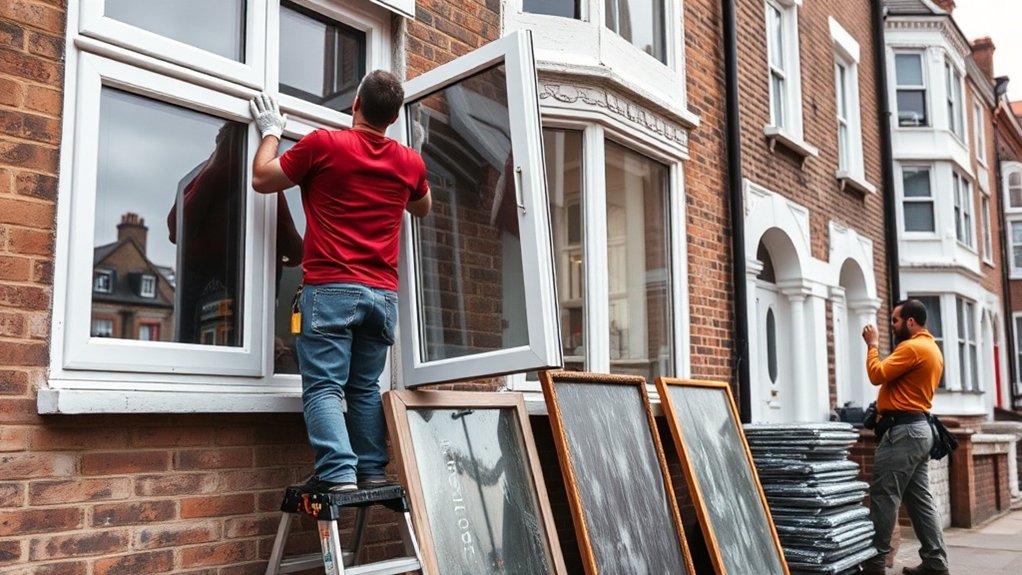
When you install quality double glazing in your London home, you cut heat loss, improve sound insulation and boost security by pairing low‑e glass with argon‑filled units, warm‑edge spacers and well‑sealed uPVC, aluminium or timber frames. You’ll need to match U‑values, acoustic performance and frame style to your property type, especially in conservation areas where slimline or secondary glazing may be required. Next, you’ll see how to choose the right specification, costs and installers.
Key insights
- Choose FENSA- or CERTASS-registered London installers to ensure Building Regulations compliance, insurance-backed guarantees, and proper certification on completion.
- Compare quotes detailing frame material, glazing type, U-values, acoustic performance, hardware, access costs, and waste removal.
- In conservation or listed buildings, check if planning permission is needed and consider slimline or secondary glazing that matches original sightlines.
- Specify argon-filled low‑E double glazing, robust seals, and high-security multi-point locks to improve energy efficiency, noise reduction, and security.
- Confirm installers’ processes for surveying, installation, sealing, and aftercare, and ask about maintenance requirements to prevent condensation, draughts, and blown units.
Is Double Glazing Worth It for London Homes?
Although initial costs can seem high, double glazing is typically worth it for London homes because it directly tackles three core issues: heat loss , noise pollution, and rising energy bills. You gain a high-performance envelope upgrade that minimises thermal bridging around frames and drastically reduces U-values compared with single glazing.
In dense London streets, double glazing cuts airborne noise from traffic and rail corridors, improving acoustic comfort and productivity. When combined with selective window tinting, you can fine‑tune solar gain, reducing summertime overheating without sacrificing natural light.
From a maintenance perspective, modern sealed units integrate coatings that resist dirt adhesion, simplifying glass cleaning and preserving optical clarity. Over time, lower heating demand and improved comfort typically offset the upfront capital outlay.
How Double Glazing Works (Simple Breakdown)
When you strip it back to basics, double glazing is simply two panes of glass separated by a sealed gap that acts as an insulation and noise‑damping barrier. You’re creating a controlled micro‑climate between the panes, usually filled with dry air or inert gas, which slows conductive and convective heat transfer.
You specify glass thickness, coatings, and glass aesthetics to tune performance: low‑emissivity layers reflect internal heat, while solar-control options limit unwanted solar gain. Edge spacers and perimeter seals maintain the gap’s integrity and minimise thermal bridging.
Frame materials then complete the system. High‑performance uPVC, thermally broken aluminium, or engineered timber hold the unit rigid, manage expansion, and integrate multi-point locking while preserving the thermal envelope and clean sightlines.
Noise, Security and Energy Ratings for London Homes
In London, you need double glazing that cuts road and rail noise to measurable decibel levels, boosts resistance to forced entry, and optimises thermal efficiency. You’ll assess acoustic glass options, locking hardware, frame materials, and spacer technologies to hit specific security and performance targets. You’ll also compare BFRC or equivalent energy ratings so you can specify windows that reduce bills and meet (or exceed) current Building Regulations.
Reducing London Traffic Noise
Despite London’s constant traffic and dense urban layout, you can cut external noise dramatically by specifying the right double glazing configuration for your home. You’ll achieve the biggest gains by combining asymmetric glass thicknesses (for example 4mm / 6mm) with a wider cavity of 16–20mm , filled with argon or krypton to damp vibration.
For façades in historical architecture, you can deploy slimline double-glazed units with acoustic interlayers (PVB or resin-based) that preserve sightlines while reaching 38–45 dB Rw ratings. Warm-edge spacer bars and thermally improved frames enhance acoustic tightness and material sustainability by reducing thermal bridging and frame resonance.
Always specify precision gaskets, multi-point compression sealing, and professional installation tolerances under 2mm to prevent flanking noise paths.
Improving Window Security Levels
London’s traffic noise isn’t the only external pressure your glazing must resist; the same robust frame tolerances, laminated glass , and airtight seals that block sound can markedly raise your home’s burglary resistance. You enhance window security by specifying multi-point lock mechanisms aligned into reinforced keeps, not just basic espagnolette locks.
Prioritise internally glazed units so intruders can’t remove beads from outside. Choose laminated inner panes that retain structural integrity even when cracked, and pair them with steel-reinforced uPVC or thermally broken aluminium frames, securely anchored into masonry with anti-pry fixings.
Insist on PAS 24 or equivalent security testing, hinge-side protection, and key-lockable night-vent positions that maintain partial opening without compromising engagement depth or sash rigidity.
Understanding Energy Performance Ratings
How do you compare one double-glazed window to another without relying on sales patter? You start by decoding energy performance ratings. In the UK, you’ll typically see a Window Energy Rating (WER) from A++ to E, alongside U-values and g-values. Treat these as engineering data, not marketing labels.
Focus on:
- U-value (W/m²K): Measures heat loss; you want the lowest possible for maximum energy efficiency in London’s variable climate.
- g-value (solar gain): Balances free solar heat with summer overheating; mid-range often works best in urban homes.
- Air leakage classification: Low permeability cuts draughts and boosts acoustic and thermal performance.
- Rw dB rating: Quantifies noise reduction; higher values matter near London traffic or flight paths.
uPVC vs Aluminium vs Timber Frames
When you choose between uPVC, aluminium, and timber frames for double glazing in London, you need to quantify how each material affects thermal efficiency, including U-values and cold-bridge risk. You’ll also want to evaluate durability and maintenance demands, from resistance to corrosion and warping to repainting cycles and hardware performance. Finally, you should assess aesthetics and design flexibility , ensuring frame profiles, finishes, and sightlines meet both planning constraints and your architectural goals.
Thermal Efficiency Comparison
Although all modern double glazing improves insulation, the frame material you choose—uPVC, aluminium, or timber—has a measurable impact on thermal performance, condensation risk, and overall energy efficiency. uPVC frames typically offer the lowest U-values due to their multi-chambered profiles and low thermal conductivity, making them highly effective at reducing heat loss. You’ll see consistent Energy savings across most window styles, especially large-format units.
Aluminium needs thermal breaks and high-performance gaskets to compete, but when engineered correctly, it delivers stable performance with slim sightlines. Timber offers strong insulating properties, with natural low conductivity and excellent synergy with high-spec glazing.
- Evaluate whole‑window U-values, not just glass
- Specify warm-edge spacers to minimise cold bridging
- Optimise glazing-to-frame ratio across window styles
- Integrate airtightness detailing at installation stage
Durability And Maintenance
Durability and maintenance should drive your frame choice as much as thermal performance because each material behaves very differently over a 30–40 year service life. uPVC resists rot and corrosion and doesn’t require painting, but it can discolour under UV exposure if you specify low‑grade profiles and hardware, and cheaper formulations may become brittle over time.
Aluminium frames offer exceptional structural stability, minimal movement, and near‑zero degradation if you choose marine‑grade powder coating, but you must monitor seal integrity and drainage paths. Timber delivers strong lifespan potential, yet only if you commit to cyclical re-coating and rapid Frame repair when you detect micro‑cracks or localised rot.
Across all systems, regular Glass cleaning plus gasket inspection extends service life and maintains airtightness.
Aesthetics And Design
Even before you compare U-values and acoustic ratings, you have to decide how the frame material will shape the visual character of your London property, because uPVC, aluminium, and timber impose very different design constraints and opportunities. uPVC profiles typically rely on chunkier sightlines and welded corners, which can limit how slender you can go on contemporary facades but work well for clean, uniform finishes on standard casements and tilt‑and‑turns.
When you evaluate window frame materials against current aesthetic trends, you should prototype elevations, not just individual openings:
- Specify aluminium for ultra‑slim sightlines, large panes, and dark powder-coated palettes.
- Use uPVC where you want cost-efficient repetition and low visual maintenance.
- Select engineered timber to satisfy conservation constraints and tactile warmth.
- Combine materials (e.g., alu-clad timber) to hybridise performance and design.
Best Double Glazing Options for Period and Conservation Homes
When you upgrade a period or conservation home in London, you have to balance thermal performance, acoustic control, and security with strict planning rules and heritage aesthetics . You need solutions that satisfy Historic preservation and ensure Architectural compatibility without sacrificing efficiency.
Slimline double glazing is often your best starting point. It uses narrow cavity widths and slender sightlines, so you retain original sash proportions while improving U-values and reducing traffic noise. For listed façades, you can retrofit slimline units into refurbished timber frames, combining laminated acoustic glass with warm-edge spacers and low‑iron outer panes .
Where you must keep single-glazed sashes, consider high-spec secondary glazing. Use low‑e coated, argon-filled panels with precision aluminium frames, matched to glazing bar patterns to keep external character intact.
London Double Glazing Rules and Regulations Explained
When you install double glazing in London, you must guarantee the units meet current Building Regulations for thermal performance, safety glazing, and ventilation. You’ll also need to confirm whether your project triggers planning permission requirements, especially for flat-fronted facades, flats, or material changes to the exterior. If your home sits in a conservation area or is listed, you must follow stricter restrictions, so you should check local authority guidance and specify sympathetic, compliant window designs.
Building Regulations Compliance
Although double glazing might look like a straightforward upgrade, in London it must comply with specific Building Regulations that govern thermal performance, safety glazing, ventilation, fire escape, and structural integrity. You’ve got to align your specification with Approved Documents L, K, F, and B, while ensuring installers are registered with a competent person scheme or that you secure the necessary building permits yourself.
Key compliance actions you should prioritise:
- Specify low‑U‑value units to exceed minimum thermal standards and cut operational carbon.
- Use safety glass in critical locations to meet impact resistance and containment criteria.
- Integrate trickle vents and purge ventilation to preserve indoor air quality.
- Validate structural loading, wind resistance, and junction detailing to minimise defects and Environmental impact.
Planning Permission Requirements
Regulatory compliance doesn’t stop at Building Regulations; you also need to assess whether your double glazing triggers planning permission in London. You’ll typically avoid consent when you replace windows on a like‑for‑like basis, keeping opening sizes, profiles, and external appearance consistent.
Planning risk increases when you alter façade geometry, considerably change window frame materials, or shift from subdivided sashes to large single panes. Switching to radically different glazing glass types—tinted, reflective, or acoustic laminates that modify external reflectivity—can also prompt scrutiny.
To streamline approval, document elevations, sections, and material specifications, then cross‑check them against your borough’s Local Plan and Supplementary Planning Documents. Where you’re pushing innovative designs, engage the planning duty officer early and obtain written confirmation that your proposal is “permitted development.”
Conservation Area Restrictions
Nowhere in London do double glazing rules tighten more sharply than in conservation areas, where planners prioritise preserving street character over efficiency gains. You can’t just swap in standard uPVC units; you must prove historic preservation and aesthetic integration, often down to sightlines, glazing bars, and putty profiles. Expect case‑by‑case scrutiny and mandatory conservation‑grade products.
- Specify slimline double glazing that mimics single-glazed reflections and narrow cavity depths.
- Use timber or composite frames with profiles matching the original section dimensions.
- Provide scaled drawings, heritage statements , and manufacturer datasheets evidencing visual equivalence.
- Consider secondary glazing where primary window alteration’s unacceptable.
If you treat the façade as a heritage asset and the glass as an upgradeable “technology layer,” planners usually engage with innovative, high‑performance proposals.
Step-By-Step Double Glazing Installation Process
When you understand each stage of double glazing installation, you can control quality, avoid damage to the building envelope, and secure the system’s thermal performance. You start by surveying openings, checking squareness, load paths, and confirming Glass design and Frame materials against specification and London regulations.
Next, you remove existing units , protect reveals, and prepare substrates, ensuring sound masonry or timber for mechanical fixings. You then dry-fit frames, set packers, verify tolerances, and laser-check plumb and level.
After that, you anchor frames with appropriate fixings, apply expanding tapes or sealants, and integrate membranes with existing vapour and air barriers. You install glazed units, insert setting and bridging blocks, and clip or bead securely. Finally, you seal perimeters , test operation, and perform air and water-tightness checks.
London Double Glazing Costs, Quotes and Typical Prices
After you understand the installation sequence and what’s involved on site , you can price double glazing in London with far more accuracy and avoid under-specifying frames, glass, or labour. You’ll see that costs hinge on aperture sizes, window styles, thermal performance targets, and access constraints.
You should request fully itemised quotes so you can benchmark like-for-like systems and quantify any uplift for premium glass innovations or bespoke detailing. Ask suppliers to separate:
- Frame materials, profiles, and hardware (including security spec)
- Glazing build-ups: U‑values, g‑values, acoustic ratings, coatings
- Installation labour: making-good, sealants, trims, waste removal
- Optional add-ons: trickle vents, integrated blinds, smart sensors
Choosing a Reliable Double Glazing Installer in London
Although London’s double glazing market is crowded with options, you should treat installer selection as a technical procurement exercise, not a casual purchase. Start by shortlisting firms with FENSA or CERTASS registration, £2m+ public liability insurance, and documented installation workflows, not just glossy brochures.
Interrogate their technical capability: ask for U‑value calculations , projected energy savings, and examples of complex installs (bay windows, heritage façades, mixed-material substrates). Demand written installation tips specific to your property type, including fixing methods, sealant systems, and ventilation strategy.
Evaluate data discipline: digital surveys, photographic pre‑works records, and QR‑coded product traceability all signal a mature process. Finally, insist on a performance-based contract specifying tolerances for air leakage, acoustic reduction, and completion sign‑off backed by an insurance‑backed warranty .
Common Double Glazing Issues in London (And How to Prevent Them)
Because London’s housing stock ranges from Victorian terraces to concrete towers, double glazing here tends to fail in predictable, technically explainable ways: internal condensation, fogged units from blown seals, frame movement and draughts, acoustic underperformance, and surface mould at cold bridges . You prevent most Condensation issues by specifying warm‑edge spacers, low‑E coatings, and trickle ventilation calibrated to room volume, rather than relying on ad‑hoc venting.
- Select argon- or krypton‑filled units with certified low U‑values to minimise cold‑spot formation.
- Specify reinforced frames and mechanically fixed packers to resist structural movement and draught paths.
- Use UV‑stable uPVC or powder‑coated aluminium to reduce Frame discoloration and surface degradation.
- Insist on double‑gasket or triple‑seal systems and precision‑machined hardware to maintain airtightness under wind load .
Maintaining Double Glazing in London’s Climate and Extending Lifespan
Preventing problems at specification stage only gets you halfway; London’s damp, pollution, and variable temperatures will still test any double glazing system over time. You need disciplined, data-driven maintenance routines to stabilise performance and extend lifespan.
Inspect perimeter seals biannually, focusing on south- and west-facing elevations where weather impact and UV exposure are highest. Clean frames and gaskets with pH-neutral agents; avoid solvents that embrittle PVC-U or degrade sealants. Check drainage slots after heavy rainfall to prevent standing water that accelerates corrosion and mould.
Monitor internal surface temperatures and condensation patterns during cold snaps; recurring edge condensation often signals early seal failure. Lubricate hardware annually with silicone-based products, then verify closing pressure using adjustable keeps to maintain airtightness and acoustic integrity.
Frequently Asked Questions
How Does Double Glazing Affect the Value and Saleability of My London Property?
It typically increases both value and saleability by upgrading your property’s performance envelope. Buyers see the enhanced Energy efficiency as lower operating costs and better EPC ratings, which can justify higher offers. You also gain Noise reduction, essential in dense urban zones, boosting perceived comfort. Modern double glazing signals a future‑ready asset, reduces maintenance, and helps differentiate your property in competitive listings, shortening time on market and supporting premium pricing.
Can I Get Double Glazing That Matches My Existing Interior Décor Style?
You can absolutely specify double glazing to match your existing interior décor style. You’ll select frame materials, profiles, and finishes engineered for interior aesthetics and precise design compatibility. Slim sightlines, bespoke colours , and hardware options let you replicate or upgrade your current look. You can also specify glazing tints, low‑iron glass, and acoustic laminates, ensuring performance enhancements integrate seamlessly with your design language rather than appearing as a retrofit compromise.
Are There Eco-Friendly or Recyclable Double Glazing Options Available in London?
Yes, you’ve got strong eco-friendly materials and recyclable options. Picture a smartphone designed for disassembly—that’s how modern glazing systems now treat frames and glass. You can specify low‑iron, low‑E glass, argon-filled units, and thermally broken aluminium or uPVC frames with documented recyclability. Ask suppliers for cradle‑to‑cradle certifications , recycled content percentages, and take‑back schemes, ensuring your windows slot into a closed-loop material cycle, not a landfill endpoint.
How Does Double Glazing Perform in London’s High-Rise and Windy Locations?
You’ll get strong performance in high-rise, windy locations if you specify pressure-rated frames, laminated outer panes, and deep cavities . Properly engineered units maintain Thermal efficiency by minimising convective heat loss and edge-seal failures under wind load. For Sound insulation, use asymmetric glazing and acoustic interlayers to counter wind‑driven façade noise. Combine this with mechanically fixed packers, structural sealants, and tested hardware to prevent racking, air leakage, and vibration.
Can Double Glazing Be Integrated With Smart Home and Ventilation Systems?
You can integrate double glazing with smart home and ventilation systems seamlessly. Through smart home integration, you’ll link motorised trickle vents, actuated sashes, and sensors to central controllers for automated comfort and energy optimisation. Ventilation compatibility depends on specifying pressure-balanced trickle vents , purge-vent modes, and, where needed, mechanical ventilation with heat recovery. You then coordinate window operation with CO₂, humidity, and temperature data to avoid condensation while maintaining airtight thermal performance.
Summary
When you choose the right double glazing, you’re not just fitting windows; you’re engineering a high‑performance envelope for your London home. By matching frame material, glass spec and installer credentials to your property type—and budget—you’ll cut heat loss , reduce noise, and boost security. The question isn’t “Is double glazing worth it?” but “Can you afford its ongoing inefficiencies without it?” Specify carefully, maintain routinely, and your units will deliver decades of reliable, measurable performance.