Window frame repair in London lets you stop rot, draughts and heat loss at their source without defaulting to full replacement. Specialists diagnose decay with moisture meters and probes, then use hardwood splices, epoxy resins, new gaskets and upgraded hardware to stabilise structure, restore airtightness and improve security. You retain original timber or modern frames while boosting energy efficiency and lifespan, and you can now see exactly which issues it tackles and how the process works.
Key insights
- Specialist London repair services diagnose timber, uPVC, and aluminium window frames for rot, distortion, draughts, and failed seals before proposing targeted repairs.
- Advanced techniques include moisture mapping, micro-drilling, epoxy resin consolidation, hardwood splicing, and stainless-steel reinforcement to restore structural integrity.
- Repairs focus on improving airtightness, reducing heat loss, and integrating with insulation and vapour-control strategies for better energy efficiency in London homes.
- Conservation-led contractors preserve original profiles and detailing in period and listed properties while discreetly upgrading glazing, gaskets, and hardware.
- Reputable firms provide detailed condition reports, thermal imaging if needed, clear repair-versus-replacement options, and itemised quotes showing long-term cost and performance benefits.
What Can Window Frame Repair Fix in London?
Window frame repair in London typically targets structural degradation , weather-related damage, and performance issues such as draughts, sticking sashes, rotten timber, corroded metal, and failed seals. You’re not just fixing cosmetics; you’re restoring performance tolerances, airtightness, and load paths.
Specialist repairs can consolidate decayed timber with epoxy resins, splice in sustainably sourced hardwood, or micro-reinforce joints with concealed stainless-steel plates. For metal frames, technicians remove corrosion , apply zinc-rich primers, and integrate high-performance gaskets to upgrade thermal performance.
You can also address glazing-bar distortion, misaligned hinges, and degraded putty without compromising Historical preservation . Intelligent material sourcing lets you match original profiles while adopting modern coatings, hybrid sealants, and acoustic/low‑E glazing interfaces that elevate efficiency yet keep the façade authentically London.
Early Signs Your London Window Frames Need Repair
Before a frame fails outright or moisture penetrates the wall build‑up, a London property will usually show subtle warning signs that a trained eye—or a careful homeowner—can spot. You’ll often notice micro‑cracks at mitre joints, hairline gaps between frame and masonry, or early paint crazing that maps underlying movement or moisture.
Run a probe along timber sills; soft spots, even with intact paint, indicate incipient decay. On metal frames, look for blistering coatings or early oxidation at drainage points. Monitor thermal performance: localised draughts or cold bridging around reveals suggest failing seals, not just old glazing.
When you detect these early indicators, you can plan targeted repair, align solutions with historical preservation objectives, and optimise material sourcing before damage escalates and costs multiply.
Common Window Frame Problems in London Homes
In many London properties, you’re likely to face two critical window frame issues: rotting timber sections and persistent draughts that drive up heating costs. Rot occurs when moisture penetrates unprotected wood, degrading the frame’s structural integrity and compromising fixings, seals, and glazing beads. Draughts and heat loss typically result from failed perimeter seals, distorted sashes, and poor junctions between the frame and masonry, all of which you can address through targeted repairs, improved sealing, and, where necessary, partial frame replacement.
Rotting Timber Window Frames
Although timber offers excellent insulation and character, prolonged exposure to London’s damp climate makes wooden window frames highly susceptible to rot, especially where paint has failed or water is trapped in joints and sills. You’ll typically see soft, discoloured patches, bubbling paint, or distorted profiles where moisture has breached surface coatings.
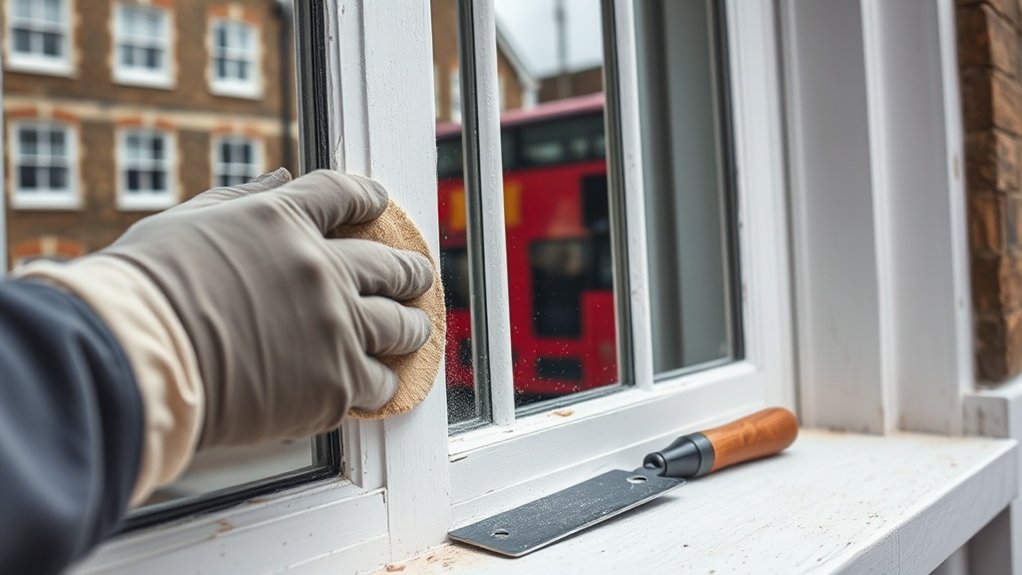
Start with a moisture-meter survey and a sharp-probe test to map decayed zones. Instead of full replacement, you can specify targeted timber preservation: cut out friable fibres, then splice in matching hardwood or use low-viscosity epoxy consolidants to stabilise semi-sound sections. Dry the substrate thoroughly before any resin work.
Finish with a high-build paint restoration system: primer, micro-porous undercoat, and UV-stable topcoat , meticulously sealing end grain, glazing rebates, and mechanical fixings.
Draughts And Heat Loss
Why does a room with closed windows still feel cold and uncomfortable? You’re likely losing heat through micro-gaps in the frame, sash, and glazing interface. In London’s wind-driven rain and variable temperatures, negative pressure pulls cold air through these leaks while warm air escapes, defeating your heating system.
You can diagnose draughts with a smoke pencil or infrared camera to map air infiltration around meeting rails, parting beads, and frame-to-wall junctions. Targeted window insulation upgrades—such as retrofitted brush seals, compressible rubber gaskets, and low-conductivity spacer bars—significantly reduce convective and conductive losses. Advanced draft proofing systems integrate discreet perimeter seals into traditional timber sashes, preserving aesthetics. Combine these with secondary glazing and insulated shutters to achieve modern thermal performance without full window replacement.
How London Property Type Affects Window Frame Repair
When you plan window frame repairs in London, you must align methods and materials with the specific demands of Victorian and period homes , modern flats and towers, and any applicable conservation controls. Each property type dictates different structural interfaces, load paths, access strategies, and compatibility requirements for timber, aluminium, or uPVC systems. You’ll also need to account for conservation area rules and listed building consent, which can restrict frame profiles, glazing upgrades, and even the type of sealants and fixings you use.
Victorian And Period Homes
Because London’s housing stock includes vast numbers of Victorian and other period properties , window frame repair almost always demands a conservation-led approach that respects original materials, joinery profiles, and historic detailing. You’re not just fixing timber; you’re recalibrating a finely balanced system of sashes, cords, pulleys, decorative glass, and bespoke window hardware.
You start by mapping existing conditions and decay patterns, then specify minimal-intervention strategies: resin splicing instead of full member replacement, micro-vented glazing rebates, and slimline double-glazed units where conservation officers allow.
Visualise:
- Flaking putty around coloured decorative glass panels
- Cast-iron pulleys and brass window hardware seized with paint
- Box frames with distorted meeting rails and air leakage
You then integrate discreet draught-proofing , improved security locks, and upgraded balances while retaining visible period character.
Modern Flats And Towers
In contemporary London flats and high-rise towers, window frame repair becomes a coordination problem as much as a technical one, governed by façade systems, leasehold covenants, and fire-safety rules. You’re not just fixing a frame; you’re interfacing with curtain walling , unitised systems, and sometimes proprietary balcony pods.
Access strategy comes first: abseil teams, cradle systems, or internal-only methods that avoid disturbing pressurised corridors and fire-stopping. You’ll specify low-VOC sealants compatible with aluminium or composite frames, ensuring movement joints don’t fail under wind loading.
Glass cleaning and diagnostics must work together; you use inspection during cleaning cycles to spot failed gaskets, corrosion, and paint peeling on powder-coated surfaces. You then phase works across elevations, aligning with service-charge budgets and building management plans.
Conservation Areas And Rules
Modern towers demand coordination with façade engineers and building managers; step into a London conservation area and your main counterpart becomes the local planning authority. You’re not just repairing; you’re operating within a Historical preservation framework where sightlines, profiles, and glazing ratios are controlled.
You start with an appraisal: original joinery species, coating build-up, decay patterns, and prior interventions. Then you map those against the conservation area appraisal and Article 4 Direction .
Visualise your constraints and opportunities:
- Slimline double glazing hidden within traditional sash profiles
- Spliced Material restoration with matching grain, density, and moisture movement
- Microporous coatings that replicate heritage colours yet optimise diffusion
You submit detailed drawings, section profiles, and a repair methodology, proving performance gains without visual disruption.
Timber Window Frame Repair for Period Properties
Although timber window frames in London’s period properties are often robustly built, they’re vulnerable to moisture ingress, joint movement, and historic paint build-up that can mask early signs of decay. You’ll need a staged, forensic approach : moisture mapping, micro-drilling to test soundness, and careful paint removal to expose failed joints and concealed rot.
Once you’ve identified deterioration, you can splice in new hardwood, use epoxy consolidants, and re-profile beads and sills to maintain historical accuracy while upgrading performance. You should integrate slimline double glazing or specialist seals without altering sightlines, then specify breathable primers and microporous coatings under high-performance decorative finishes. This preserves original fabric, stabilises thermal behaviour, and extends service life while keeping the façade architecturally coherent.
UPVC And Aluminium Window Frame Repair Options
Where timber frames reward repairable craftsmanship, uPVC and aluminium systems demand a diagnostic, component-based strategy that respects their factory-engineered tolerances and profiles. You start by mapping faults: warped sashes, failed gaskets, oxidised aluminium, UV-chalked uPVC, or worn hinges and espagnolette locks. Each defect drives a targeted intervention, not a cosmetic patch.
You’ll specify seal replacements , precision hinge re-alignment, and upgraded multi-point locking to restore airtightness and smooth operation. Surface renewal can integrate advanced Glass cleaning and low-VOC Frame painting systems engineered for plastics and powder-coated metal, enhancing optics without clogging drainage paths.
Visualise the process:
- Condensation-beaded panes transforming to crystal clarity
- Dull, pitted frames regaining sharp, architectural lines
- Sluggish vents snapping back into precise, friction-balanced motion
Repair Vs Replacement For London Window Frames
When you’re weighing repair against full replacement of London window frames, you first need to assess the frame’s structural condition , extent of decay, and hardware integrity. You’ll then compare the projected repair cost and expected service life extension against the capital cost and lifespan of new units. At the same time, you should factor in the energy efficiency gains from upgraded frames and glazing, including reduced heat loss, improved airtightness, and potential savings on heating bills.
Assessing Frame Condition
Before you decide to repair or replace a window frame in London, you need to carry out a systematic condition assessment that considers structure, safety, energy performance, and compliance with local standards. You’ll benchmark each frame against three criteria: structural integrity, building physics, and conservation obligations , including window frame aesthetics and historical preservation where applicable.
Start with targeted visual and tactile checks:
- Rotten timber at sill ends, distorted joints, or corroded metal sections under flaking coatings
- Condensation trails, draught paths, and cold spots detected with thermal imaging or smoke pencils
- Degraded putty lines, failed sealant joints, and loose glazing beads compromising weather seals
Then probe with moisture meters, confirm anchoring to masonry, and photograph defects. This dataset lets you justify either high‑precision repair or strategic replacement.
Cost And Longevity
Once you’ve documented each frame’s condition , you can convert that survey into hard numbers on cost, service life, and whole‑building performance. You should model two timelines: “repair and maintain” versus “full replacement”. For each frame type, calculate remaining service years based on material durability, exposure, and historic failure patterns in London’s climate.
You’ll often find that targeted repairs (spliced timber sections, corrosion treatment, re-sealing) extend life by 10–20 years at a fraction of replacement cost, while preserving window aesthetics critical in conservation areas. However, where decay affects structural junctions or repeated failures occur, replacement usually gives a lower life‑cycle cost.
Build a simple matrix: initial outlay, predicted maintenance intervals, and risk of unplanned failures. Let that data, not habit, drive your decision.
Energy Efficiency Considerations
How much does energy performance really influence whether you repair or replace window frames in London? It’s often the decisive factor, especially with rising energy prices and strict efficiency standards. You’ll compare U‑values, air‑tightness , and thermal bridging, not just visible decay.
- Picture cold draughts tracking along distorted sash joints, forcing your boiler to overcompensate.
- Visualise slim, high‑performance double glazing discreetly integrated into traditional sash profiles.
- Imagine infrared heat loss scans highlighting weak points in outdated window frame design.
If you’re in a conservation area or dealing with historical architecture, deep refurbishment can upgrade gaskets, parting beads, and glazing while preserving heritage profiles. Full replacement, however, lets you deploy advanced composites, warm‑edge spacers, and trickle‑vent strategies for maximum, measurable energy gains.
Energy And Security Benefits Of Window Frame Repairs
Properly repaired window frames do more than improve appearance; they restore critical performance in both energy efficiency and security. When you eliminate frame distortion, failed seals, and air gaps, you stabilise internal temperatures and reduce uncontrolled ventilation losses. High-performance draught seals , precision refitting, and insulated glazing interfaces cut conductive and convective heat transfer without compromising window aesthetics or historical preservation.
From a security standpoint, frame repairs let you upgrade structural anchoring, locking points, and hinge geometry. Reinforced timber splices, epoxy consolidation, and concealed steel plates increase resistance to jemmying and impact. Precision-aligned sashes ensure multipoint locks engage fully, while laminated or toughened glass integrates seamlessly with the restored frame, giving you a discrete, high-security envelope that aligns with London’s demanding urban conditions.
Window Frame Repair Costs In London Explained
Beyond the performance gains in energy efficiency and security, you also need a clear picture of what window frame repair in London actually costs and why. Pricing hinges on frame material, deterioration depth, access complexity, and whether you pair repairs with glass replacement or broader interior decoration upgrades.
You’ll typically see costs broken into diagnostics, fabrication or machining, and onsite installation. To visualise where your budget goes, imagine:
- Precision routing of decayed timber, then splicing in engineered hardwood inserts
- Aluminium frame re-alignment, new thermal breaks, and upgraded gaskets
- Coordinated glass replacement with low‑e units that complement your interior decoration scheme
When you compare quotes, interrogate labour hours, component specifications, and warranties, not just headline figures. That’s how you invest intelligently, not reactively.
How London Window Frame Repairs Typically Work
Underneath every successful window frame repair in London sits a methodical process: a specialist surveys the frames in situ, maps moisture ingress and structural movement , then specifies whether you’re looking at localised resin consolidation, full section splicing, or partial frame replacement. You’ll see probes, moisture meters, and endoscopes used to quantify decay without stripping sound timber.
Next, they stabilise the opening , strip defective coatings, and machine out rotten sections with precise margins. Epoxy or polymer-modified repair systems then rebuild profiles, tied back with stainless fixings. Joints are micro-vented to cope with London’s variable humidity.
You coordinate this with other upgrades—insulation strategies, airtightness, even future gardening tips for shading and kitchen renovations that alter ventilation paths—so the repaired frames perform as an integrated envelope component.
How To Choose A Reliable Window Frame Repair Specialist
When you’re choosing a window frame repair specialist in London, treat it as a technical procurement exercise rather than a quick household hire. You’re protecting building performance, not just fixing timber. Validate their grasp of historical preservation, vapour dynamics, and load paths, especially in period housing stock.
Ask each candidate to show you, in writing, their diagnostic methodology, risk assessment , and material selection logic for your specific frames and glazing.
Visualise their approach:
- Moisture mapping, decay probing, and thermal imaging around frames
- Precision routing of rot, resin repairs, and spliced timber inserts
- Integration of seals, fixings, and coatings as a single performance system
Check for project photos with failure analysis, manufacturer-backed training, and clear warranties. Prioritise those who specify standards, not just products.
Frequently Asked Questions
Can Window Frame Repairs Be Done Without Disturbing Listed Building Planning Permissions?
Yes, you can, but you must keep interventions strictly “like‑for‑like.” You’ll prioritize historical accuracy by matching original profiles, glazing sightlines, and joinery methods, while upgrading material durability with discreet improvements—hidden draught seals, micro‑porous coatings, or engineered timber inserts. You avoid changing frame dimensions or appearance, document every specification, and consult the conservation officer early, so innovative repairs stay compliant and don’t trigger fresh listed building consent .
Are There Eco-Friendly or Recycled Materials Used in London Window Frame Repairs?
Yes, you can specify eco friendly materials and recycled components in many repairs. Contractors use FSC-certified or reclaimed timber, recycled aluminum sections, and low-VOC sealants so your upgrade feels like a hardware lab, not a landfill. You’ll also see recycled glass spacers, cellulose-based insulation, and silicone alternatives with reduced embodied carbon. Ask suppliers for Environmental Product Declarations and chain-of-custody certificates to verify each material’s sustainability claims.
Do I Need to Move Furniture or Curtains Before the Repair Team Arrives?
Yes, you should clear the area. Prioritize furniture removal within at least 1–1.5 meters of the window to enable unobstructed tool access and dust-control setup. Perform curtain adjustment by fully drawing back , tying up, or temporarily taking down fabrics to prevent contamination and damage. This preparation streamlines workflow, reduces on-site delays, and allows the repair team to deploy precision equipment and protective sheeting efficiently.
Can Window Frame Repairs Be Carried Out Outside Typical Weekday Working Hours?
Yes, you can usually schedule window frame repairs outside typical weekday hours. Think of your schedule as an adjustable circuit, with timing flexibility built in. Many specialists offer after hours services , including early mornings, evenings, and select weekends, minimizing operational downtime. You’ll coordinate access, noise constraints, and light requirements, and they’ll sequence tasks—assessment, prep, and curing—so adhesives, sealants, and coatings perform ideally even under non‑standard time and temperature conditions.
Are Window Frame Repairs Covered by Home Insurance Policies in London?
Yes, they can be, but it’s highly conditional. You’ll need to interrogate your policy’s Insurance coverage clauses: are window frames listed under buildings, accidental damage, storm or impact events? Insurers typically exclude wear, rot, and gradual deterioration, so Repair costs from age-related failure are usually yours. You should document damage with timestamped photos, obtain a detailed repair quote, then submit a claim aligned precisely with your policy’s defined peril triggers .
Summary
When you repair your window frames, you’re not just patching timber or sealing gaps; you’re tightening every bolt in your home’s performance engine. By acting early, you’ll stop decay, improve insulation, and reinforce security without full replacement costs. In London’s demanding climate and varied property stock, precise frame repairs give you cleaner sightlines, lower energy bills, and longer-lasting windows—so your home stands firm, efficient, and secure against the city’s constant weather and wear.