You rely on correctly aligned, well‑maintained window hinges to stop draughts, prevent sash drop, and keep your London property secure and energy‑efficient without full replacement costs. You’ll spot hinge issues through scraping sashes, visible gaps, stiffness, or rusted friction stays. Minor lubrication and screw tightening are often safe DIY, but warped sashes, distorted frames, or corroded hinges need a specialist. With the right repair approach, you can cut heat loss, noise, and future maintenance.
Key insights
- Specialist window hinge repair services in London can fix draughts, misalignment, and stiff operation without full window replacement.
- Many London repairers handle uPVC, timber, and aluminium frames, including older or heritage properties needing matched or discreet hardware.
- Professionals diagnose whether issues stem from hinges, warped frames, failed seals, or glazing, preventing unnecessary replacement costs.
- Mobile engineers typically offer on-site hinge replacement, lubrication, realignment, and security upgrades across most London postcodes.
- Request a quote detailing call-out fees, hinge types, labour costs, and any additional work like seal replacement or security enhancements.
How to Spot Window Hinge Problems
Although window hinges are small components, recognising early signs of failure is critical to preventing draughts, security issues, and costly repairs. You should first check alignment: if the sash scrapes the frame or doesn’t close flush, the hinge geometry may be distorted. Look for visible gaps , especially at the hinge side, that indicate worn pivot points.
Next, operate the window slowly. Any grinding, stiffness, or stuttering motion suggests inadequate hinge lubrication or internal corrosion. Inspect the metal surfaces for rust, hairline cracks, or elongated screw holes that allow unwanted movement.
Finally, monitor performance over time. If repeated lubrication no longer restores smooth action or the window frequently drops or misaligns, you’re likely beyond adjustment and need targeted hinge replacement.
Are Faulty Window Hinges the Real Issue?
You might notice stiffness , draughts, or misalignment and assume the window hinges have failed, but these symptoms are often misdiagnosed. In many London properties, the real causes can include warped sashes, failed seals, frame movement, or incorrect installation that mimic hinge problems. Understanding when hinges are and aren’t to blame helps you target the right repair and avoid unnecessary costs.
Common Symptoms Misdiagnosed
When a window sticks , lets in drafts, or won’t close flush against the frame, it’s easy to blame the hinges, but these symptoms often originate elsewhere. You need to distinguish between issues that demand hinge lubrication and those that genuinely justify hinge replacement, otherwise you risk unnecessary cost and downtime.
Common symptoms that get misdiagnosed as hinge failure include:
- Uneven closing pressure that actually results from minor sash distortion, not worn hinge knuckles.
- Localised draughts caused by failed compression points along the seal line, while the hinge geometry remains accurate.
- Perceived “hinge drag” that’s really due to surface contamination along the friction stays, solvable with precision cleaning and targeted lubrication, not full replacement.
Accurate diagnosis preserves hardware and optimises lifecycle performance.
Other Hidden Window Faults
Often the “faulty hinge” turns out to be a symptom, not the root cause , and the true problem sits elsewhere in the window assembly. You might see stiff operation or poor sealing and assume the hinge has failed, when the real issue lies in distorted frames, failed gaskets, or misaligned locking points.
You also need to contemplate upstream variables such as window hinge manufacturing tolerances and hinge calibration. Even a precision hinge can’t compensate for a twisted sash, worn keeps, or incorrectly packed glazing. Thermal movement, moisture ingress, and sub‑standard fixings can all shift loads away from the hinge, making it appear defective. A systematic assessment lets you distinguish genuine hinge wear from deeper structural or fabrication faults before you commit to replacement.
When Hinges Aren’t Blamed
Curiously, faulty window hinges sometimes escape suspicion altogether, even though they’re driving the very symptoms you’re trying to fix. You might blame failed seals, warped frames , or poor glazing while a worn hinge silently misaligns the sash, breaks the air seal, and stresses locking points. In modern London properties, where performance glass and smart ventilation are standard, hinge accuracy is critical.
You can often trace misdiagnosed issues back to hinge friction , corrosion, or deformation:
- Drafts that persist after resealing or re‑caulking
- Resistance, grinding, or “bounce back” when you open or close the sash
- Localised water ingress despite intact gaskets
Targeted hinge lubrication may restore smooth travel and tight closure. When wear is advanced, precise hinge replacement is the only durable solution.
Safety and Draught Risks From Faulty Hinges
When window hinges fail, you’re not just dealing with a minor annoyance; you’re exposing your home to real safety and performance risks . Poorly aligned or loose sashes create weak points that intruders can exploit, while constant draughts drive up heat loss and energy costs. Over time, these air leaks also encourage condensation and mould growth around frames, which can damage finishes and affect indoor air quality.
Compromised Home Security
How secure is a window that doesn’t close or align correctly because of worn or damaged hinges? Misaligned sashes create leverage points that intruders can exploit with minimal force, bypassing even advanced locks. Gaps in the frame also compromise acoustic privacy and undermine premium home decor choices or window tinting investments by leaving your glazing under‑protected.
You should treat hinge integrity as part of a holistic security system, not a minor hardware issue. Precise hinge repair re-establishes full compression against seals and restores the designed locking geometry.
- Reduced pry points along the frame, making forced entry harder
- Correct engagement of multi-point locking mechanisms and restrictors
- Improved compatibility with sensors, smart locks, and other security upgrades
Increased Heat Loss
Compromised hinges don’t just weaken security; they also disrupt your window’s thermal performance by preventing the sash from sealing evenly against the frame. When hinges wear, bend, or loosen, the sash alignment shifts, creating micro‑gaps around the perimeter. These gaps let warm air escape and cold air infiltrate, driving up your heating demand and reducing overall energy efficiency .
You’ll often feel this as localized draughts near the window frame, even if the glazing itself is high‑spec. Misaligned hinges can undermine advanced double or triple glazing by bypassing the insulated glass unit entirely. Precision hinge adjustment and, where necessary, replacement restores uniform compression between sash and frame, stabilises internal temperatures, and supports smart‑home heating systems that rely on predictable thermal performance.
Condensation And Mould Risks
Poorly aligned or worn hinges don’t just cause draughts; they also create cold spots around the frame that drive surface condensation and, over time, mould growth . As warm, moist indoor air hits these chilled edges, vapour condenses, feeding spores embedded in seals, plaster, and even framing materials.
You’re not just facing cosmetic staining; you’re risking structural damage and degraded indoor air quality. Innovatively engineered hinge systems and precise adjustment critically cut this risk by maintaining uniform compression on the seals.
- Reduce micro-gaps that trigger cold-bridge formation and persistent damp patches
- Support better window cleanliness by limiting biofilm-friendly moisture on glass and frames
- Combine accurate alignment with scheduled hinge lubrication to stabilise movement and maintain long-term airtight performance
Can You Fix Window Hinges Yourself?
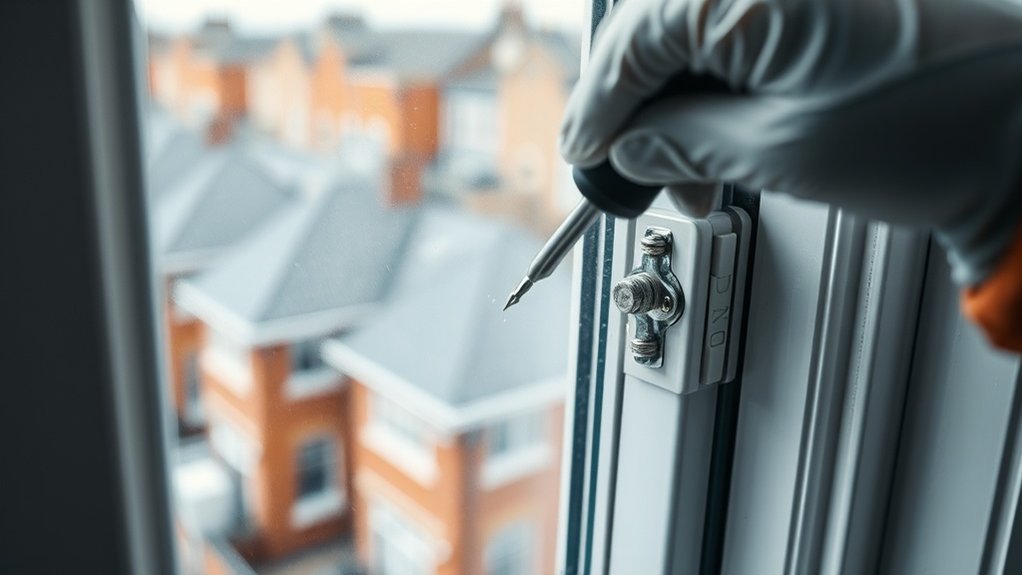
Although many homeowners are tempted to tackle loose or squeaking window hinges themselves, whether you should depends on the hinge type, frame material, and level of wear. If your casement or friction hinges only need minor realignment, lubrication, or screw tightening, you can often handle that safely with careful observation and methodical adjustment.
However, once you’re dealing with warped sashes, damaged screw fixings , or corroded friction stays, DIY work becomes risky. You can easily compromise window hinge aesthetics, especially on properties with historical window designs, where the ironmongery and sightlines must remain consistent. Incorrect work may also impair weather‑sealing, tilt-and-turn safety functions, or fire egress compliance. In those cases, it’s more efficient and secure to rely on a specialist.
Tools and Materials for Window Hinge Repair
Before you adjust or replace any window hinges, assemble the right tools and materials so you can work accurately and avoid damaging the frame or sash. For London properties, especially those with historical architecture or decorative hinges , precision gear protects both performance and heritage value.
You’ll typically need:
- Hand tools: Multi-bit screwdriver set , hex keys, fine-tooth hacksaw, and a low‑profile pry tool for tight rebate clearances.
- Measuring and alignment kit: Digital caliper, torpedo level, feeler gauges, and shims to maintain consistent reveal and compression.
- Fixings and protection: Stainless or brass screws matched to existing hardware, rust‑inhibiting lubricant, painters’ tape, and microfibre cloths to shield glass and finishes.
Select hinge replacements compatible with existing profiles, load ratings, and security requirements.
DIY Window Hinge Repair: Step by Step
Once you’ve assembled the right tools and replacement hardware, you can move methodically through a structured hinge repair process to restore smooth, secure window operation. Start by inspecting hinge alignment, wear points, and fixings, comparing them with historical hinge designs to understand original movement geometry and tolerance.
Remove sash screws while supporting the frame, then detach the failed hinge. Note hinge manufacturing materials and thickness so your replacement matches load capacity and corrosion resistance. Clean contact surfaces, remove debris, and verify fixing substrates are sound.
Position the new hinge, temporarily fix with two screws, and test movement . Confirm full opening, closing, and locking without resistance. Finally, fully tighten fixings, apply appropriate lubrication, and re‑check alignment under repeated operation.
Hinge Repairs on uPVC, Timber and Aluminium Windows
When you’re repairing window hinges , you need to recognise that uPVC, timber, and aluminium frames each present distinct wear patterns and failure points. You’ll first identify issues such as sagging sashes, restricted movement, corrosion, or misalignment specific to each material. Then you can apply material-appropriate repair methods, from hardware replacement and lubrication to frame reinforcement and precise hinge adjustment.
Identifying Common Hinge Issues
How do you know if a faulty hinge is to blame for your window problems? Look for changes in motion, alignment, and sealing. When friction increases, you’ll notice resistance, scraping, or uneven travel, even after careful hinge lubrication. On uPVC, sagging sashes that catch on the frame often indicate worn friction hinges. Timber windows typically show visible gaps, drafts, or binding at specific points in the opening arc. Aluminium systems may exhibit subtle misalignment that stresses locking mechanisms.
Common symptoms include:
- Visible gaps around the sash , causing drafts or water ingress
- Stiff or jerky operation, even with regular cleaning and lubrication
- Misaligned locking points, indicating wear that may require hinge replacement options
Repair Methods By Material
Although hinge problems present similar symptoms across window types , effective repair depends heavily on the frame material and hinge design. uPVC windows typically use friction hinges fixed into steel-reinforced profiles, so repairs focus on accurate realignment, correct packer use, and secure re-fixing into sound reinforcement. You’ll also verify material durability at the fixing points and apply silicone-safe hinge lubrication to minimise wear.
On timber windows , you must assess substrate integrity, consolidate any decay, then use longer or offset screws to anchor into sound wood. Precision rebating and weather-seal adjustment are key.
For aluminium systems, you’ll often deal with proprietary hinges integrated into thermal-break profiles; correct shim selection, torque-controlled re-fixing, and non-reactive lubricants protect both hardware performance and frame longevity.
When to Repair Window Hinges vs Replace Them
Often the challenge isn’t spotting a faulty hinge, but knowing whether it’s worth repairing or if a full replacement’s the smarter choice. You should repair when the metal’s structurally sound , alignment issues are minor, and lubrication or screw resets restore smooth motion. This preserves Historical hinge designs and protects carefully curated interior hinge aesthetics.
You should replace when:
- Wear has elongated screw holes, warped arms, or cracked knuckles, so the hinge can’t hold calibration.
- Corrosion’s advanced , pitting is deep, or protective coatings have failed, risking sudden hinge failure.
- You’re upgrading to higher-spec hardware for security, larger glazing, or automated ventilation, and legacy hinges can’t meet new load or performance criteria.
Balancing heritage value, performance, and lifecycle cost guides the decision.
Types of Window Hinges in London Homes
Because London’s housing stock ranges from Georgian terraces to post‑war estates and new-build flats, you’ll encounter a wide spectrum of window hinge types, each with distinct repair considerations. In period properties, you’ll typically see side-hung casement hinges, often in Historical hinge styles such as butt, parliament, or friction stays retrofitted to timber frames. These demand precise alignment and corrosion‑resistant replacement screws.
In Victorian and Edwardian homes, you may also manage sash windows using concealed pivot or cord‑balanced hinges, where wear on pivot pins or shoes affects smooth travel. Contemporary flats usually rely on uPVC or aluminium friction hinges , egress hinges, and restrictor hinges that integrate ventilation and safety functions. Decorative hinge designs appear on premium refurbishments, requiring discreet, sympathetic repair methods.
Costs of Window Hinge Repair in London
The range of hinge types across London homes directly affects how much you’ll pay to repair them, as materials, access, and hardware complexity all influence cost. You’re typically looking at a lower price band for standard friction hinges and a higher one for bespoke or concealed mechanisms that demand precision alignment and specialist parts.
Key cost drivers include:
- Heritage factors – Historical hinge styles on period properties often need custom fabrication or source-matched components, increasing labour and lead times.
- Performance requirements – Upgrading to higher hinge material durability (e.g., marine-grade stainless steel) costs more upfront but reduces future maintenance cycles.
- Site constraints – Upper-floor access, integrated alarms, or oversized glazing add setup time, specialist equipment, and risk management, all reflected in your final invoice.
Choosing a Reliable Window Hinge Repair Service
When you’re choosing a window hinge repair service in London, you need a contractor who can demonstrate proven technical competence, not just general glazing experience. You should verify they understand both current hardware systems and historical hinge designs common in London’s period properties, from sash windows to steel-framed casements.
Ask how they assess hinge material durability across brass, stainless steel, and coated alloys, and whether they specify components with tested corrosion resistance and load ratings. Check for membership in recognised trade bodies, detailed written surveys, and itemised quotes that reference specific hinge models and performance data.
Favour firms that document their work with before‑and‑after photos , offer clear warranties, and can integrate discrete upgrades—like friction‑stay or concealed hinges—without compromising the original frame geometry.
Simple Maintenance to Keep Window Hinges Smooth
Although hinge mechanisms look simple, you’ll keep them smooth and extend their service life in London’s variable climate by following a few routine maintenance steps. Inspect the hinge knuckles, pins, and fixing screws quarterly, especially on upper floors exposed to driving rain. Address paint peeling promptly, as exposed metal accelerates corrosion and creates friction points.
- Clean hinges with a non-abrasive solvent, then apply a silicone-based or PTFE lubricant; avoid thick oils that attract dust.
- Check for lock loosening and frame movement; retighten or replace fixings before play in the hardware distorts hinge alignment.
- Verify the sash opens in a single, fluid motion; if it binds, adjust the hinge screws incrementally rather than forcing the handle or over-torquing the lock.
Energy and Regulatory Benefits of Good Hinge Repair in London
Keeping hinges clean and correctly adjusted doesn’t just improve operation; it also plays a direct role in energy performance and compliance with London’s building standards. When hinges hold sashes squarely in the frame, seals compress evenly , reducing uncontrolled air leakage and thermal bridging. That immediately supports energy efficiency targets and lowers heating and cooling demand.
Precise hinge repair also helps you align with Part L requirements and broader regulatory compliance goals, especially in refurbishments where upgraded performance is expected without full window replacement. By ensuring consistent closing pressure and smooth operation, you reduce occupant-driven gaps, condensation risk, and draught complaints. In many cases, targeted hinge work becomes a low‑disruption strategy to extend window life while contributing measurably to building‑level sustainability metrics.
Frequently Asked Questions
How Do Window Hinge Repairs Affect My Home Insurance or Warranty Coverage?
Repairs can protect coverage if you use qualified contractors and document everything. You typically don’t void insurance, but poor workmanship or non-compliant parts can complicate the insurance claim process . For warranties, you must follow manufacturer specs; unauthorized modifications may cancel coverage. Upgrading window hinge durability with certified components can even strengthen risk profiles. Always keep invoices, before/after photos, and compliance certificates to streamline both warranty and insurance interactions.
Are There Noise-Reducing Benefits From Upgrading Older Window Hinges?
Yes, you’ll hear noticeable noise reduction. Smooth, sealed, and stable hinges stop subtle rattling, reduce vibration transfer, and improve sash compression against gaskets. When you apply precise hinge lubrication , you minimize friction noise and micro-movement. Advanced hinge replacement techniques let you specify tighter tolerances, multi-point friction stays, and improved alignment, which collectively cut wind whistle, traffic infiltration, and structure-borne sound—especially when paired with modern frames and high-performance glazing.
Can I Claim Window Hinge Repairs as a Tax-Deductible Home Improvement in London?
You generally can’t claim window hinge repairs as tax‑deductible home improvements in London, since HMRC treats them as routine maintenance. You’d usually only offset such costs against future Capital Gains Tax when selling, not against income tax. To stay compliant, document invoices, Cost estimation data, and any DIY repair materials separately. For innovative retrofits improving energy efficiency, seek specialist tax advice—some broader upgrades may qualify under evolving incentive schemes.
How Do Heritage or Conservation Area Rules Affect Window Hinge Repairs?
They restrict what you can change and what materials you can use. You must respect historical preservation goals , so you’ll usually match original profiles, sightlines, and opening mechanisms. Material authenticity matters: planners may insist on steel, brass, or traditional ironmongery instead of modern visible plastics. You should consult the local conservation officer, specify like‑for‑like or reversible upgrades, and document performance benefits to get approval for innovative hinge solutions.
Are Environmentally Friendly or Recyclable Window Hinge Options Available in London?
You can absolutely source eco friendly materials and recyclable components for window hinges locally. You’ll find stainless steel and aluminium hinges with high recycled content, plus powder‑coated finishes with low VOCs. Some suppliers offer modular hinges so you can replace parts instead of whole units, reducing waste. You should specify RoHS‑compliant, fully demountable designs and confirm take‑back or recycling schemes with your chosen fabricator or installer.
Summary
When you ignore damaged window hinges , you’re practically inviting draughts, leaks, and security risks to march straight into your home. In London’s climate and regulatory environment, that’s a technical and financial disaster waiting to explode. By diagnosing issues early, using the right tools, and choosing a qualified repair specialist, you don’t just fix a hinge—you restore performance, protect your property, slash heat loss, and extend your windows’ lifespan almost beyond belief.