If you notice misted panes , draughts, or cold bands on your glazing, you likely need window seal repair in London. Specialists can reseal perimeters, dry and refill argon cavities, or replace failed sealed units while keeping existing frames, which is ideal for sound uPVC, timber, or aluminium. This restores U-values, reduces condensation and noise, and avoids costly full-frame replacement. In some cases, structural damage means full replacement is safer and more efficient, which you can discover next.
Key insights
- Look for London glazing specialists who diagnose misted or draughty windows and offer seal repair or sealed-unit replacement, not just full frame replacement.
- Repair is usually viable when frames are sound, glass is intact, and problems are limited to misting, draughts, or early-stage seal failure.
- Many London firms provide minimally invasive repairs for heritage and period properties, preserving original frames while restoring insulation and airtightness.
- If frames are rotten, warped, or corroded, reputable specialists will recommend full unit or window replacement to ensure safety and energy performance.
- Ask contractors about diagnostic tools, compliance with British Standards, written warranties, and options for upgrading to modern low‑E, argon‑filled double glazing.
How to Spot Failed Window Seals in London Homes
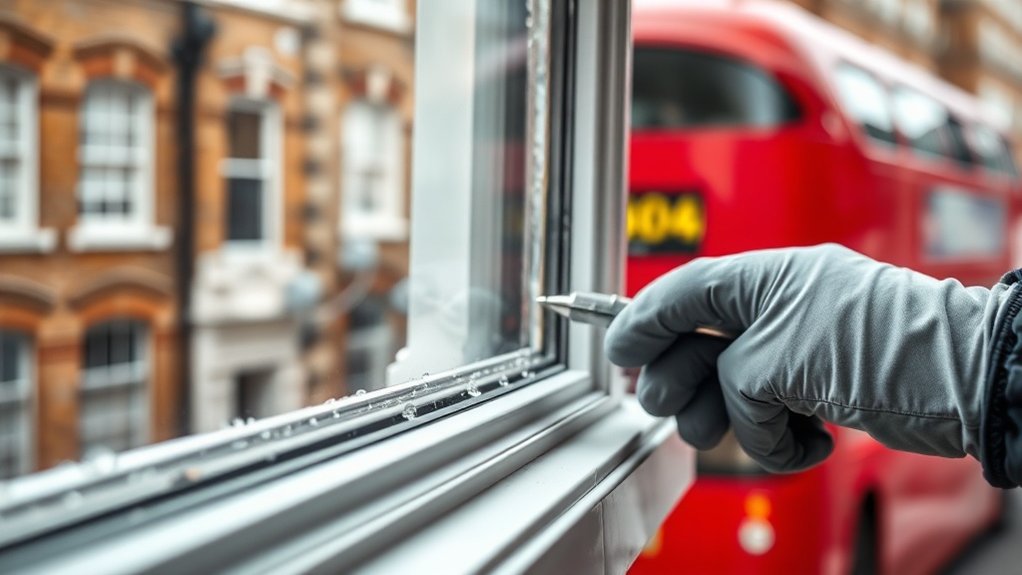
When a double- or triple-glazed unit starts to fail in a London property, you’ll usually spot the symptoms long before the sash or frame shows obvious damage. First, look for persistent condensation or mist trapped between panes; that indicates the argon cavity’s no longer sealed. Next, inspect for milky staining, mineral trails, or iridescent patterns on the inner faces, all signalling long-term moisture ingress.
In homes within conservation areas or historical architecture, compare newer units to original single glazing: failed units often feel noticeably colder at the centre , revealing compromised glass durability and thermal performance. Run your hand around the perimeter; localized cold bands or draughts suggest edge-seal breakdown rather than frame movement, guiding you toward targeted, minimally invasive intervention.
Can Your Window Seals Be Repaired?
Once you’ve spotted signs of seal failure —persistent condensation between panes, draughts, or visible gaps—the next step is to evaluate whether repair will restore performance. You’ll need to take into account the extent of moisture ingress, frame condition, and glass integrity to determine when targeted resealing or re-pressurising is technically viable. When damage is too advanced, or the unit’s thermal efficiency is badly compromised, full replacement becomes the more reliable and cost-effective option.
Signs Of Seal Failure
Although failed window seals don’t always crack or fall apart visibly, they do leave clear diagnostic clues that you can spot before the problem escalates. You’ll often notice persistent internal condensation between panes that doesn’t clear with ventilation. This indicates moisture has bypassed the perimeter seal.
You may also see fogging or milky staining that obscures views and undermines historical architecture or carefully specified decorative finishes. Drafts around the sash perimeter , even when the window’s locked, suggest air leakage along degraded seals.
Look for dark mould traces on rebates, subtle distortion in glazing lines, or rattling glass under wind load. Rising energy bills, localized cold patches around frames, and audible outside noise intrusion are further performance indicators of compromised window seals.
When Repair Is Possible
Before you decide a failed window seal means full replacement, it’s worth evaluating whether targeted repair can restore performance and preserve the existing frames. You can usually repair seals when the glazing units remain structurally sound, the frame isn’t warped, and moisture ingress is localised rather than systemic.
Technicians can micro‑access the cavity, evacuate moisture, install modern desiccant systems , and re-establish the perimeter seal with high‑performance elastomers. This approach works especially well in historical architecture, where you want aesthetic restoration without sacrificing original joinery or heritage glass.
If the sightlines are intact and the sash still closes squarely, you’re a good candidate for repair. You’ll retain thermal efficiency, reduce drafts, and extend service life while avoiding invasive interventions.
When Replacement Is Better
Repair isn’t always the most effective or economical option, and some failed seals demand full unit replacement to restore performance. You should consider replacement when desiccants are exhausted, internal condensation is persistent, or spacer bars are corroded, indicating systemic failure rather than a local leak.
Assess your glazing against historical trends in double‑ and triple‑glazed unit lifespans; if your units are near or beyond their expected service life , replacement often outperforms patch repairs. Evaluate material durability: degraded uPVC, warped timber, or pitted aluminium frames compromise new seals and waste investment.
Replacement lets you upgrade to low‑E coatings, warm‑edge spacers, argon or krypton fill, and improved gaskets, delivering step‑change gains in U‑values, acoustic control, and long‑term resilience.
Window Seal Repair Options in London (Reseal, Reglaze, Replace Units)
When double‑glazed windows start misting or losing insulation, you’ve fundamentally got three technical routes in London: reseal the frame, reglaze the sash, or replace the sealed unit entirely. You first diagnose whether failure sits in the perimeter seal, the glazing interface, or the IGU cavity.
Resealing suits sound glass where only the perimeter gasket or mastic’s degraded. It’s ideal when you want to preserve historical window styles and introduce decorative seal designs using coloured or profiled gaskets. Reglazing means installing new glass into an existing frame, often upgrading to low‑E or acoustic laminates while retaining original joinery. Full unit replacement swaps the insulated glass unit, restoring argon/krypton fill and spacer performance, without necessarily changing frames or overall façade geometry.
What Window Seal Repairs Cost in London
Several cost bands apply to window seal repairs in London, and you’ll choose between them based on access, frame material, and how far the failure has progressed. You’re not just paying for silicone; you’re paying for precision, compatibility with historical architecture, and minimal disruption to your interior decor.
-
Minor reseals – Typically the lowest band. Technicians target perimeter gaps, renew sealant , and test for air and moisture ingress. Ideal for modern uPVC or aluminium frames with early-stage failure.
-
Unit-focused repairs – Mid-range. This covers partial reglazing, spacer-bar renewal, and inert-gas replenishment where feasible, optimising thermal performance without full replacement.
-
Complex or heritage-sensitive works* – Highest band. Expect bespoke gaskets, access equipment, and *conservation-grade methods to protect period façades while maintaining your design-led interiors.
Why Window Seal Repair Matters in London Properties
In London’s dense, mixed-age building stock, sound window seals aren’t cosmetic extras; they’re critical components that control heat loss, noise ingress, and moisture migration through your envelope. When seals fail, you don’t just lose comfort; you undermine energy performance , building fabric, and indoor air quality.
Effective seal repair lets you preserve historical architecture while discreetly upgrading to modern thermal standards. You protect sash boxes, frames, and surrounding plaster from condensation-driven decay, mould, and corrosion. Precision gaskets and advanced sealants can integrate with heritage profiles and decorative accents without altering sightlines.
Common Causes of Window Seal Damage in London Homes
London’s window seals typically fail through a mix of predictable mechanisms: UV-degraded rubber on south-facing elevations, frame movement from seasonal moisture and thermal expansion , and poor detailing where old timber boxes meet newer double-glazed units. In London’s dense streetscape, you’re also managing vibration from traffic, pollution, and mixed-age stock where Historical architecture meets Modern design.
You’ll most often see damage arising from:
- Environmental loading – UV, driving rain, freeze–thaw cycles, and wind pressure stressing perimeter seals and gaskets.
- Substrate movement – differential movement between masonry, timber, and aluminium/UPVC frames, opening micro-gaps in the sealant line.
- Specification errors – incompatible sealant chemistry, inadequate backing rods, or poorly primed substrates, especially where retrofitting modern units into period frames.
Repairing vs Replacing Failed Window Seals
When a sealed unit starts misting, draughts appear, or noise levels rise, you need to decide whether to restore the existing perimeter seal or replace the glazing or gasket assembly outright. You’ll weigh thermal performance, structural integrity, and visual impact.
Seal repair suits relatively young units where the frame is sound and glass coatings remain efficient. Technicians can rout out failed sealant, dry the cavity, inject inert gas, and re-establish a vapour-tight edge, preserving original frames in Historical buildings and limiting disruption.
Targeted replacement of gaskets or double-glazed units works better when rubber profiles have perished or glass specs are outdated. Here, you can integrate low‑iron glass, warm‑edge spacers, or acoustic laminates, achieving discreet Aesthetic enhancements without full window renewal.
When Full Window Replacement Beats Seal Repair
When a failed seal exposes underlying structural damage or compromises the integrity of the frame, you’re no longer looking at a simple repair but a safety-critical replacement decision. You need to assess issues like rotten timber, warped uPVC, or corroded metal alongside measurable heat loss, condensation, and cold-spot readings. At this point, a full window replacement can restore structural safety and markedly improve U-values, airtightness, and overall energy performance in a way seal repair alone can’t achieve.
Structural Damage And Safety
Sometimes the real issue isn’t the failed seal at all, but the window’s structural integrity and your safety. In London’s historical architecture, decayed frames, corroded fixings, and distorted sashes often sit behind pristine decorative finishes, hiding critical risk . When load paths are compromised, seal repair becomes a cosmetic patch on a failing structure.
You should consider full replacement instead of seal repair when:
- Frame degradation – Rot, rust, or cracking around fixings reduces load-bearing capacity and impact resistance.
- Glazing instability – Loose panes, failed setting blocks, or warped beads can’t reliably retain glass under wind or impact loads.
- Movement in the opening – Subsidence, lintel failure, or racking causes misalignment that repetitive seal repairs can’t correct safely.
Energy Efficiency Considerations
Structural safety isn’t the only factor that makes seal repair a false economy ; energy performance often tips the balance toward full replacement as well. When double‑glazed units lose argon gas or develop widespread fogging, a new seal can’t restore original U‑values or solar control. You’re still paying to heat London’s air.
You should benchmark performance: infrared thermography , blower‑door tests, and U‑value calculations reveal whether your glazing system fundamentally underperforms. In many cases—especially in historical architecture—slimline heritage double glazing or secondary glazing outperforms patched units while preserving sightlines.
Frequent window cleaning can expose micro‑fractures, frame distortion, and edge‑seal failures; if these are systemic, replacement delivers better lifecycle value. High‑performance low‑E glass with warm‑edge spacers often repays its premium through reduced energy bills.
Choosing a Reliable London Window Specialist
Although many firms advertise window services in London , only a subset have the technical competence and equipment to diagnose and repair failed seals correctly, so you need to vet potential specialists carefully. Look for contractors who understand London’s historical architecture and can work around decorative details without damaging frames, lintels, or exterior masonry.
-
Technical diagnostics – Ask how they detect seal failure: do they use infrared thermography, moisture meters, or pressure‑testing, rather than only visual checks?
-
System compatibility – Confirm they specify glass units, spacers, and sealants compatible with your frame material and existing glazing system.
-
Standards and documentation – Verify compliance with relevant British Standards, written warranties on seal performance, and detailed method statements outlining access strategy, environmental controls, and cleanup.
DIY Window Seal Fixes vs Hiring a Pro
Once you understand what a competent London window specialist should offer, you can decide whether to attempt minor seal fixes yourself or bring in a professional. You might handle small tasks: re-caulking internal beads, replacing perimeter silicone, or tightening hardware on uPVC or modern aluminium units using high-quality sealants and a moisture meter.
However, historical architecture and complex timber frames with decorative finishes demand pro-level diagnostics. A specialist can run thermal imaging , pressure tests, and frame movement checks, then specify compatible sealants, glazing tapes, and venting strategies that won’t damage heritage substrates.
If you see blown double glazing, extensive condensation, frame distortion, or paint and putty failure on period sashes, you’ll gain better performance, aesthetics, and compliance by commissioning a professional repair.
Preventing Future Window Seal Failures in London’s Climate
Because London’s damp, variable climate constantly stresses window assemblies, preventing future seal failures means treating your glazing as a building envelope system, not just glass and putty. You need strategies that stabilise temperature, manage moisture , and protect sealant chemistry while respecting window aesthetics and historical preservation requirements.
-
Specify climate‑appropriate glazing: choose sealed units with warm‑edge spacers, low-permeability sealants, and drainage-promoting frame designs tested for cyclical wet–dry exposure.
-
Control internal humidity: deploy continuous extract ventilation, smart trickle vents, and sensor-driven dehumidification to keep indoor RH within 40–55%, limiting vapour pressure across seals.
-
Implement proactive maintenance: schedule annual inspections, re-detail failed perimeter sealant with compatible systems, clean weep holes, and apply UV-stable coatings to exposed beads and frames.
Frequently Asked Questions
Are Failed Window Seals Covered by Home Insurance or Warranty in London?
You’ll rarely see failed window seals covered by standard Insurance policies ; they’re usually treated as wear and tear. However, manufacturer or installer Warranty coverage may apply if the failure occurs within the specified term and meets installation and maintenance criteria. You should audit policy exclusions, document condensation or fogging, and request a written assessment. Then you can strategically decide between a warranty claim, specialist repair, or proactive system upgrade.
How Long Does Professional Window Seal Repair Typically Take per Window?
You’ll typically see 30–60 minutes per window, assuming standard access and no structural issues. Duration varies with seal material : silicone, EPDM, or hybrid polymers each demand different cure times and repair techniques. Technicians remove failed seals, precision-clean contact surfaces, apply advanced elastomeric compounds, then pressure-test and inspect. For multi-pane units, add time for desiccant check and perimeter re-bonding to guarantee long-term thermal performance and airtight integrity.
Will Repairing Window Seals Reduce Street Noise in Busy London Areas?
Yes, you’ll notice reduced street noise because well‑repaired seals restore the window’s acoustic performance. As the adage goes, “a chain’s only as strong as its weakest link,” and failed seals are that weak link. By eliminating air gaps, you enhance soundproofing benefits and enable other noise reduction techniques—like laminated glass or acoustic trickle vents—to work best, creating a tighter, more innovative building envelope for busy London environments.
Can I Live in the Property During Extensive Window Seal Repair Work?
Yes, you can usually live in the property during extensive window seal repair work , but you should plan for targeted Noise disruption and short-term loss of thermal comfort per room. Coordinate a phased schedule so contractors work zone-by-zone, allowing you to retain functional spaces. Consider a Temporary living setup in a quieter room, use acoustic dividers, and specify low-VOC sealants to minimize odours, ensuring a high-performance yet minimally invasive upgrade.
Do Listed or Conservation Area Homes Face Restrictions on Window Seal Repairs?
Yes, you face restrictions, but you can still upgrade intelligently. In listed or conservation homes , Historic preservation controls the visual impact, while Building regulations govern performance. You’ll usually need consent for changing frame profiles, glazing thickness, or spacer appearance. Work with a conservation-savvy surveyor to design slimline or vacuum glazing, warm-edge spacers, and reversible seals that enhance efficiency, maintain heritage character, and meet regulatory requirements without triggering enforcement.
Summary
Now you can recognise failed seals, weigh repair options, and even challenge a pushy “full replacement” quote. But the real decision still sits with you: will you act before trapped moisture rots frames, drives up energy bills, and devalues your London home—or wait until replacement is the only option left? Choose carefully, choose data‑driven, and choose soon… because every fogged pane is quietly measuring the cost of doing nothing.