
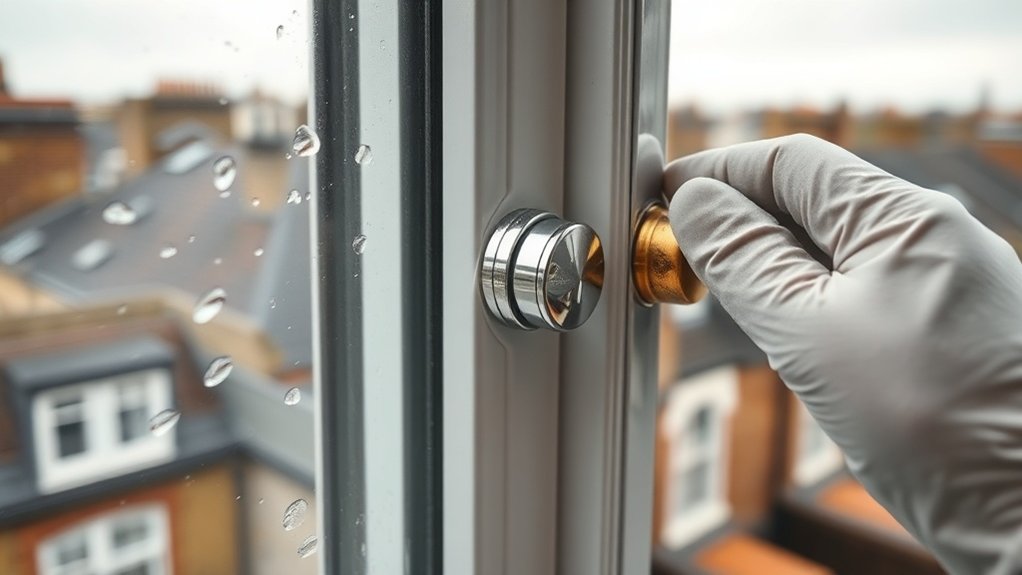
You replace a window handle in London when it’s stiff, loose, won’t lock securely, or lets in draughts that waste energy. First identify your handle type (espag, cockspur, tilt-and-turn, or casement) and measure spindle length and fixing centres precisely. Upgrading to modern, lockable handles improves security, sealing pressure, and child safety. Simple like-for-like swaps are DIY-friendly, but complex multi-point or high-level windows need a specialist. Next, you’ll see exactly how to choose and fit the right option.
Key insights
- Most standard uPVC or aluminium window handles in London can be replaced in 30–60 minutes, costing roughly £10–£80 for parts plus £60–£120 labour.
- Identify your handle type (espag, cockspur, tilt-and-turn, or casement fastener) and measure spindle length and screw centres before ordering a replacement.
- Upgrading to modern, multi-point, key-locking handles improves security, draught sealing, and energy efficiency, especially in older or poorly sealing frames.
- Use a FENSA/CERTASS-registered London fitter for complex cases, high-rise access, warped sashes, child-safety restrictors, or integrated alarm/smart-handle systems.
- Take clear photos of the existing handle and fixings, label measurements, and request a written, specification-led quote including materials, corrosion resistance, and warranty.
When Should You Replace a Window Handle? Key Signs
Although window handles are often overlooked, you should substitute them as soon as you notice functional or safety-critical issues such as stiffness, excessive looseness, or incomplete locking. These symptoms indicate worn internal gearing or spindle damage that can compromise security and ventilation control in your London property.
You should also act when the handle no longer aligns cleanly with the locking points, scrapes the frame, or requires two hands to operate. Corrosion , pitting, or hairline cracks signal declining handle material durability and a higher risk of sudden failure. Finally, if child-safety features stop engaging reliably or the finish has degraded enough to undermine window handle aesthetics in a high-spec space, a proactive replacement ensures performance, safety, and visual consistency.
Common Types of Window Handles in London Homes
When you’re planning a window handle replacement in London, you need to understand the main handle styles used on uPVC, timber, and aluminium frames so you can match function and security requirements. You’ll also want to assess materials and finishes—such as aluminium, stainless steel, brass, and coated zinc—for durability, corrosion resistance, and compatibility with existing hardware. By selecting the right combination of style, material, and finish, you reduce wear, improve safety, and maintain a consistent appearance across your property.
Popular Handle Styles
As you plan a window handle replacement in your London home, it helps to understand the main handle styles you’re likely to encounter: espagnolette (espag) handles on modern uPVC and aluminium windows, cockspur handles on older uPVC and some timber frames, tilt-and-turn handles on dual‑action European-style windows, and traditional casement fasteners on timber windows.
Espag handles give you multi-point locking and integration with modern security hardware. Cockspur handles, rooted in historical design, suit legacy frames but may limit advanced locking options. Tilt-and-turn handles provide controlled ventilation and secure night‑vent positions, ideal for higher floors. Traditional casement fasteners can incorporate child‑safe restrictors while still delivering artistic finishes that complement period façades.
Materials And Finishes
Beyond the handle style itself, the material and finish you choose in London has a direct impact on durability, security, and long‑term maintenance. uPVC and powder‑coated aluminium handles resist corrosion and suit high‑moisture or roadside environments with airborne pollutants, while stainless steel offers superior strength and pitting resistance for coastal or exposed sites.
If you’re prioritising material durability under heavy use, specify stainless steel with through‑section spindles and reinforced screw points. For heritage frames , consider solid brass with advanced clear lacquer to stabilise finish aesthetics and minimise tarnish. In contemporary schemes, anodised or powder‑coated aluminium lets you align colour with existing hardware while maintaining structural integrity. Always verify that the substrate, coating system, and cleaning regime are compatible to prevent galvanic corrosion and premature wear.
How to Identify and Measure Your Window Handle
Before you order a replacement, you’ll need to correctly identify your existing handle type and check that its operation matches your window system. Using a tape measure or calipers, you’ll take precise measurements of the handle length, the fixing centres, and the spindle projection to guarantee a safe, compatible fit. It’s also essential that you record the spindle thickness and fixing screw sizes accurately, so the new handle secures firmly without stressing the frame or mechanism.
Spotting Common Handle Types
How do you know which replacement handle will actually fit your window? Start by identifying the mechanism. On uPVC windows, you’ll usually see espagnolette handles with a straight lever and a square spindle. Older timber frames often use cockspur handles with a hooked nose that clamps onto a wedge; these link closely to historical handle designs and heritage refurbishments in London.
Tilt-and-turn windows use multi-position handles with clear “tilt” and “turn” detents, while sash windows rely on fasteners and lifts rather than rotating handles. Note whether the handle is locking or non‑locking , inline or cranked, as this affects security and ergonomics. As you inspect, record each feature; it’ll guide safe upgrades, smart compatibility choices, and future‑proof DIY maintenance tips.
Taking Accurate Handle Measurements
Once you’ve identified the handle type, you need accurate measurements to avoid buying hardware that won’t seat, lock, or operate correctly. Start by cleaning the area so dirt doesn’t distort readings and you can inspect the handle design clearly. Use a steel rule or digital caliper; avoid tape measures for short critical dimensions.
Measure the overall handle length and projection from the sash to ensure comfortable grip clearance, especially where blinds or secondary glazing sit close. Note the backplate outline and screw positions relative to the window edge; this helps preserve structural integrity and security performance.
Document everything in a simple sketch . This habit supports long‑term handle maintenance, lets you compare upgraded designs easily, and guarantee the correct fit and function.
Recording Fixing and Spindle Sizes
Although overall handle dimensions matter, replacements live or fail on the fixing centers and spindle size you record now. Measure the distance between screw centers with a steel rule or digital caliper, reading to the nearest millimetre. Note whether screws are vertical or horizontal; this affects compatibility and window handle aesthetics.
Next, remove the handle with the sash supported, avoiding glass stress. Extract the spindle fully. Measure its length from the underside of the handle base to the spindle tip, then its square thickness, typically 7 mm in uPVC systems. Record both, plus any step or cranked offset.
Store measurements, photos, and part labels together. As handle maintenance tips, log this data for every window; it streamlines future upgrades and safety-critical replacements.
Security Benefits of Window Handle Replacement in London
Because window handles are a primary point of entry manipulation, upgrading them in London properties directly enhances your security posture by reducing opportunities for forced or covert access. By replacing dated, loose, or generic handles, you implement targeted security upgrades that resist leverage attacks, snapping, and unauthorised disengagement with basic tools.
Modern locking handles integrate multi-point engagement and tamper-resistant fixings, while still allowing controlled openings for safe ventilation improvements without compromising perimeter integrity.
- Multi-lock handles that interface with shootbolts and espagnolettes for higher resistance
- Keyed-locking designs with anti-drill cylinders and concealed fixings
- Child-safety restrictor handles that prevent full opening without a key or release
- Handles compatible with smart sensors to monitor status (open/closed/locked) in real time
How New Window Handles Reduce Draughts and Boost Efficiency
When you upgrade to well-specified modern window handles, you don’t just improve operation ; you also tighten the sealing pressure between sash and frame, cutting draughts and thermal leakage. Precision-engineered locking cams pull the sash firmly into compressed gaskets, delivering reliable draught prevention and stabilising internal temperatures.
By eliminating micro-gaps, you reduce convective heat loss, which directly improves energy efficiency and lowers heating demand in London’s variable climate. Advanced handle gearing maintains uniform pressure along the perimeter, so seals perform consistently rather than relying on ad‑hoc adjustments.
You also minimise cold spots and condensation risk around frames, protecting finishes and hardware. Specifying quality handles with robust materials and accurate tolerances ensures long-term performance, making them a low-disruption upgrade with measurable thermal benefits.
DIY Window Handle Replacement: Step-By-Step Guide
If you’re comfortable with basic hand tools and follow a clear process, you can replace most window handles yourself safely and accurately. Start by identifying your existing handle: note fixing-screw positions, spindle length, lock type, and how it relates to the window’s historical design. Photograph everything before you touch a screw.
- Isolate risk: wear cut‑resistant gloves, use stable access, and support the sash.
- Remove the old handle: expose caps, undo screws, withdraw spindle straight.
- Fit the new handle : align spindle, check operation before fully tightening.
- Final checks: confirm smooth locking, no frame fouling, and airtight closure.
Select hardware with durable finishes and low‑toxicity coatings to minimise environmental impact and extend service life.
DIY vs Pro: When to Call a London Specialist
Although many London homeowners can handle a straightforward window handle swap, certain situations demand a specialist to guarantee safety, compliance, and long‑term performance. You should call a pro when handles integrate with multi‑point locks , child‑safety restrictors, or alarm contacts, because incorrect fitting can compromise security and invalidate insurance.
If the sash is warped, draughty, or the gearing feels rough, a specialist can diagnose whether the problem is the handle, the espagnolette, or frame alignment. They’ll also advise on window handle aesthetics that complement slimline profiles or heritage frames while maintaining PAS 24 or Secured by Design standards.
For high‑rise properties, fire‑escape windows, or advanced finishes prioritising handle material durability in marine or polluted urban environments, professional input isn’t optional—it’s essential.
Window Handle Replacement Costs and Timescales in London
Once you know whether a DIY swap will suffice or you need a London specialist , the next step is to understand what the work will cost and how long it will actually take. Budget handles start around £10–£20 each, while precision-engineered options, compatible with Historical styles or Eco friendly materials, can reach £45–£80.
Labour in London typically ranges from £60–£120 per hour, with most straightforward replacements completed within 30–60 minutes per window, assuming safe access and no sash damage. Complex mechanisms or corroded fixings can extend work to 90 minutes or more.
- Typical per‑window cost ranges
- Factors that accelerate or delay installation
- Impact of material choice on longevity and safety
- How multiple windows affect total timescales and pricing
How to Choose a Window Handle Fitter in London
Choosing a window handle fitter in London starts with verifying competence and safety credentials, not price. You should confirm FENSA, CERTASS, or equivalent accreditation, plus evidence of public liability insurance and DBS checks for residential work. Ask how they assess existing mechanisms, ventilation requirements, and security standards (PAS 24, Secured by Design).
Drill into their understanding of modern window handle design: child-safety locks, key-lockable options, smart or sensor-integrated handles, and compatibility with your frame materials and glazing specifications.
Request a specification-led quote detailing fixings, corrosion resistance, and warranties. Evaluate their handle maintenance strategy: lubrication schedules, torque checks on fixings, and emergency response times for failures. Finally, review case studies , not just reviews, to see how they’ve solved complex access and retrofitting challenges.
Frequently Asked Questions
Can I Replace Window Handles in a Listed or Conservation Area Property in London?
You can replace window handles, but you must align with Window handle replacement regulations and Historic property preservation rules. First, check if your building’s listed status or conservation area controls treat handles as “fixtures” affecting character. You’ll likely need listed building consent and possibly conservation officer approval . Specify like-for-like aesthetics with improved security or smart hardware. Always verify fire egress, ventilation, and child-safety compliance before commissioning the work.
Are There Eco-Friendly or Recycled-Material Window Handle Options Available in London?
Yes, you’ll find eco-friendly options as plentiful as leaves on a tree. You can specify window handles made from Eco friendly materials such as certified FSC timber, low‑VOC bio‑resins, or recycled aluminium alloys. Some UK ironmongers now offer Recycled handles using post‑consumer metal and plastics, with full lifecycle data. You should verify mechanical performance (EN standards), finish durability, and compatibility with existing gearing to guarantee safe, long‑term operation.
How Do I Match New Window Handles to My Period or Heritage-Style Interiors?
You match new window handles by prioritising historical accuracy and material matching. First, identify your window’s original era and mechanism (sash, casement, tilt‑turn). Then select brass, bronze, or iron finishes that replicate period profiles while complying with today’s safety and locking standards. Use manufacturers offering heritage lines with concealed modern gearing, corrosion‑resistant coatings, and test data, so you integrate innovation without visually compromising your period or heritage‑style interiors.
Will Changing My Window Handles Affect My Home Insurance or Warranty in London?
Yes, it can. Picture your hand closing around a sleek new lever: if window handle compatibility isn’t like‑for‑like, insurers may treat it as a material alteration and question claims or security standards. Your warranty can also lapse if you ignore manufacturer specs. Use technical datasheets , confirm lock ratings, and document any changes. Prefer accredited fitters, or follow strict DIY installation tips, including torque limits and approved fixings.
Can Landlords in London Charge Tenants for Window Handle Replacement Due to Damage?
Yes, your landlord can usually charge you if you’ve caused damage beyond fair wear and tear. You should first request a detailed cost estimation, including parts, labour, and any security concerns that justify upgraded handles or locking systems. Check your tenancy agreement and deposit scheme rules. You can challenge unreasonable charges, ask for invoices or multiple quotes, and propose innovative, higher‑security replacements that still meet British Standards.
Summary
When you spot loose, stiff, or damaged handles , don’t delay replacement—it’s a small job with big security and efficiency gains. A South London flat, for example, cut draught complaints and improved child safety simply by upgrading to lockable espag handles with proper alignment. Assess your handle type, measure accurately, and follow safe DIY steps—or call a vetted London specialist. The right handle, correctly fitted, keeps your windows secure, smooth, and energy‑efficient.